
Flow Agents and Excipients in Botanical Capsules: Clean-Label Options and Trade-Offs
Buyer’s snapshot
- A botanical powder that fills unevenly gives capsules with uneven doses. The Hausner ratio (tapped density divided by bulk density) is the standard quick screen: values above roughly 1.25 to 1.4 are generally read as poor flow (AAPS PharmSciTech, 2008, summarising the USP powder-flow chapter).
- Flow can be fixed three ways: change the powder (particle size, blend), change the machine (dosator or tamping filler), or add a flow agent. Only the third adds a line to the label.
- In the US, excipients and fillers are “ingredients” and appear under “Other Ingredients” in descending order of weight (FDA Dietary Supplement Labeling Guide, Chapter V).
- Silk Route Ventures (SRV) does not publish a standard excipient list. The excipients, if any, are declared per SKU in the specification and the quote, which is the document to ask for.
- This piece is for wellness brand buyers writing a “no fillers” or “clean label” brief. It is not for briefs that want a clean label and a free-flowing sticky powder at the same time with no trial.
A brand sends a brief for a moringa or gotukola capsule: “no fillers, no flow agents, clean label.” The supplier replies with a question: what does the powder do in the hopper? That exchange decides the product. The label promise is a design constraint on the powder, and the flow problem has to be solved somewhere other than the ingredient list.
Why do some botanical powders need flow help at all?
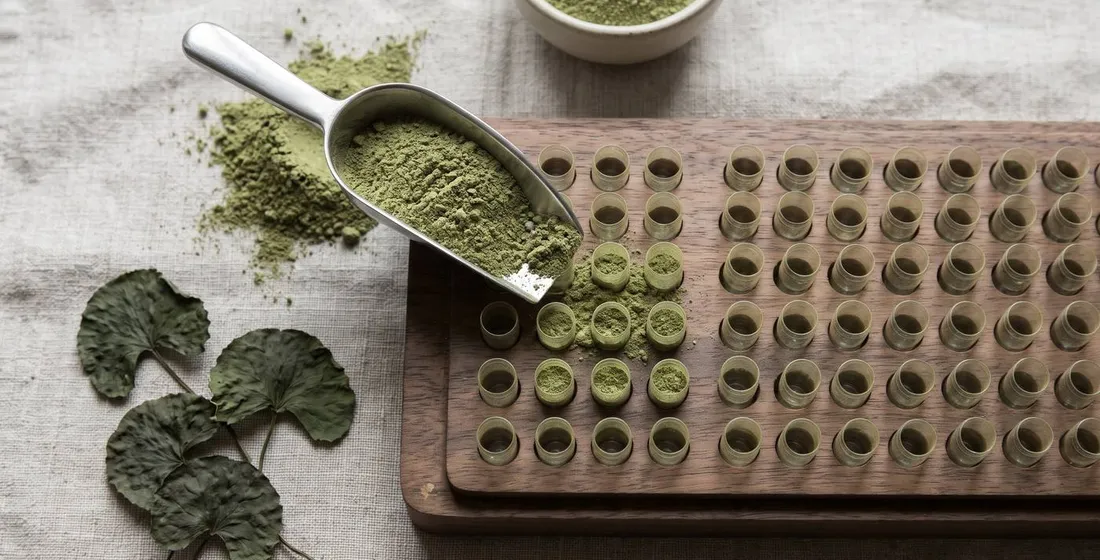
Milled plant material is irregular. Fibrous leaf and root powders interlock, oily or sugary fruit powders cling, and fine particles hold static charge and moisture. In a capsule filler, the powder either drops into the dosing bore at a steady weight or it bridges, rat-holes and fills light and heavy in turn.
The measurable symptoms are plain. Fill weight drifts from capsule to capsule. The line stops to clear bridging. Weight checks fail even though the average is correct, which means some capsules carry a different dose from the bottle’s label. The capsule size and fill weight guide covers how the fill weight is set, and the multi-botanical capsule blends guide covers why blends add a second flow problem on top of single-herb behaviour.
A screen is available before any trial run. The USP general chapter on powder flow describes bulk and tapped density, Hausner ratio and Carr’s index, angle of repose and flow through an orifice. The Hausner ratio is the quickest, but it is not a fixed property of the powder: results depend on tapping conditions, so compare values only from the same method.
| Hausner ratio (approximate) | Reading | Typical response |
|---|---|---|
| Below about 1.25 | Acceptable flow | Fill as is, check weight variation |
| About 1.25 to 1.4 | Borderline | Adjust particle size or blend first, test on the line |
| Above about 1.4 | Poor flow | Machine change or a flow agent, then re-test |
The bands are a guide only. The AAPS PharmSciTech article cited below gives the 1.25 to 1.4 range as the point where flow is generally judged poor, and a line trial overrules the number.
What are the options before adding anything?
Fix the powder first. Four levers cost nothing on the label.
- Particle-size band. A narrower sieve cut often helps more than any additive. Very fine fractions cling, very coarse ones segregate. The mesh is named on the specification and checked on the COA.
- Moisture. Powder that has taken up water flows worse. Loss on drying and water activity limits belong in the spec, and the capsule stability guide explains why the same numbers also protect shelf life.
- Pre-blending and granulation steps. A short, defined pre-blend evens out a multi-herb mix before filling.
- Filling machine. A dosator or tamping-pin filler handles cohesive powder differently from a gravity-fed filler. Ask which filler the line uses and run the trial on it.
When those four are exhausted and the Hausner ratio is still in the poor band, an excipient enters the conversation.
What do the common flow agents and excipients do?
Each class solves a different problem, and each shows up on the label differently.
| Class | What it does | Label and market note | Trade-off |
|---|---|---|---|
| Silicon dioxide (silica) | Coats particles, reduces cohesion and moisture pickup | Declared as an ingredient. In the EU it falls under the silicon dioxide additive group (E 551 to 553), authorised at quantum satis in the general lists of Regulation (EC) 1333/2008 Annex II | Very small amounts are typical, but it is the first line a “no additives” brief rejects |
| Magnesium stearate or stearic acid | Lubricant, reduces sticking to filling parts | Declared as an ingredient. Magnesium salts of fatty acids are E 470b in the EU additive lists | Widely used, widely questioned by clean-label buyers, and can slow dissolution if overused |
| Plant-derived fillers (rice-based powders, cellulose) | Add bulk and ease flow | Declared, often with a friendlier name | Add weight to the fill and take dose space from the botanical |
| No additive, engineered powder | Flow comes from sieve cut, moisture and machine | Nothing extra to declare | Needs a trial, may cap the fill speed or the blend complexity |
Two cautions apply. First, “natural” substitutes marketed as magnesium stearate replacements are mostly supplier-sourced claims. A search for independent, peer-reviewed comparisons of rice-based lubricants against magnesium stearate in botanical capsule fills returns mostly vendor material, so treat any performance figure as unverified until your own blend passes a line trial. Second, the EU permissions above sit in the general additive lists. Whether and at what level an additive is permitted in a food supplement in a given destination is a per-market check, and the claims by market guide covers the wider label picture.
Spec snapshot: the excipient section of a capsule specification Fill: botanical powder, plant part, Latin name, mesh Flow aid: none, or named, with the function and the level in mg per capsule Shell: gelatin or HPMC, size Label declaration: every added ingredient listed under “Other Ingredients” in descending order by weight Documents: COA on request, with microbiology and heavy metals through an external laboratory on request
What does “clean label” actually allow?
There is no single legal definition of clean label, so the brief has to define it line by line. Three versions turn up in practice.
“No synthetic excipients.” Rules out silicon dioxide and magnesium stearate as commonly supplied, leaves plant-derived options. The triphala formulation guide shows how that wording pushes the flow work into mesh and particle engineering.
“No fillers.” Often means no added bulk, but it can still allow a flow agent at a fraction of a percent. The wording needs a number: does a flow agent at a stated mg per capsule count as a filler? Ask the question in the brief, not after the first sample.
“Single-ingredient capsule.” The strictest version: botanical powder in a shell. Only possible when the powder flows on its own. The shell itself, gelatin or HPMC, is still an ingredient and appears on the label.
On a US label, FDA’s guidance treats binders, colours, excipients, fillers, flavours and sweeteners as ingredients, lists them in descending order of predominance by weight, and introduces the list with “Other Ingredients” when source ingredients already appear in the Supplement Facts panel. A brand cannot make a flow agent invisible, only choose whether it is there. The guidance is a 2005 nonbinding document, and the brand’s own regulatory adviser has the final say on the wording.
From the Trade Team The most common mistake in a first capsule brief is writing the label promise before the powder has been tested. The usual sequence runs backwards: the artwork says “no flow agents”, the sample then bridges in the hopper, and the brand either accepts a lighter promise or pays for a rework. A short flow screen on the actual powder lot, done before the label is approved, is the cheapest line in the project.
The consequence is simple arithmetic. A flow agent that takes 1 percent of a 500 mg fill is 5 mg. A different route, such as a narrower mesh, costs nothing on the label but may add a sieving step and a lot-to-lot yield loss that shows up in price. Pick the trade-off in the open and put it in the quote.
How should the RFQ state the excipient policy?
Write it as a short block a supplier can answer with a yes, a number or a named ingredient.
- Botanical, plant part, Latin name and mesh range.
- Flow target: the Hausner ratio or weight-variation limit the line must meet, and the method.
- Excipient policy in one sentence: none, or the allowed list, with a maximum in mg per capsule.
- Definition of the clean-label wording used on the pack, so “no fillers” is not left open.
- Shell: gelatin or HPMC, with the size.
- Ingredient and processing-aid declaration requested from the supplier, covering every added input, including carriers and flow agents.
- Trial: a filling trial on the commercial powder lot before the label is signed off.
- Documents: a COA on request, with microbiology and heavy metals through an external laboratory on request.
The RFQ checklist for standardized botanical extracts uses the same logic for extract SKUs, where a carrier is added by design and has to be declared separately.
Botanical supply for these capsules comes from the Sri Lankan growing belt around Matale. The Sri Lankan herbs range lists what is available, and a capsule such as the gotukola capsules SKU is a typical starting point for a fibrous leaf powder trial.
Where Silk Route Ventures doesn’t fit A brief that demands single-ingredient capsules, a fixed launch date and the lowest fill cost, with no powder trial allowed. A fibrous leaf powder may flow without help or may not, and a supplier who promises it before testing the lot is guessing.
Frequently asked questions
Do botanical capsules always need a flow agent?
No. Many milled root and leaf powders fill acceptably when the sieve cut, moisture and filling machine are right. Cohesive or sugary powders and multi-herb blends are the usual exceptions. A Hausner ratio near or above the 1.25 to 1.4 range, plus a line trial, tells you which case you have.
Can a capsule be labelled clean label and still use a flow agent?
It depends on how the brand defines the wording, because there is no single legal definition. Any added flow agent still appears under “Other Ingredients” in descending order by weight on a US label. The brief should say whether a named agent at a stated level is allowed.
Are rice-based flow aids a proven replacement for magnesium stearate?
Not on the evidence available here. Performance claims mostly come from suppliers, and independent comparisons in botanical fills are thin. Treat them as an option to trial on your own powder, comparing weight variation and disintegration against a baseline, rather than as a drop-in swap.
Does Silk Route Ventures offer private label capsules with a custom excipient policy?
Yes, as part of private-label capsule development. The excipient policy, shell and fill trial are agreed per brief and stated in the specification. Private-label orders run 4 to 6 weeks from PO to dispatch, and the capsule MOQ is confirmed on your quote.
How Silk Route Ventures can help
Silk Route Ventures (SRV) manufactures nutraceutical capsules and supplies bulk Ayurvedic and functional botanicals to wellness brands globally. The Silk Foods Ceylon (SFC) facility in Matale is audited to BRCGS and FSSC 22000 V6, with USDA Organic and EU Organic on selected SKUs, confirmed per SKU. The capsule MOQ is confirmed on your quote, bulk herbs start from 25 kg per SKU, and samples are free for evaluation (you cover the courier). For a new capsule, the useful first step is to send the botanical, the dose, the label wording you want and your excipient policy, so the trade desk can propose a powder spec and a filling trial around them. Contact us to send an inquiry or request a sample.
Sources
- U.S. Food and Drug Administration, Dietary Supplement Labeling Guide: Chapter V, Ingredient Labeling (April 2005; ingredients include excipients and fillers; descending order by weight; “Other Ingredients” heading). https://www.fda.gov/food/dietary-supplements-guidance-documents-regulatory-information/dietary-supplement-labeling-guide-chapter-v-ingredient-labeling (retrieved 25 November 2026)
- European Union, Regulation (EC) No 1333/2008 on food additives, consolidated version of 22 March 2023 (Part B and Part C entries for E 470b, E 551 to 553 and E 460). https://eur-lex.europa.eu/eli/reg/2008/1333/2023-03-22/eng (retrieved 25 November 2026)
- AAPS PharmSciTech (2008), powder flow measurement review covering the compressibility index and Hausner ratio, as used in USP general chapter 1174. https://link.springer.com/article/10.1208/s12249-008-9046-8 (retrieved 25 November 2026)
- Tablets & Capsules magazine, Excipients: Using Natural Alternative Excipients for Tableting and Capsule Filling (further reading). https://www.tabletscapsules.com/3641-Technical-Articles/588177-Excipients-Using-Natural-Alternative-Excipients-for-Tableting-and-Capsule-Filling/ (retrieved 25 November 2026)
Written by the Silk Route Ventures Trade Team. Silk Route Ventures (E-Silk Route Ventures (Pvt) Ltd) is a Sri Lankan B2B supply-chain operator for the Food, Beverage, Wellness, and Nutraceuticals sectors. The Silk Foods Ceylon manufacturing arm holds BRCGS and FSSC 22000 V6 certifications. Questions or to request a sample: Contact us or email info@esilkroute.com.lk.