
Dried Curry Leaves and Curry Leaf Powder: A Sourcing Spec for Sauce and Snack Makers
Buyer’s snapshot
- Curry leaves from India have been under increased EU border controls since February 2023: Implementing Regulation (EU) 2023/174 placed them in Annex II of Regulation (EU) 2019/1793, with an official certificate and sampling results required for pesticide residues and a 50% identity and physical check rate.
- The entry that regulation creates names India only. Annexes are reviewed twice a year, so confirm the live consolidated text before each shipment instead of assuming any origin is listed or clear.
- Colour and aroma are set by the dryer, not the mill. Published trials favour tray drying near 55 °C, fluidised-bed drying at 45 °C, or microwave-vacuum drying over open sun, and the leaf’s volatile oil is the first thing lost.
- Silk Route Ventures supplies dried curry leaves and curry leaf powder at 50 kg per SKU on a first order, with a ten-line spec at the close that sauce and snack makers can attach to an inquiry.
- Written for formulators of sauces, snacks and seasonings. If the brief is a fresh-leaf chilled supply chain, this is the wrong post.
Curry leaf inquiries reach the Silk Route Ventures (SRV) trade desk framed as a price question: a quote per kilogram for “dried curry leaves, A grade.” The purchase order rarely says which drying method produced the leaf, what the pesticide panel covered, or whether the buyer wants whole leaf or powder. Those decisions, plus one live regulatory question about EU border checks, determine whether the first container clears and whether the product tastes like curry leaf at all.
What does a dried curry leaf spec need to cover?
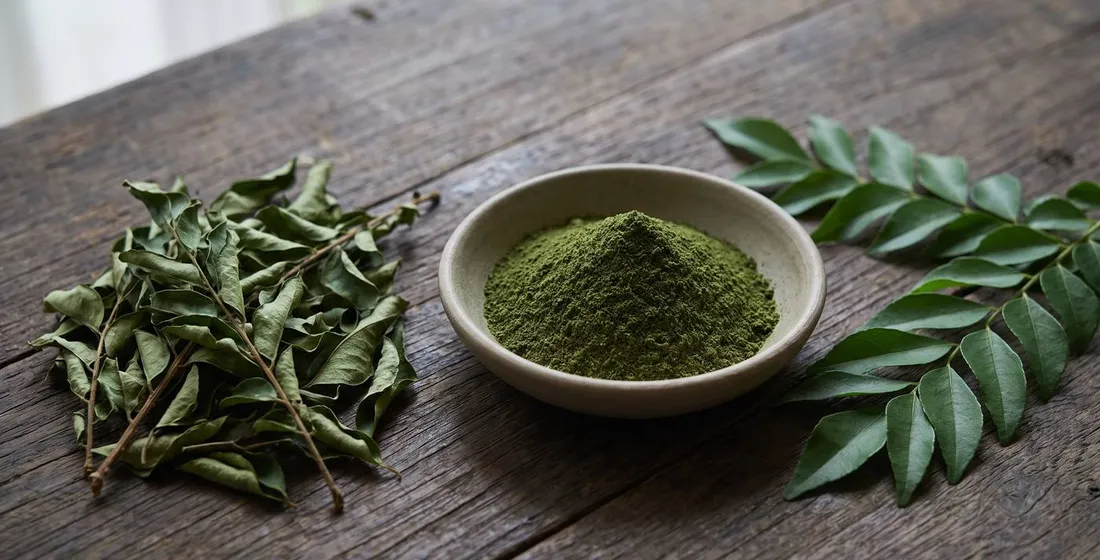
Curry leaf (Murraya koenigii, also catalogued as Bergera koenigii) is sold as whole dried leaf, crushed leaf and milled powder. The commercial differences are drying method, particle size and how much of the volatile fraction survives to the pack.
A spec that says only “dried curry leaf, green, 8% moisture” leaves the largest quality variables open: drying route (colour and aroma), leaf-to-stem ratio (yield and fibre) and particle size (dispersion in a sauce or seasoning slurry).
Whole leaf is a tempering ingredient that releases its aroma in hot oil. Powder is a dispersed ingredient that carries colour and a green-herbal note through a sauce, snack seasoning or blend.
| Form | Typical use | What the spec must fix | Main risk |
|---|---|---|---|
| Whole dried leaf | Tempering, ready-meal garnish, tea cut for infusions | Leaf size, stem content, colour, foreign matter | Brown or brittle leaf, stems in the pack |
| Milled powder | Sauces, snack seasonings, pastes, dry blends | Mesh or particle size distribution, colour, moisture | Heat from milling, caking, faded green |
Source: format use cases from SRV trade desk specification practice; product forms per the Silk Route Ventures curry leaves powder range.
How does the drying method change colour and aroma?
Most price differences between two “A grade” quotes originate here. Open sun drying is cheapest and slowest; controlled drying costs more per tonne and holds more of the character the buyer is paying for.
Kenghe and colleagues compared sun, shade and tray drying of curry leaves at 45, 55 and 65 °C in a 2015 study. Tray drying cut drying time by 27% against sun and shade, and the 55 °C tray-dried leaves held their green colour better and kept a more porous structure. A fluidised-bed trial from ICAR dried leaves from roughly 184% to about 5% moisture on a dry basis, and concluded that 45 °C at 4 m/s air velocity best held rehydration ratio and volatile oil content.
Choo and colleagues compared hot-air, microwave-vacuum, a two-stage hybrid, and freeze drying in Processes in 2020. Microwave-vacuum drying preserved colour parameters across the conditions tested, and the hybrid method cut specific energy use by 67.3% against hot-air drying at 50 °C. The same paper names the leading volatiles in the dried leaf as beta-phellandrene (31%), alpha-pinene (19.9%) and sabinene (16%). Terpenes like these are volatile, so a long, hot, open drying cycle strips aroma before the leaf reaches the mill.
| Drying route | Published finding | What it means on a purchase order |
|---|---|---|
| Tray, about 55 °C | 27% faster than sun or shade; better green colour | A sound default for whole and crushed leaf |
| Fluidised bed, 45 °C | Best rehydration and volatile oil in the ICAR trial | Premium route; relevant where aroma is the claim |
| Microwave-vacuum | Best colour retention across conditions tested | Strong for powders where colour carries the product |
| Hybrid two-stage | 67.3% lower specific energy than 50 °C hot air | Cost lever; confirm aroma retention on your own sensory panel |
Source: Kenghe et al., 2015; ICAR fluidised-bed drying trial; Choo et al., Processes, 2020. Findings are from single studies on specific cultivars and equipment, so treat them as a reason to ask the question, not as a guarantee of any one supplier’s output.
A supplier should state the drying route, temperature ceiling and final moisture on the specification sheet. If the answer to “how was this dried?” is “naturally,” colour will move from lot to lot.
Do curry leaves face extra EU border checks?
For leaf from India, yes. Commission Implementing Regulation (EU) 2023/174, published in the Official Journal on 27 January 2023, placed curry leaves from India in Annex II of Regulation (EU) 2019/1793. The listed hazard is pesticide residues, the identity and physical check frequency is 50%, and each consignment must travel with sampling results and an official certificate. A transitional clause let consignments dispatched before the amendment enter the Union until 16 October 2023 without them.
The SRV procurement desk reads this entry narrowly, and buyers should too. It names India. It does not declare any other origin safe or exempt. Annexes are reviewed every six months, with entries added, moved and removed, so a buyer qualifying a Sri Lankan supplier in late 2026 should read the current consolidated text and record the date they did so.
Regardless of listing, under Regulation (EC) No 396/2005 a default maximum residue level of 0.01 mg/kg applies where no specific limit is set for a crop and an active substance. Curry leaf is a minor crop, so the default is often the operative number. Buyers who have worked through the same logic on seed spices will recognise it from the coriander, cumin and fennel MRL discipline and the curry powder MRL ceiling.
Buyer’s checklist: curry leaf residue and compliance file
- Pesticide panel matched to the destination market, naming the MRL basis, including multi-residue GC-MS and LC-MS coverage
- A statement that the supplier checked the live Annex I and Annex II of Regulation 2019/1793 for curry leaf, with the check date
- Growing district and harvest window named on the certificate of analysis
- Sampling per lot, not per first shipment
- Treatment method for microbial control named in writing (saturated steam preferred, ethylene oxide excluded)
- Heavy metals panel with action levels
- Foreign matter and stem content limits
- Retained sample held by the supplier for each lot shipped
What moisture, microbial and sensory limits should the spec carry?
Moisture is the one number everybody writes and few define. For a powder that sits in a pouch for twelve months, a single-digit ceiling is the working norm (the ICAR trial dried leaf to about 5% on a dry basis). State the basis, method and ceiling, and ask for the figure on every lot certificate.
Microbial load is the second line. The US Food and Drug Administration’s draft risk profile on pathogens and filth in spices found Salmonella in 6.6% of imported spice shipments sampled between fiscal years 2007 and 2009, and filth adulteration in 12%. A dried leaf sold into a sauce or snack that gets no kill step downstream needs a microbial spec that assumes none is coming: Salmonella absent in 25 g, with total plate count and yeast and mould ceilings agreed before the first order.
Sensory is the line formulators skip and then regret. Curry leaf aroma is a top note that drops out first during hot-fill, spray drying and baking. Run the panel on the finished sauce or snack, not the raw leaf, and set the dose from that result.
Nobody has ever approved a curry leaf powder on the strength of its certificate of analysis alone. They approved it because the sample smelled like the leaf.
Where does curry leaf powder actually go?
In sauces and pastes, dose powder late where the process allows. In snack seasonings, particle size decides whether the green fleck shows and the carrier decides how evenly it coats. In dry blends, curry leaf is a minor inclusion that changes character more than its weight suggests, which is why the private label spice blend range guide treats it as a locked line rather than a swappable one.
A pattern the SRV procurement desk has seen: a sauce maker requests curry leaf powder for a tempering-style note and receives a pale, dusty material that was dried in open sun and milled hot. The sauce tests acceptable on day one and flat at month four. The fix is not a higher dose. It is a different drying route and a lower milling temperature, and both belong on the specification.
Where SRV’s spec discipline does not fit
Buyers who want the lowest-price dried leaf with no drying method, residue panel or lot sample attached. That product exists, but it is not the one the specification below describes, and it leaves the border risk with the buyer.
Spec snapshot: dried curry leaves and curry leaf powder
Botanical: Murraya koenigii (syn. Bergera koenigii), leaf Forms: whole dried leaf, crushed leaf, milled powder Drying: route and temperature ceiling stated on the specification Moisture: ceiling and basis stated, confirmed on every lot Microbial: Salmonella absent in 25 g; steam treatment, ethylene oxide excluded Residues: destination-market panel, MRL basis referenced SRV bulk MOQ: 50 kg per SKU on first order; 2 to 3 weeks PO to dispatch
The curry leaf RFQ: ten lines to send with the inquiry
These ten lines turn a price request into a product description. A broader template sits in the spice RFQ guide.
- Botanical name and plant part: Murraya koenigii leaf
- Form: whole, crushed (cut size range) or milled powder (particle size distribution)
- Application and process: tempering, sauce base, snack seasoning, dry blend
- Drying route, temperature ceiling and final moisture with basis
- Colour requirement and how it will be judged (reference sample, not a word)
- Growing district and harvest window
- Microbial panel with methods; Salmonella absent in 25 g
- Pesticide panel for the destination market, MRL basis named
- Documentation set: certificate of analysis per lot, certificate of origin, phytosanitary certificate, and the supplier’s dated check of the live EU control annexes
- Order terms: first-order quantity, lot size, retained sample, and Incoterm
A supplier who answers all ten without a follow-up call is quoting the product the buyer is buying.
Frequently asked questions
Are curry leaves subject to increased EU import controls?
Curry leaves from India are, under Implementing Regulation (EU) 2023/174, which placed them in Annex II of Regulation (EU) 2019/1793 with a 50% identity and physical check rate for pesticide residues. The entry names India only. Annexes are reviewed every six months, so check the live consolidated text for any origin before shipping.
Which drying method keeps the most colour and aroma in curry leaf?
Published trials point to controlled drying. Kenghe and colleagues found 55 °C tray drying held green colour better than sun or shade drying in 2015, an ICAR fluidised-bed trial favoured 45 °C for volatile oil, and Choo and colleagues in 2020 found microwave-vacuum drying preserved colour best. Ask the supplier to name the route and test your own lot.
What moisture level should I specify for curry leaf powder?
State a single-digit ceiling, name the basis (wet or dry) and the method, and ask for the figure on every lot certificate. The ICAR fluidised-bed trial dried leaf to about 5% on a dry basis. The right ceiling for your SKU depends on pack barrier and shelf life, so confirm it with a stability test.
Does Silk Route Ventures supply curry leaf powder for private label?
Yes. Silk Foods Ceylon processes dried curry leaves and curry leaf powder under BRCGS and FSSC 22000 V6, and supplies bulk material at 50 kg per SKU on a first order. Lead time is 2 to 3 weeks from purchase order to dispatch, and samples move by international courier in 3 to 5 business days.
How Silk Route Ventures can help
Silk Route Ventures (SRV) supplies dried curry leaves powder and whole curry leaf against the buyer’s specification, processed at the Silk Foods Ceylon (SFC) facility in Matale under BRCGS and FSSC 22000 V6. Bulk MOQ is 50 kg per SKU on a first order, with 2 to 3 weeks from purchase order to dispatch and sea freight of 3 to 4 weeks to the EU and Australia or 4 to 5 weeks to the US. For blend makers, the same site fills private label spice blends so the curry leaf line and the finished blend run under one certification stack. Contact us to send an inquiry or request a sample. The full range sits with our Ceylon spices supplier.
Sources
- European Union, Commission Implementing Regulation (EU) 2023/174 of 24 January 2023 amending Implementing Regulation (EU) 2019/1793, OJ L 25, 27 January 2023. https://eur-lex.europa.eu/eli/reg_impl/2023/174/oj (retrieved 14 October 2026)
- European Union, Commission Implementing Regulation (EU) 2019/1793 on the temporary increase of official controls and emergency measures governing the entry into the Union of certain goods from certain third countries. https://eur-lex.europa.eu/eli/reg_impl/2019/1793/oj (retrieved 14 October 2026)
- European Union, Regulation (EC) No 396/2005 on maximum residue levels of pesticides in or on food and feed of plant and animal origin. https://eur-lex.europa.eu/eli/reg/2005/396/oj/eng (retrieved 14 October 2026)
- Choo et al. Comparison of hot-air, microwave-vacuum, hybrid and freeze drying of Murraya koenigii leaves. Processes, 2020, 8(2):240. https://www.mdpi.com/2227-9717/8/2/240 (retrieved 14 October 2026)
- Kenghe RN, et al. Drying characteristics of curry leaves: sun, shade and tray drying at 45, 55 and 65 °C. 2015. https://issuu.com/ijoear-environmentalandagriculturer/docs/ijoear-sep-2015-4 (retrieved 14 October 2026)
- ICAR, fluidised bed drying of curry leaves, Journal of Applied Horticulture. https://krishi.icar.gov.in/jspui/handle/123456789/53669 (retrieved 14 October 2026)
- US Food and Drug Administration, Draft Risk Profile: Pathogens and Filth in Spices, 2013. https://www.fda.gov/food/risk-and-safety-assessments-food/risk-profile-pathogen-and-filth-spices (retrieved 14 October 2026)