
The Sample and Documentation Pack: What Arrives With a Sample, and When
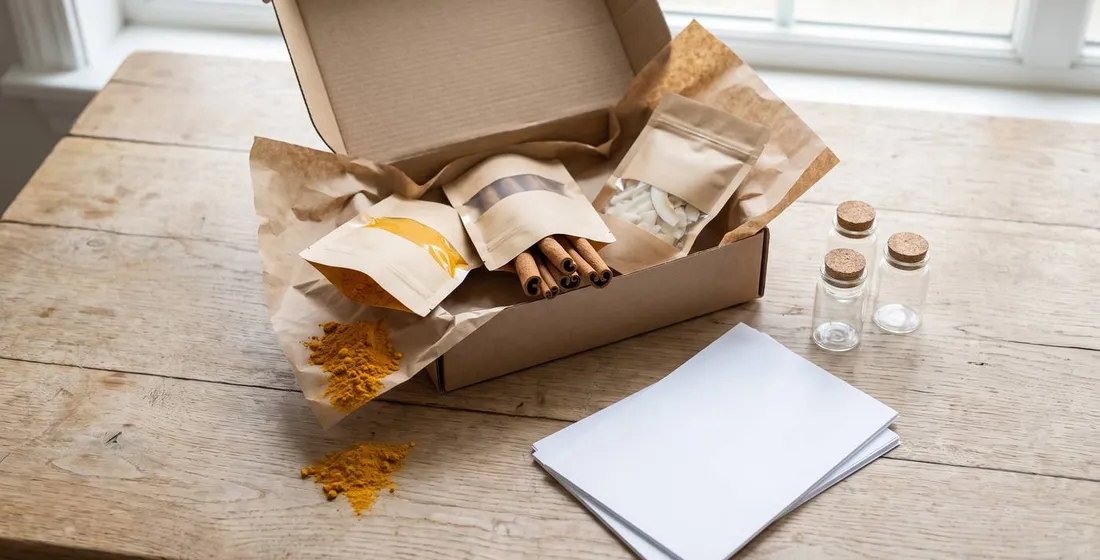
Buyer’s snapshot
- Herbs and spices drew 392 notifications in the EU’s Alert and Cooperation Network in 2024, 4 percent of the year’s total (European Commission, ACN 2024 Annual Report). A sample is the cheapest point at which to catch a documentation gap.
- A sample pack is five documents plus the physical sample: spec sheet, certificate of analysis (COA), allergen statement, organic certificate scope, and a traceability record.
- Samples are free for evaluation and the buyer pays the courier. Shipment documents (certificate of origin, phytosanitary certificate) belong to the order, not the sample.
- Silk Route Ventures issues the pack from the Silk Foods Ceylon site in Matale, with trial quantities from 10 kg once the sample is approved.
- For procurement and QA teams in the US, EU, UK and Australia who want a Ceylon supplier cleared before the first PO.
A buyer who asks a supplier for “a sample” usually gets a pouch and a courier note. The QA manager then spends the next two weeks asking for the paperwork that should have travelled with it: the specification, the analysis, the allergen position, the organic scope. Four emails for one pack.
Silk Route Ventures (SRV) handles sample requests for its manufacturing arm, Silk Foods Ceylon (SFC), in Matale. This post sets out what a complete pre-order pack contains, what each document lets your technical team decide, and what is deliberately not in it. It is cross-category on purpose. The coconut sample-to-PO timeline covers the commercial steps for one product family, and this post covers the paper that sits behind the pouch for any of them.
What does a complete sample pack contain?
A complete pre-order pack contains the physical sample and five controlled documents, each answering one question your approval file will ask. The pack is built for evaluation, so it describes the product and the site, not a shipment. Samples are free for evaluation, the buyer pays the courier, and the request confirms the dispatch arrangements rather than promising a date.
| Document | Question it answers | What your team can decide |
|---|---|---|
| Specification sheet | What exactly is this ingredient? | Whether the parameters (moisture, particle size, species or grade) match your formulation brief |
| Certificate of analysis (COA) | What did the lab find in this lot? | Whether the sample lot sits inside your limits, and which tests the supplier will run for you |
| Allergen statement | What is in the product and the line it ran on? | Whether it clears your allergen policy and your label |
| Organic certificate scope | Is this exact SKU on a current certificate? | Whether the organic claim on your pack is supportable |
| Traceability record | Where did this lot come from and where did it go? | Whether the supplier can support a recall drill |
The COA is available on request, so ask for it by name in the first message. Microbiology, heavy metals, aflatoxin, pesticide residues and coumarin are tested through an external laboratory on request, which means the parameters on a sample COA are the ones you ask for, not a fixed panel. Say which ones in the same email. Our guide to reading a per-lot heavy metal and pesticide COA covers how to read the result once it arrives.
Why ask for documents before the physical sample lands?
The documents take longer to clear than the sample takes to taste. Your own approval file has to be complete before a PO can be raised, and that file is what a certified buyer’s auditor reads. Under the US FDA’s Foreign Supplier Verification Programs rule, an importer must evaluate each foreign supplier’s procedures and compliance history, and the evaluation starts with exactly this paper (US FDA, FSVP final rule, 2016).
The pattern repeats across the EU and UK. Herbs and spices accounted for 392 of the 9,460 reports in the EU’s Alert and Cooperation Network in 2024, with multiple pesticide residues and unauthorised dyes among the recurring hazards (European Commission, ACN 2024 Annual Report). A buyer who has read a supplier’s COA and allergen statement before the sample ships has done the cheapest part of that risk screen already.
From the Trade Team The SRV procurement desk sees the same sequence on most first requests. The buyer asks for a sample, then for the specification, then the allergen statement, then the organic scope, each as a separate email. Buyers who ask for all five documents in the first message skip most of those exchanges, and the sample is judged against a complete file instead of a half-built one.
What does each document need to show?
Each document has a minimum content a technical team should insist on, and a gap in any one of them is a reason to pause the approval, not to chase it later.
Specification sheet. It lists the botanical or product identity, the grade, moisture, particle size where relevant, and the packing format. For spice products the species matters: the sheet should name it, because a common name alone does not settle a cassia versus Ceylon question. The Ceylon cinnamon grade sheet shows what a grade-level spec looks like for one family.
Certificate of analysis. It must carry the lot number, the test methods, the results against the limit, the laboratory, and the date. The lot number is what ties the document to the pouch in your hand. A COA with no lot number describes nothing in particular.
Allergen statement. The EU lists 14 allergen groups under Annex II of Regulation (EU) No 1169/2011, and the US added sesame as the ninth major allergen on 1 January 2023 under the FASTER Act (US FDA, 2023). A usable statement covers both what the product contains and what else runs on the same line. Our post on allergen control in a multi-product export facility sets out the statement a buyer should expect.
Organic certificate scope. USDA Organic and EU Organic apply to selected SKUs, confirmed per SKU. Ask for the scope page that lists the product by name, not a facility-wide statement. If your SKU is not on a current certificate, it is not organic for your label, and the pack should say so plainly.
Traceability record. Lots are traceable from raw material intake to shipment through batch coding. The record shows the intake lot, the batch code assigned at the site, and where the finished lot went. It is the paper behind the one-step-back, one-step-forward duty that Article 18 of Regulation (EC) No 178/2002 places on food business operators in the EU (Regulation (EC) No 178/2002, Article 18). Our primer on traceability depth and COA cadence covers what depth to ask for.
What is not in the sample pack?
Shipment documents are not in the pack, because there is no shipment yet. The certificate of origin, the phytosanitary certificate where the destination requires one, and for organic lots the import certificate the destination requires (EU or GB Certificate of Inspection, or a USDA NOP Import Certificate) travel with the order. The 2026 Ceylon export compliance checklist lists them with the buyer-side file, and the coconut export documents guide walks through one category in detail.
Pricing basis for the order is FOB Colombo, with CFR and CIF on request. SRV does not quote DDP. That belongs in the quote stage, but it is worth knowing before the sample request, because it decides who holds the import paperwork.
The pack also does not replace your supplier approval questionnaire. It feeds it. The questionnaire sections map to controlled documents the site already holds, which our post on supplier approval questionnaires and how a certified exporter answers them sets out section by section.
How does the pack scale across categories?
The pack is built once per SKU, then reused. The Silk Foods Ceylon floor is a cellular layout of about 10,000 sq ft with more than 400 products, and the spice and herb powder lines run 100 to 200 kg an hour, roughly 1 to 2 metric tonnes a day. Because each line is a cell, the documents for a new SKU do not require a separate audit cycle.
For a buyer, that means the pack for a second or third SKU is mostly a repeat of the first. The site-level documents stay the same: the allergen position of the facility, the traceability method, and the certification scope. Only the SKU-level documents change: the specification, the COA and, where it applies, the organic scope line.
| Stage | What is confirmed | Typical figure |
|---|---|---|
| Sample | Spec, COA, allergen, organic scope, traceability | Free for evaluation, buyer pays courier |
| Trial order | Quantity from approved sample | From 10 kg |
| First commercial order | Minimum per SKU | From 100 kg (dried herbs from 25 kg) |
| Production | PO to dispatch, standard SKUs | 2 to 3 weeks |
| Private label, custom spec, organic | PO to dispatch | 4 to 6 weeks |
Capsule, retail-pack and private-label unit minimums are confirmed on the quote.
Buyer’s checklist: the sample request email
- Name the exact SKU and grade you want evaluated
- Name the destination market (US, EU, UK or Australia)
- Ask for the specification sheet, COA, allergen statement, organic scope and traceability record together
- List the lab parameters you want on the COA (for example heavy metals, pesticide residues, aflatoxin, coumarin)
- State whether you need organic confirmed for this SKU
- Give a courier account number or confirm you will pay the courier
- Say what volume you plan to trial after approval
Who is this pack not for?
A sample pack is built for a buyer with a real brief. It is not for catalogue collecting, and SRV does not pre-fill dozens of sample requests for price comparison alone. If your decision is on lowest invoice price per kilo and the origin or certification is not part of the brief, a documents pack costs both sides time and returns little.
If you do have a brief, the pack is how a Ceylon spice order moves fastest. A buyer sourcing from the Ceylon spices supplier range should expect the same five documents for each SKU, and the spices product category lists the formats the pack can be built for.
Frequently asked questions
What documents come with an ingredient sample from Sri Lanka? A complete pre-order pack has a specification sheet, a certificate of analysis on request, an allergen statement, an organic certificate scope for the SKU if it is organic, and a traceability record. Shipment documents such as the certificate of origin and phytosanitary certificate belong to the order, not the sample.
Does Silk Route Ventures charge for samples? No. Samples are free for evaluation and the buyer pays the courier. Dispatch arrangements are confirmed on the request instead of being promised in advance. Trial quantities after an approved sample start from 10 kg, and first commercial orders from 100 kg per SKU, with dried herbs from 25 kg.
Can the COA include the lab tests my market requires? Yes, on request. Microbiology, heavy metals, aflatoxin, pesticide residues and coumarin are tested through an external laboratory. Name the parameters in your sample request, because the panel on the COA follows what you ask for, and the destination market (US, EU, UK or Australia) usually decides the list.
Does Silk Foods Ceylon manufacture under a recognised food safety certificate? Yes. The Matale facility holds BRCGS and FSSC 22000 V6, plus USDA Organic and EU Organic on selected SKUs, confirmed per SKU. For spice products, the relevant certificate is FSSC 22000 V6, because the BRCGS scope covers herbal and plant-based powders, capsules, plant milks, vegan meats, beverages and jams, not spices.
How Silk Route Ventures can help
Silk Route Ventures supplies Ceylon spices, herbs and coconut products as ingredient supply to specialty brands and distributors in the US, EU, UK and Australia. The Silk Foods Ceylon facility in Matale holds BRCGS and FSSC 22000 V6, with USDA Organic and EU Organic on selected SKUs, confirmed per SKU. Samples are free for evaluation (you cover the courier), trial quantities start from 10 kg, and first orders from 100 kg per SKU. Contact us to send an inquiry and name the five documents you want in the pack.
Sources
- European Commission, DG SANTE, “Alert and Cooperation Network: 2024 Annual Report” (2025). https://op.europa.eu/en/publication-detail/-/publication/65ee7b44-35eb-11f0-8a44-01aa75ed71a1/language-en. Retrieved 13 November 2026.
- US FDA, “FSMA Final Rule on Foreign Supplier Verification Programs (FSVP) for Importers of Food for Humans and Animals” (2016). https://www.fda.gov/food/food-safety-modernization-act-fsma/fsma-final-rule-foreign-supplier-verification-programs-fsvp-importers-food-humans-and-animals. Retrieved 13 November 2026.
- US FDA, “FASTER Act: Sesame as the Ninth Major Food Allergen” (2023). https://www.fda.gov/food/food-allergies/faster-act-sesame-ninth-major-food-allergen. Retrieved 13 November 2026.
- European Parliament and Council, Regulation (EU) No 1169/2011, Annex II. https://eur-lex.europa.eu/eli/reg/2011/1169/oj. Retrieved 13 November 2026.
- European Parliament and Council, Regulation (EC) No 178/2002, Article 18 (traceability). https://www.legislation.gov.uk/eur/2002/178/article/18/data.htm. Retrieved 13 November 2026.