
Sri Lankan Cocoa Nibs and Cocoa Powder: A Spec Primer for Craft Chocolate and Bakery
Procurement snapshot
- Cocoa buyers in the EU work to cadmium ceilings of 0.10 to 0.80 mg/kg depending on the finished product, and 0.60 mg/kg for cocoa powder sold to consumers (Regulation (EU) 2023/915, as summarised by CBI, 2024). The CBI table does not list nibs or beans, so a nib spec needs its own agreed cadmium limit.
- The EU deforestation rules cover cocoa, and they apply to large and medium operators from 30 December 2026 (European Commission, 2026). Plan the paperwork now, not in December.
- Silk Route Ventures (SRV) lists five cocoa SKUs: whole roasted beans, coarse cut, nibs, fine-cut nibs and powder. Commercial orders start at 100 kg per SKU, with trial quantities from 10 kg.
- This primer is for craft chocolate makers, bakeries and snack brands choosing between nibs and powder. It is not for buyers who need a single-estate, bean-to-bar origin story, because the catalogue does not make one.
Cocoa is easy to order and hard to specify. Two lots can both read “roasted cocoa nibs” on a quote and behave differently in a conche, a dough or a snack bar. Silk Route Ventures (SRV) lists cocoa as part of its ingredient range, and this piece sets out what the catalogue states, what it leaves for the quote, and what a buyer should write into an RFQ before a sample ships. Silk Foods Ceylon (SFC) is the Matale manufacturing arm; where cocoa is processed for a given SKU is confirmed on the quote.
What does the SRV cocoa range actually include?
Five SKUs sit in the catalogue, and the descriptions are specific about form and use.
| SKU | Form | Documented use |
|---|---|---|
| Cocoa beans (COC-BN) | Whole roasted beans | Raw material for grinding into nibs, cocoa mass and chocolate |
| Cocoa coarse cut (COC-CC) | Roasted cocoa broken into coarse pieces | Brewing, infusions, confectionery |
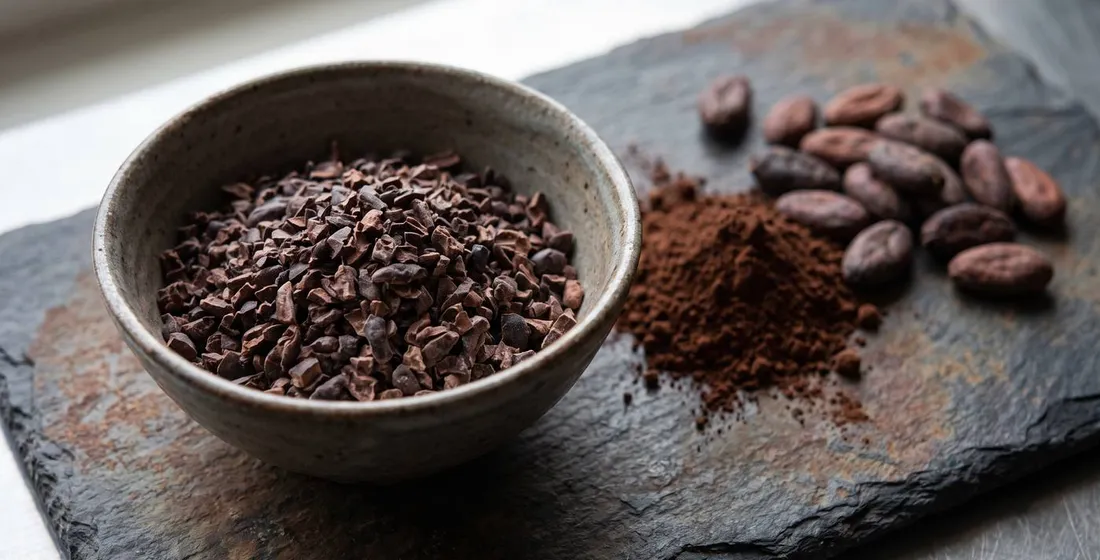
| Cocoa nibs (COC-NB) | Crushed roasted beans, no added sugar | Baked goods, granola, confectionery, toppings, infusions |
| Cocoa nibs fine cut (COC-NBF) | Nibs cut to a finer grade | Batters, doughs, toppings, bar formulations |
| Cocoa powder (COC-PWD) | Roasted cocoa ground to a fine powder | Beverages, bakery mixes, desserts, dairy applications, drinking chocolate |
Nibs and fine-cut nibs are offered in bulk and for private label. That is the whole documented spec. Fat percentage, particle size bands, moisture and the processing route (natural or alkalised powder, for example) are not published on the product pages, so they are request items, not assumptions.
Spec snapshot: cocoa nibs (COC-NB) Form: crushed roasted cocoa beans, no added sugar Sibling grades: fine-cut nibs (COC-NBF), coarse cut (COC-CC) Fat, moisture, particle size: confirmed on the specification sheet at quote Organic status: not assumed; confirmed per SKU against current certificates MOQ: 100 kg per SKU, trial from 10 kg Lead time: 2 to 3 weeks PO to dispatch for standard SKUs, 4 to 6 weeks for private label or custom specification
Nibs or powder: which one fits the application?
Choose by what the product has to do in your process, not by price per kilogram. Nibs bring texture and visible fragments. Powder brings colour and dispersion. Fine-cut nibs sit between the two for products where a coarse crunch would be too much.
For a craft chocolate maker, whole beans or nibs are the starting point, because the maker controls grinding, conching and refining. For a bakery, powder is the working ingredient in cakes, brownies and mixes, with nibs as an inclusion. For a snack-bar or granola brand, nibs or fine-cut nibs carry the chocolate note without added sugar. A hot chocolate or latte blend starts from powder; the private-label powder blends for winter ranges piece covers that format.
If a range will need both forms, name both in the first RFQ so one supplier qualification covers them.
Which spec fields should an RFQ name?
Write these into the brief before asking for a sample. Each is a field a supplier should be able to answer in writing.
- Form and cut: whole, coarse, nib or fine nib, with a particle size band you can test against.
- Fat content and moisture, stated as a range, not a typical value.
- Processing route for powder (natural or alkalised) and the colour reference your product needs.
- Flavour and defect tolerances: shell content, mould, insect damage, off-notes. State your acceptance method.
- Heavy metals, with cadmium named and a limit agreed against your destination market.
- Microbiology and any allergen-control statement for the line.
- Documents: COA on request, certificate of origin, and phytosanitary certificate where the destination requires it.
- Organic status, if you need it, confirmed for the exact SKU against the current certificate.
On fat, one caution from a neighbouring category applies here too. A fat figure is only useful when the method and basis are written beside it, as the jackfruit in brine and patty fat RFQ primer argues for plant-based buyers. The same discipline works for cocoa: ask for the number, the method and the basis, and compare lots on that.
How do EU cadmium limits apply to cocoa products?
Cadmium is the heavy-metal question for cocoa in the EU. Regulation (EU) 2023/915 sets maximum levels for finished cocoa and chocolate products. CBI, the Dutch trade-promotion agency, tabulates them as follows (mg/kg wet weight, CBI page updated July 2024):
| Product | Cadmium maximum |
|---|---|
| Milk chocolate, under 30% total dry cocoa solids | 0.10 mg/kg |
| Chocolate under 50% dry cocoa solids; milk chocolate at 30% or more | 0.30 mg/kg |
| Chocolate at 50% dry cocoa solids or more | 0.80 mg/kg |
| Cocoa powder sold to final consumers, including sweetened cocoa powder (drinking chocolate) | 0.60 mg/kg |
Two points follow for a buyer. First, the table covers finished products, and CBI notes that beans and nibs are not listed. Its guidance says some buyers reject beans above 0.3 mg/kg, which is a buyer expectation, not a legal maximum. Second, if your nibs go into a chocolate bar or a powder sold to consumers, the finished product has to meet the limit in the table, so the nib lot needs headroom against it.
The practical move is to agree a cadmium ceiling for the nib or powder lot in the contract and to request a test result before the PO. SRV arranges heavy-metal testing through an external laboratory on request. Verify the current legal text on EUR-Lex for your product category before you fix the number.
Buyer’s checklist: cocoa and cadmium
- Name your finished product and its cocoa solids share.
- Look up the matching maximum in Regulation (EU) 2023/915.
- Set a lot ceiling for nibs or powder with headroom below it.
- Ask for an external laboratory result against that ceiling.
- Record the method and the lot number on the COA.
What do the EU deforestation rules mean for cocoa?
On 23 December 2025 the EU published Regulation (EU) 2025/2650, which moved the start of the deforestation regulation (EUDR) by twelve months (Stibbe, 2025). The European Commission’s page now gives 30 December 2026 for large and medium operators and 30 June 2027 for micro and small operators. For anyone who had planned around the earlier date, that is a reprieve of one year, and no more than that.
Cocoa is inside the scope. CBI lists cocoa beans, shells, paste, butter, powder, and chocolate and other cocoa-containing foods among the covered products. An EU or UK-bound buyer should expect to be asked for proof that cocoa was not grown on recently deforested land. That evidence starts upstream of any exporter, so ask early what documentation the supplier can provide for a given lot.
A fuller walk-through of the EUDR for cocoa and coffee follows in a December post. For now, the action is simple: put “EUDR documentation for each lot” on the RFQ, and treat a vague answer as a finding.
What should you ask about fermentation and drying?
Fermentation and drying shape cocoa flavour and defect rates, and they happen before the beans reach any processor. The SRV catalogue does not publish fermentation, drying or growing-region data for its cocoa SKUs, and this post does not invent any. If your product story depends on a named origin, estate or fermentation protocol, ask for it in writing and treat what you get as the spec. If the supplier cannot document it, do not print it on a pack.
This is also where SRV is honest about fit. A craft maker selling a single-estate bar needs documented farm-level provenance. SRV’s cocoa range is built for buyers who need a specified ingredient in a bulk or private-label format, with documentation confirmed on the quote.
What does the order look like?
Commercial orders start at 100 kg per SKU, and trial quantities start at 10 kg. Samples are free for evaluation, with the buyer paying the courier. Standard SKUs run 2 to 3 weeks from PO to dispatch; private-label or custom-specification orders run 4 to 6 weeks. Pricing is FOB Colombo, with CFR and CIF on request. The 2026 export compliance checklist lists the documents an EU or US importer will ask for. For small first orders, the low-MOQ contract manufacturing guide explains when a small run pays.
Frequently asked questions
Does SRV supply cocoa nibs and cocoa powder?
Yes. Silk Route Ventures lists cocoa beans, coarse cut, nibs, fine-cut nibs and cocoa powder, offered in bulk, with private label on nibs, fine-cut nibs and powder. Commercial orders start at 100 kg per SKU and trial quantities at 10 kg. Fat, moisture and particle size are confirmed on the specification sheet at quote.
Is there a legal cadmium limit for cocoa nibs in the EU?
CBI’s 2024 table of Regulation (EU) 2023/915 lists limits for chocolate (0.10 to 0.80 mg/kg) and for cocoa powder sold to consumers (0.60 mg/kg), but not for nibs or beans. Finished products still have to comply, so agree a lot ceiling in the contract and check the current text on EUR-Lex.
When do the EU deforestation rules apply to cocoa?
Cocoa is a covered commodity. Following Regulation (EU) 2025/2650, the European Commission gives 30 December 2026 for large and medium operators and 30 June 2027 for micro and small operators. Check which category your company falls into and ask suppliers for lot-level documentation.
Can Silk Foods Ceylon make a private-label cocoa product?
Private label is offered on nibs, fine-cut nibs and cocoa powder. Minimums for retail packs and private-label units are confirmed on the quote, and private-label orders run 4 to 6 weeks from PO to dispatch. Share your target pack, spec and destination market in the first message.
How Silk Route Ventures can help
Silk Route Ventures supplies cocoa nibs, fine-cut nibs, coarse cut, whole beans and cocoa powder to bakeries, snack brands and chocolate makers, through its Ceylon spices and ingredient supply range and the cocoa nibs product page. Commercial orders start at 100 kg per SKU, trial quantities from 10 kg, with a COA on request and external laboratory heavy-metal testing available. Certification coverage and organic status are confirmed for the specific SKU on the quote. Send your spec, destination market and target volume through the contact form, and the trade desk will reply with a specification sheet and sample terms.
Sources
- CBI (Netherlands Enterprise Agency), “What requirements must cocoa meet to be allowed on the European market?” (updated 10 July 2024), cadmium table under Regulation (EU) 2023/915 and EUDR product scope. https://www.cbi.eu/market-information/cocoa/buyer-requirements (retrieved 27 October 2026)
- European Commission, “Regulation on deforestation-free products”, application dates for large, medium, micro and small operators. https://environment.ec.europa.eu/topics/forests/deforestation/regulation-deforestation-free-products_en (retrieved 27 October 2026)
- Stibbe, “The amended EUDR: what has changed and what has remained?” (Regulation (EU) 2025/2650, published 23 December 2025). https://www.stibbe.com/publications-and-insights/the-amended-eudr-what-has-changed-and-what-has-remained (retrieved 27 October 2026)
- Regulation (EU) 2023/915 on maximum levels for certain contaminants in food, EUR-Lex. https://eur-lex.europa.eu/eli/reg/2023/915/oj (further reading; verify product-category limits against the official text)
Written by the Silk Route Ventures Trade Team. Silk Route Ventures (E-Silk Route Ventures (Pvt) Ltd) is a Sri Lankan B2B supply-chain operator for the Food, Beverage, Wellness, and Nutraceuticals sectors. The Silk Foods Ceylon manufacturing arm holds BRCGS and FSSC 22000 V6 certifications. Questions or to request a sample: Contact us or email info@esilkroute.com.lk.