
Running a Certified Organic Line Beside Conventional
Buyer’s snapshot
- Certification scope held: BRCGS, FSSC 22000 V6, plus USDA Organic and EU Organic on selected SKUs, confirmed per SKU.
- Organic-capable formats: dried spices, single-botanical powders, coconut products, capsules.
- Powder throughput: 100 to 200 kg per hour, roughly 1 to 2 MT per shift day.
- Organic MOQ: 100 kg per SKU, the same as conventional (dried herbs from 25 kg). Capsule MOQ confirmed on your quote.
- PO to dispatch: 4 to 6 weeks for organic orders (2 to 3 weeks for standard SKUs). Samples free for evaluation (you cover the courier).
- Records per organic run: COA on request, lot traceability from raw material intake to shipment through our batch coding, input-output mass balance.
Most brand owners who ask about organic co-manufacturing are really asking one question, and it is rarely the one they open with. They ask whether the facility is certified. What they want to know is whether an organic lot can pass through a plant that also runs conventional material and still survive a certifier inspection, a retailer audit, and a residue test at the port of entry. Those are three different tests with three different failure modes. The commercial stakes have grown with the category: the Organic Trade Association reported United States organic sales of 76.6 billion dollars in 2025, up 6.8 percent, with organic food alone at 70.1 billion dollars. This is a plain account of how a split operation is run at the Silk Foods Ceylon (SFC) facility in Matale, what the controls cost in throughput, and how much organic-only capacity is genuinely available to book.
What a split operation is, and why the regulators allow it
A split operation is a site that handles both certified organic and non-organic product. Both major standards permit it by name, and neither treats it as a lesser arrangement. What they require is proof.
Under the United States National Organic Program, a handler must implement measures necessary to prevent commingling of organic and non-organic products and protect organic product from contact with prohibited substances, per 7 CFR 205.272. The phrase “split operation” appears in the regulation itself: 7 CFR 205.201(a)(5) requires the organic system plan to describe the management practices and physical barriers established to prevent commingling on a split operation, and that plan is approved before the first certified run rather than after it. The European Union framework, in application since 2022 under Regulation (EU) 2018/848, reaches the same place through a different door. Annex II Part IV requires that preparation of organic and non-organic products be kept separate in time or space, that operations run continuously until the production run is complete, and that organic work begins only after suitable cleaning of the production equipment.
The practical consequence for a brand owner is that certification is not a wall around the building. It is a set of documented behaviours around a batch. A dedicated organic-only plant sells that story more easily, and it also sells at a dedicated plant’s cost base, which is why most brands below a full-container cadence end up in a split site regardless of preference. So the question worth putting to a co-manufacturer is not whether the line is dedicated. It is to show the segregation matrix, the cleaning validation record, and last quarter’s mass balance for an organic SKU.
How organic material is kept apart from conventional stock
Segregation runs on three axes at once, and a plant that manages only one of them will eventually fail an inspection.
Space is the first, and the certification bodies say so plainly. CERES, an accredited organic certifier, put it in its 2022 processing guidance: the best separation is in space, separate warehouses and lines, and where that is not possible the operator separates in time and cleans the line before organic runs. Certified organic raw material arrives sealed and lot-marked and goes into a designated bay that holds nothing else, with conventional material of the same botanical on a separate rack rather than a lower shelf of the same rack. Dust falls downward, so vertical adjacency is a control failure even when the horizontal distance looks generous on a floor plan.
Time is the second. Organic runs are scheduled first after a validated full cleandown, as the opening run of a shift rather than squeezed between two conventional lots. That single scheduling rule removes most of the residual risk in a powder plant, because it removes the need to trust a partial changeover.
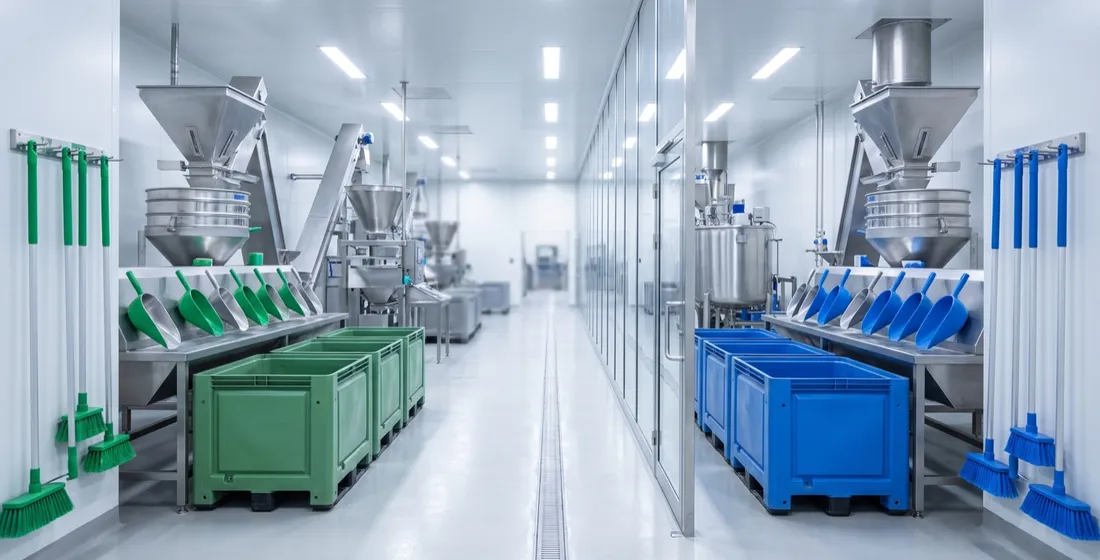
Tools are the third, and this is where a plant is easiest to assess on a walkthrough. Colour-coded scoops, brushes, tote bins and sieve screens, stored on separate racks, make a wrong-tool event visible to anyone on the floor rather than detectable only in a record review. In a dry powder environment the sieve screen matters more than most buyers expect, because a screen is the one contact surface that is hard to clean to a visual standard and easy to reuse without thinking.
| Control axis | What is actually done | What the record looks like |
|---|---|---|
| Storage | Dedicated organic bay, lot-marked sealed intake, no vertical adjacency to conventional stock of the same botanical | Goods-in log with lot number and the supplier’s organic certificate reference |
| Scheduling | Organic run placed first after a validated full cleandown, normally the opening run of the shift | Production schedule showing run order and the preceding cleandown sign-off |
| Tools and contact parts | Colour-coded scoops, brushes, tote bins and dedicated sieve screens on separate racks | Equipment issue log naming the screen and tool set used per batch |
| Air and dust | Dust extraction run through changeover, no simultaneous conventional milling of the same botanical | Changeover checklist with extraction confirmed before the organic run opens |
| Packing | Dedicated organic liners and printed film staged after cleandown, not before | Packing material issue record against the batch |
| Rework | Organic rework returns only to the same organic batch, never to a conventional pool | Rework log tied to the originating batch number |
Cleaning validation, and what the purge run really costs
Cleaning validation is the part of a split operation that brand owners underestimate, because on paper it reads as a checklist and in practice it is a yield deduction.
A changeover into an organic run at the SFC facility is a documented sequence, not a wipe-down: dry strip of the contact parts, removal and replacement of the sieve screen, cleaning of the mill and conveyor path, visual inspection sign-off, and then a purge quantity of the incoming organic material run through the line and taken off as conventional-grade product. That purge is not an SRV invention. CERES states the rule for continuous processes such as mills directly in its 2022 guidance: at the start of organic processing, a reasonable quantity of organic product is used to flush the line and is then sold as conventional.
The purge is the honest cost, material the buyer’s organic lot pays for in yield but never receives. A co-manufacturer that reports no purge on a shared powder line is describing a plant that has not thought about the sieve screen.
SRV finding from split-line changeovers
- Across dry botanical powder changeovers, the first material through a freshly cleaned mill and screen is taken off as conventional grade rather than counted into the organic lot.
- Buyers planning a first organic run should budget the purge as a real yield line, not as an overhead absorbed by the manufacturer.
- The purge quantity is set per product and per line configuration, and it is stated in the quotation rather than discovered at reconciliation.
The record that matters is the verification, not the cleaning: who inspected, against what standard, and what happened to the purged material. The European Union rule is explicit that the operator must implement suitable cleaning measures, monitor their effectiveness, and keep records of those operations, which is a higher bar than performing the clean. A purge that vanishes from the record is worse than no purge at all, because it opens the question of whether it was quietly counted into the organic yield. That question is exactly what a mass balance is designed to answer.
Mass balance, the record that carries the organic claim
If a brand owner audits one document at a co-manufacturer, it should be the mass balance, and the reason is that it is a binding regulatory test rather than a nicety. Under 7 CFR 205.403, the on-site inspection must verify that quantities of organic product and ingredients produced or purchased account for those used, stored, sold or transported. Inputs account for outputs, in the regulation’s own words. The 2023 Strengthening Organic Enforcement rule then made mass balance and supply-chain traceability audits a required part of on-site inspections, and set a minimum of 5 percent of a certifying agent’s operations to be inspected unannounced each year, as the Congressional Research Service summarised in its 2025 review of organic oversight. The European Union arrives at the same requirement by asking the operator to keep an updated register of all operations and quantities processed.
The arithmetic is unglamorous and completely decisive. Take a 500 kg organic turmeric powder run as a worked example.
| Line item | Quantity | Where it is evidenced |
|---|---|---|
| Certified organic raw material received | 500 kg | Goods-in record plus the supplier’s organic certificate for the lot |
| Cleaning and sorting loss | 18 kg | Pre-processing weigh-off sheet |
| Changeover purge taken off as conventional grade | 12 kg | Changeover record and conventional-grade transfer note |
| Grinding and sieve loss | 21 kg | Line weigh sheet against the batch |
| Rejected on screening or metal detection | 4 kg | Rejects log tied to the batch number |
| Certified organic finished goods packed | 445 kg | Packing record, batch code, dispatch documentation |
| Unexplained residual | 0 kg | The number a certifier and a retailer auditor both look for first |
Two disciplines make that table possible rather than retrospective. The first is that every line is captured by the operator while the run is happening, not reconstructed from memory at month end. The second is retention: United States rules require records to be kept for not less than five years beyond their creation, and a retailer audit will often reach back further than the certifier does, so the file has to survive staff turnover at the manufacturer. Ask how far back the mass-balance files go, and ask to see one from a year that no current line operator worked.
How much organic-only capacity is actually available
Capacity questions get vague answers in this industry, so here are numbers a brand owner can plan against. The 10,000 sq ft SFC facility at Nalanda in Matale runs a cellular layout, which is the structural reason organic scheduling works at moderate volumes: cells can be cleaned and committed independently rather than requiring the whole plant to change state.
| Format | Throughput | MOQ per SKU | PO to dispatch (organic orders) |
|---|---|---|---|
| Dried spices and single-botanical powders | 100 to 200 kg per hour, about 1 to 2 MT per shift day | 100 kg (dried herbs from 25 kg) | 4 to 6 weeks |
| Capsules, bottled and labelled | 100,000 capsules per shift, 200,000 per day | Confirmed on your quote | 4 to 6 weeks |
| Spray-dried powders | 50 kg per day | 100 kg | 4 to 6 weeks |
| Coconut products, bulk | Line dependent | 100 kg | 4 to 6 weeks |
Read those alongside the segregation rules and the real constraint becomes visible. It is not machine hours. A powder cell producing 1 to 2 MT in a day absorbs a 500 kg organic SKU comfortably, so the binding constraint is changeover slots, because organic runs want the opening position after a validated cleandown. A brand owner booking three organic SKUs of 500 kg each is not asking for three days of machine time, it is asking for three clean opening slots, which is a scheduling conversation held four to six weeks out. Sea freight then adds 3 to 4 weeks to the European Union or Australia and 4 to 5 weeks to the United States, and air freight 3 to 4 days when a launch date has slipped.
Does one organic certificate cover both the United States and the European Union?
No, and this is the single most expensive assumption a scaling brand makes. The two systems are separate certifications with separate scopes, labelling rules and control-body recognition, and a manufacturer holding one has not automatically satisfied the other. The Court of Justice of the European Union made the point sharply in Case C-240/23: neither organic terms nor the EU organic logo may be used by products that comply only with standards merely equivalent to the European Union production rules. Equivalence is a trade mechanism, not a labelling shortcut.
That mechanism also has a clock on it. The European Commission’s December 2025 proposal to amend Regulation (EU) 2018/848 records that recognition of third countries whose organic systems were recognised as equivalent expires on 31 December 2026, and proposes extending it to 2036 to avoid trade disruption. For a brand owner the action is concrete: confirm the route by which a manufacturer’s organic status reaches each destination market, and confirm both scopes are live on the site and on the product before the run is scheduled rather than after the pallets are built. The detail is set out in organic equivalence for Canadian and US botanical importers and in the buyer’s guide to organic certifications, and the United Kingdom position after divergence is covered in the GB organic and labelling rules for Ceylon ingredient buyers.
What to ask a co-manufacturer before the first organic run
Six questions separate a plant that runs organic from a plant that holds a certificate.
- Which specific product categories sit inside the organic scope, and is the format being quoted inside it or adjacent to it?
- What is the purge quantity for this product on this line, and is it stated in the quotation?
- Where does the purged material go, and how does the record show it left the organic lot?
- Can a completed mass balance for a comparable organic SKU be shown, including the residual line?
- How far back do the organic batch records reach, and who holds them if a line operator leaves?
- Are the United States and European Union organic scopes both live on the site today, and does the labelling review happen before artwork is signed off?
A co-manufacturer that answers all six from the floor rather than from a certificate has the operating discipline. One that answers by sending a certificate has answered a different question. That distinction is developed further in qualifying a coconut and plant-based contract manufacturer and, for buyers moving from a bench formula to a certified first run, in NPD as a service.
What organic certification does not cover
- An organic certificate speaks to inputs and handling, not to hazard control or to contaminant limits.
- BRCGS and FSSC 22000 V6 cover the food-safety system, and heavy metal and pesticide residue results (tested through an external laboratory on request) cover contaminants, as set out in the guide to reading a COA.
- A buyer selling organic into a regulated market needs all three running together, not one standing in for the others.
Frequently asked questions
Can a certified organic product be made in a plant that also runs conventional material? Yes. Both the United States National Organic Program and the European Union organic framework permit split operations, provided the handler documents and implements measures preventing commingling and contact with prohibited substances. The controls are separation in space, separation in time, dedicated contact parts, and a reconcilable mass balance for every certified run.
What is a mass balance in organic certification? A mass balance reconciles certified organic input against certified organic output for a batch or period, with process loss, changeover purge and rejects accounting for the difference. Under 7 CFR 205.403 the certifier must verify that inputs account for outputs at on-site inspection, and the 2023 Strengthening Organic Enforcement rule made those audits a required inspection step.
Does a USDA Organic certificate allow a product to be labelled organic in the European Union? No. The two systems are separate certifications with separate scopes and labelling rules. In Case C-240/23 the Court of Justice of the European Union held that the EU organic logo and organic terms may not be used by products complying only with merely equivalent standards, so both scopes must be confirmed before a dual-market run is scheduled.
What is the minimum order quantity and lead time for a certified organic run at Silk Route Ventures? Organic runs carry the same 100 kg per SKU minimum as conventional powder and spice runs, with the capsule MOQ confirmed on your quote. Samples are free for evaluation (you cover the courier), and production runs 4 to 6 weeks from purchase order to dispatch for organic orders (2 to 3 weeks for standard SKUs), with organic slots booked four to six weeks out to secure a post-cleandown opening position.
How Silk Route Ventures can help
Silk Route Ventures (SRV) manufactures through the Silk Foods Ceylon (SFC) facility at Nalanda in Matale, a 10,000 sq ft cellular-layout plant certified to BRCGS and FSSC 22000 V6, with USDA Organic and EU Organic on selected SKUs, confirmed per SKU, across dried spices, single-botanical powders, coconut products and capsules. Organic runs are scheduled into post-cleandown opening slots with a documented changeover, a stated purge quantity, a COA on request and a mass balance issued against every certified lot, at 100 kg per SKU for powders and a capsule MOQ confirmed on your quote. The team handles formulation and first-run scale-up in parallel through contract manufacturing and R&D, so a brand owner moving an organic SKU from bench to certified export run works from one production record rather than three suppliers’ versions of it. Request a co-manufacturing capability briefing with the target market, the format and the certification scope needed, and the response comes back with the purge, the slot and the MOQ economics on the same sheet. For a first-order quote, start with our Ceylon spices supplier.
Sources
- 7 CFR 205.272, Commingling and contact with prohibited substance prevention practice standard, eCFR. Retrieved 29 August 2026.
- 7 CFR 205.201, Organic production and handling system plan, eCFR. Retrieved 29 August 2026.
- 7 CFR 205.103, Recordkeeping by certified operations, eCFR. Retrieved 29 August 2026.
- 7 CFR 205.403, On-site inspections, eCFR. Retrieved 29 August 2026.
- Organic Agriculture Standards: Oversight and Enforcement, Report R48379, 30 January 2025, Congressional Research Service. Retrieved 29 August 2026.
- Regulation (EU) 2018/848 on organic production and labelling of organic products, Annex II Part IV and Article 28, EUR-Lex. Retrieved 29 August 2026.
- COM(2025) 780 final, proposal amending Regulation (EU) 2018/848, 16 December 2025, European Commission. Retrieved 29 August 2026.
- Brief Introduction to Requirements for Processing of Organic Food, version 1 October 2022, CERES Certification of Environmental Standards. Retrieved 29 August 2026.
- Organic Market Report 2026, March 2026, Organic Trade Association. Retrieved 29 August 2026.