
Pyrrolizidine Alkaloids in Herbal Teas and Botanicals: The EU Limits and What to Test
Compliance snapshot
- Regulation (EU) 2023/915 sets pyrrolizidine alkaloid (PA) maximum levels from 75 µg/kg (tea and herbal infusions for infants) up to 1,000 µg/kg (borage, lovage, marjoram and oregano). Dried herbal infusions sit at 200 µg/kg, or 400 µg/kg for a short named list.
- The limit applies to the lower-bound sum of 21 named PAs plus 14 that co-elute with them, so a method that reports one or two compounds cannot prove compliance.
- The alkaloids come from weeds cut with the crop, not from the herb itself. That makes sorting and field control as important as the lab result.
- Silk Foods Ceylon (SFC) tests through an external laboratory on request, and a COA is available on request. This post is for tisane and supplement buyers writing the PA clause of an RFQ. It is not for buyers who want a single heavy-metals-and-pesticides COA to stand for the whole contaminant stack.
A herbal tea lot can pass colour, aroma, moisture and a full pesticide panel and still be unsaleable in the European Union. The reason is a group of plant toxins that no sensory check will find and that the herb never made. Pyrrolizidine alkaloids reach a lot on the back of a weed, and the limit that now governs them is written into the contaminants regulation, not a buyer’s preference. This is the plain-language version for procurement: what the limits are, why they differ by product, what an adequate test reports, and what a supplier should be able to describe about the field and the sorting table. Silk Route Ventures (SRV) covers the category-level picture in its tisane buyer’s guide. This one stays on the alkaloids.
Why do pyrrolizidine alkaloids turn up in herbal tea?
Pyrrolizidine alkaloids are defence compounds made by thousands of plant species, mainly in the Boraginaceae, Asteraceae (Compositae) and Fabaceae families. A 2023 review of exogenous PAs in tea notes that the tea plant does not make them: they arrive through weeds growing among the crop (Pharmacological Research - Modern Chinese Medicine, 2023). The same logic holds for most leaf and aerial-part botanicals. A weed such as Senecio or Heliotropium is cut, dried and packed with the herb, and a handful of stems can contaminate a lot.
The regulatory concern is toxicological. The European Food Safety Authority (EFSA) set a reference point of 237 µg/kg body weight per day for the carcinogenic risk of 1,2-unsaturated PAs in 2017, and concluded that tea, herbal infusions and food supplements are significant contributors to exposure (EFSA Journal, 2017, 15(7):4908). Those findings drove the limits that followed.
One consequence is easy to miss. The risk does not follow the herb. It follows the field and the harvest. A leaf botanical cut close to the ground carries more exposure than a root, and the same species can pass in one lot and fail in the next.
What are the EU limits, and why do they differ?
The limits are set per product category, on the dried product as placed on the market, in point 2.4 of the contaminants annex to Regulation (EU) 2023/915, which carried over the earlier Regulation (EU) 2020/2040. The figures below were checked against the consolidated text of that annex in November 2026. Verify them again before you write a contract, because the annex is amended from time to time.
| Product (dried, as placed on the market) | Maximum level, µg/kg |
|---|---|
| Tea and herbal infusions for infants and young children | 75 |
| Tea (Camellia sinensis) and flavoured tea | 150 |
| Herbal infusions and their ingredients, general | 200 |
| Rooibos, anise, lemon balm, chamomile, thyme, peppermint, lemon verbena (and mixtures only of these) | 400 |
| Dried herbs, general | 400 |
| Cumin | 400 |
| Food supplements containing botanical preparations, including extracts | 400 |
| Borage, lovage, marjoram, oregano (dried) | 1,000 |
Two details change the arithmetic for buyers. First, for powdered extracts of herbal infusions a concentration factor of 4 is applied when checking against the limit. Second, the 400 µg/kg tier for infusions is a closed list. A blend of chamomile and lemongrass is not “exclusively composed” of the named herbs, so it falls under the stricter 200 µg/kg line.
Compliance snapshot: reading the limit for a blend A tisane of peppermint and lemon balm: 400 µg/kg (closed list, mixture of listed herbs only). The same tisane with lemongrass added: 200 µg/kg. The same herbs sold as a food supplement: 400 µg/kg on the finished product as placed on the market. Dried herbs sold as a culinary ingredient: 400 µg/kg, or 1,000 µg/kg for borage, lovage, marjoram and oregano.
Which test panel should the RFQ name?
Name the method, not just the analyte. The regulation sets the limit on the lower-bound sum of 21 listed PAs and N-oxides, plus 14 further PAs known to co-elute with them on common methods. Lower bound means every result below the limit of quantification counts as zero. Any PA that the method can identify and separate must be quantified and added to the sum.
In practice this is a liquid chromatography with tandem mass spectrometry (LC-MS/MS) analysis, and an adequate report shows four things:
- Each PA and N-oxide quantified individually, with a total.
- The limit of quantification, stated per compound and low enough to read against the 75 to 200 µg/kg limits.
- The matrix and the sample preparation. A dried herb, a tea-bag cut and an extract behave differently.
- The laboratory’s accreditation for this method.
A COA that lists heavy metals, pesticides and microbiology but not PAs has cleared part of the contaminant stack. For a leaf or aerial-part herb it is incomplete, and the per-lot COA guide explains how to read the rest of the sheet beside it.
Sampling matters as much as the assay. PA contamination is patchy: one stem can carry a large share of a lot’s total. A result from a single small subsample can pass a lot that a second subsample would fail. Ask how many incremental samples were drawn and how the composite was homogenised before the laboratory ground it.
What do field and sorting controls look like?
The lab result is a verdict. The controls decide whether the verdict is a pass. Because the toxin comes from a weed, the controls a supplier describes should follow the weed through the chain.
The published mitigation measures are practical and unglamorous: weed control in the field, inspection of fields before harvest, seed cleaning, and manual or mechanical sorting afterwards. A review of the regulatory response in Planta Medica reports that monitoring data show a significant fall in PA load in herbal drugs and extracts since such measures were adopted (Steinhoff, 2021). Mechanical weeding is hard to justify economically on small plots, which is why post-harvest sorting carries so much of the load.
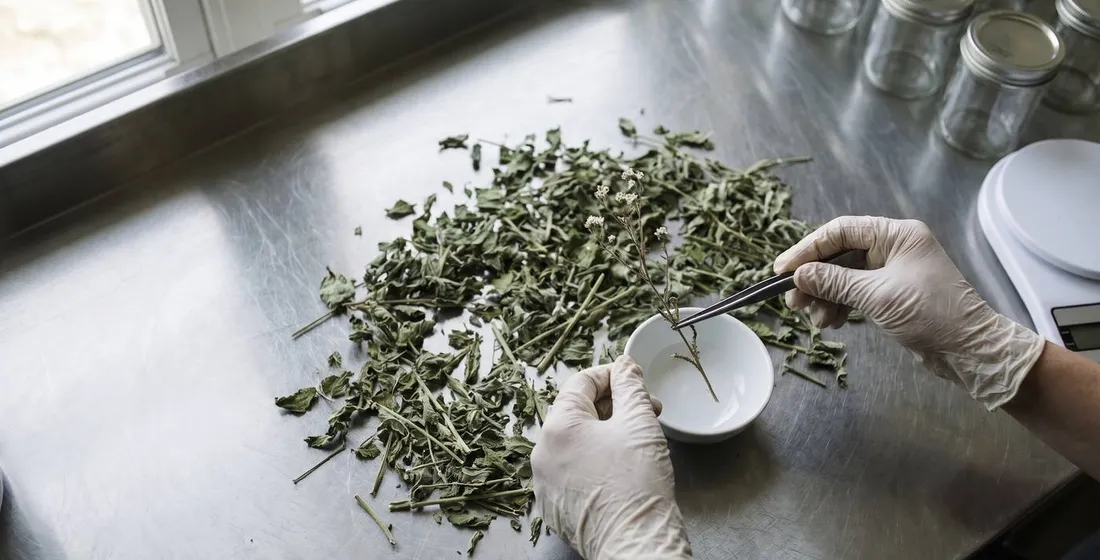
On 1 July 2022 the European Union’s PA limits began to apply to tea and herbal infusions, and food placed on the market before that date could stay on sale until 31 December 2023 (Regulation (EU) 2023/915, Article 2). Before the date a tisane lot was judged on sensory quality and a pesticide panel. After it, a lot over the limit stopped being a quality complaint and became a product that could not be placed on the market. The weed behind it is a dry flowering stem on a tray of green leaf, easy to miss and impossible to pick out of a ground cut. Sorting has to happen before the herb is cut. After cutting and blending, the weed is in every bag, and the only remaining control is the test.
Buyer’s checklist: PA controls to ask any supplier about
- Which weed species grow in or beside the harvest area, and how they are identified
- Whether fields are walked before harvest, and who signs that off
- Whether herb is hand-sorted before cutting, and what is removed
- Whether each lot is tested for the full PA sum, with the individual results shown
- Which herbs in the range are leaf or aerial-part and so higher risk
- What the supplier does with a lot that fails, and whether it is ever blended down
Blending down is the control to ask about last. Diluting a failing lot into a clean one is a way of passing a number without removing the cause, and a buyer who accepts it inherits the risk.
Where does this leave a Ceylon herb buyer?
For Ceylon botanicals the practical sorting is by plant part. Roots, barks and rhizomes carry less weed-exposure risk than leaves and aerial parts, so a cinnamon or ginger programme and a lemongrass, gotukola or tulsi programme need different PA scrutiny. The right posture is the same for each: test the lot, name the method, and ask for the field and sorting story in writing.
SFC tests microbiology, heavy metals, aflatoxin and pesticide residues through an external laboratory on request. A PA panel is an additional analysis a buyer should specify for leaf and aerial-part herbs, and its availability and cost are confirmed on the quote. Results are judged against the destination market, which for the European Union means the table above. What SRV does not do is publish a catalogue PA figure for each herb. Any supplier who quotes one number across a whole range has not tested lots.
Where Silk Route Ventures walks away Briefs that ask for EU-compliant herbal tea at a price that leaves no room for lot testing, sorting or a failed-lot policy. A reseller with no analytical data will always quote lower, and the buyer carries the recall risk. For a tisane with a health-adjacent story, that is the more expensive lot.
Frequently asked questions
What is the EU limit for pyrrolizidine alkaloids in herbal tea?
Dried herbal infusions are limited to 200 µg/kg of pyrrolizidine alkaloids, and 400 µg/kg for rooibos, anise, lemon balm, chamomile, thyme, peppermint, lemon verbena and mixtures made only of them (Regulation (EU) 2023/915). Tea from Camellia sinensis is capped at 150 µg/kg, and infant products at 75 µg/kg.
What does a PA test need to include to prove compliance?
It needs an LC-MS/MS result quantifying each of the 21 listed pyrrolizidine alkaloids and N-oxides, plus the 14 that co-elute, reported as a lower-bound sum with the limit of quantification stated. Ask also for the sampling plan, since contamination is patchy and a single subsample can mislead.
Can sorting remove pyrrolizidine alkaloids from a contaminated lot?
Sorting removes the weed, not the alkaloid, so it works only before the herb is cut and blended. Hand or mechanical sorting of whole leaf can cut a lot’s load substantially, but it is a control to verify with a PA result, not a substitute for one. A cut and blended lot that fails has to be rejected.
Does Silk Route Ventures supply tisane herbs with PA testing for EU buyers?
Silk Route Ventures supplies tea-bag-cut and other cuts of Ceylon herbs from the Silk Foods Ceylon facility in Matale, with external-laboratory testing and a COA available on request. A PA panel for your destination market is specified and confirmed on the quote. First orders start at 25 kg per SKU for dried herbs. Private label and custom-specification orders run 4 to 6 weeks from PO to dispatch.
How Silk Route Ventures can help
Silk Route Ventures (SRV) supplies Ceylon herbs in tea-bag cut, fine cut, coarse cut and powder to tisane brands and supplement formulators in the US, EU and Australia, and the Sri Lankan herbs supplier range is the place to start. The BRCGS and FSSC 22000 V6 audited Silk Foods Ceylon (SFC) facility in Matale prepares each herb to the buyer’s written specification, with a COA available on request and USDA Organic and EU Organic on selected SKUs, confirmed per SKU. First orders start at 25 kg per SKU for dried herbs, trial quantities from 10 kg, and lead time is 2 to 3 weeks from PO to dispatch for standard SKUs; samples are free for evaluation (you cover the courier). Sea freight runs 3 to 4 weeks to the EU and Australia and 4 to 5 weeks to the US. To test a cut against your PA clause, request a sample of Lemongrass TBC and contact us with your destination market and test panel.