
Instant Soup Premix Private Label: Mushroom and Vegetable Soup Powders for Winter Ranges
Buyer’s snapshot
- The UK’s 2024 salt reduction targets set soups at 0.50 g salt per 100 g on average and 0.59 g as a maximum, and they count dried soups “as consumed”, after reconstitution (Public Health England, September 2020). The salt ceiling for a dry premix depends on how much water the pack says to add.
- Celery is a declarable allergen in the EU and UK but not in the US or Australia. A single soup formula sold into all three markets needs one allergen matrix, not three labels written after the fact.
- Silk Foods Ceylon (SFC) blends dry powders at 100 to 200 kg per hour in Matale, with a 100 kg MOQ per SKU and R&D in 3 to 4 weeks at most.
- The reconstitution table and the buyer’s checklist are the parts to forward to R&D and QA.
A winter soup range usually reaches a co-manufacturer as one line in an email: “instant mushroom soup and a vegetable soup, private label, sachets and pouches, on shelf by the cold months.” The first reply most suppliers send is a price per kilogram. That number matters less than three decisions the brief has not made yet: what the base is built from, how much water the pack tells the consumer to add, and which allergens the formula is allowed to carry into which market.
Silk Route Ventures (SRV) wrote this for CPG scale-ups and own-brand teams building a dry soup range for the EU, UK, Australia or the US.
How is an instant soup premix built?
An instant soup premix is a dry blend that has to do four jobs: thicken in hot water without lumps, carry flavour, stay free-flowing in the pack for its full shelf life, and hit a sodium figure once it is in the bowl. Each job falls to a different ingredient group, and each group brings its own allergen question.
| Ingredient group | Role in the bowl | Allergen to check | Spec to write into the brief |
|---|---|---|---|
| Base and thickener (starch, rice flour, wheat flour, maltodextrin) | Body and texture | Wheat (gluten) if wheat flour is used | Starch type, gelatinisation behaviour in hot water, moisture |
| Flavour powders (mushroom, onion, garlic, tomato, vegetable powders) | The named flavour | Celery if celery powder or celery salt is used | Particle size, moisture, colour, microbial panel |
| Spices and herbs (black pepper, white pepper, bay, thyme) | Seasoning and aroma | Mustard if a mustard powder is added | Grade, mesh size, heavy metals and pesticide results |
| Salt and savoury enhancers (salt, yeast extract, hydrolysed vegetable protein) | Savoury depth and sodium | Soy if the protein is soy-derived | Sodium contribution per 100 g of powder |
| Creaminess (milk powder, cream powder, or a plant-based fat powder) | Mouthfeel in a “cream of” soup | Milk for dairy powders | Fat %, carrier, and whether a dairy-free claim is wanted |
The Codex Alimentarius standard for bouillons and consommés (CXS 117-1981) covers dehydrated products made by reconstituting a dry mixture according to the directions for use. The pack instruction is part of the specification.
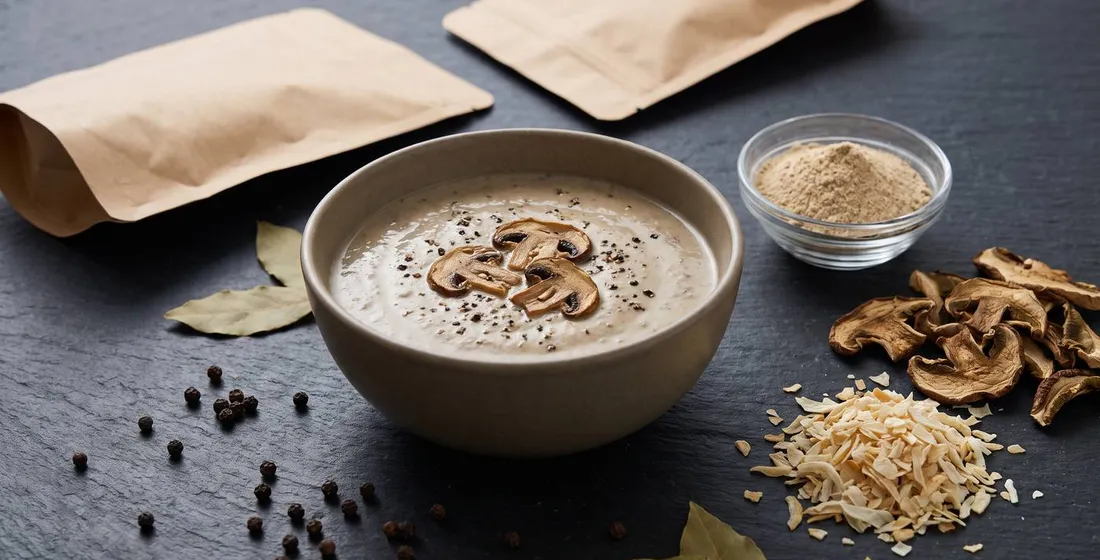
SRV lists a mushroom soup powder built from dried mushrooms as a base for own-brand soup ranges, and a vegetable soup is developed from the same blending line using vegetable powders, onion and spice. The drying routes behind those powders are set out in the fruit and vegetable powder capacity guide.
Where is sodium measured on a dry soup?
On the finished bowl, not the powder. Public Health England’s 2024 salt reduction targets, published in September 2020, place soups in category 9.1 and include “dried soups as consumed”. The average target is 0.50 g salt (200 mg sodium) per 100 g, and the maximum is 0.59 g salt (235 mg sodium) per 100 g.
That changes the formulation question. A soup powder with a high salt percentage can still meet the target if the pack calls for more water, and a low-salt powder can miss it if the serving is made strong. The arithmetic below shows the salt ceiling in the dry powder for three common reconstitution ratios. These figures are calculated from the UK target, not measured from any product, and they ignore the small sodium contribution of tap water.
| Pack instruction (powder to water by weight) | Powder share of the bowl | Powder salt ceiling at the 0.59 g maximum | Powder salt at the 0.50 g average |
|---|---|---|---|
| 1 part to 9 (for example 20 g in 180 ml) | 10% | 5.9 g per 100 g | 5.0 g per 100 g |
| 1 part to 10 (for example 20 g in 200 ml) | about 9.1% | 6.5 g per 100 g | 5.5 g per 100 g |
| 1 part to 12 (for example 15 g in 180 ml) | about 7.7% | 7.7 g per 100 g | 6.5 g per 100 g |
The ceiling is 0.59 g multiplied by the number of parts in the finished bowl. Fix the serving instruction before R&D starts, because a later change to the water volume moves the compliant salt range with it. The UK targets are voluntary, and the US FDA has published its own voluntary sodium goals by food category, with a second phase in draft since August 2024.
Taking salt out means more work for mushroom, onion, yeast extract and pepper. The black and white pepper, and the dried herbs for a winter blend, can be specified from the Ceylon spices range on the same COA stack as the soup base.
Spec snapshot: dry soup premix at Silk Foods Ceylon, Matale Line: spice, herb and powder blending, 100 to 200 kg per hour (about 1 to 2 tonnes a day) MOQ: 100 kg per SKU; trial quantities from 10 kg R&D: signed brief to approved formulation, 3 to 4 weeks at most Production: 4 to 6 weeks PO to dispatch for private label (2 to 3 weeks for standard SKUs) Certifications: BRCGS and FSSC 22000 V6 at the facility; scope for the specific soup SKU confirmed on the quote Documents: COA on request; microbiology, heavy metals, aflatoxin and pesticide residues tested through an external laboratory on request Formats: single-serve sachets, retail pouches and bulk food-service packs, confirmed at brief stage against the line schedule
Which allergens catch out a multi-market soup range?
Celery is the one most buyers miss. It sits in Annex II of Regulation (EU) No 1169/2011, alongside cereals containing gluten, milk, mustard and soybeans, so it must be emphasised in the ingredient list for EU and UK packs. It is not one of the nine major food allergens in the US, where sesame became the ninth on 1 January 2023 under the FASTER Act (FDA). It is also not on the list of allergens that Australia and New Zealand must declare under Plain English Allergen Labelling, which took effect on 25 February 2024 (FSANZ).
| Allergen often found in dry soup | EU and UK | United States | Australia and New Zealand |
|---|---|---|---|
| Celery (celery powder, celery salt) | Must be declared | Not a major allergen | Not a mandatory declaration |
| Wheat and gluten (wheat flour thickener) | Must be declared | Wheat must be declared | Must be declared (wheat, gluten) |
| Milk (milk or cream powder) | Must be declared | Must be declared | Must be declared |
| Soy (soy-derived protein) | Must be declared | Must be declared | Must be declared |
| Mustard (mustard powder) | Must be declared | Not a major allergen | Not a mandatory declaration |
| Sesame | Must be declared | Must be declared since 1 January 2023 | Must be declared |
Write the allergen position into the brief as a target, for example “no celery, no milk, wheat permitted”, so R&D builds to it. A vegetable soup without celery powder is entirely possible, but the choice is made in formulation, before the label is drafted. Then ask for the allergen declaration and the cleaning-validation summary for the production week, since cross-contact on a shared blending line is what a retailer’s auditor will ask about.
What happens on the line for a first order?
The blending line is rarely the constraint. At 100 to 200 kg per hour, a 200 kg run of two SKUs clears in one to two hours. The planning sits around it: raw materials tested, formulation locked, film and artwork approved.
The MOQ sets the shape of a first order. At 100 kg per SKU, a mushroom and a vegetable soup launched together need at least 200 kg of finished powder. At a 20 g sachet, 100 kg of powder fills 5,000 sachets, so the two-SKU minimum is 10,000 sachets. A pouch range divides the same way: 100 kg is 1,000 pouches of 100 g. That arithmetic is for sizing only. Unit minimums for sachets and retail packs are confirmed on the quote against the line schedule. How the MOQ feeds into unit price is covered in how low-MOQ and high-volume contract manufacturing are priced.
The timeline stacks the same way as any SRV private-label powder. R&D runs 3 to 4 weeks at most from signed brief to approved formulation. Production takes 4 to 6 weeks from PO to dispatch for private label. Sea freight adds 3 to 4 weeks to the EU or Australia and 4 to 5 weeks to the US. A US-bound winter range needs a signed brief roughly 15 weeks before it reaches port, before customs and distribution are added. The winter beverage equivalent of this plan is in the dairy-free hot chocolate and latte premix guide.
When Public Health England set the 2024 targets in 2020, the soups category could have measured salt on the powder, which is how it is bought and shipped. It chose the bowl. That one line in a government table moved the sodium decision off the factory floor and onto the pack instruction, which the brand writes. A dry soup brief has to be written by both sides together.
Buyer’s checklist: instant soup premix RFQ
- Flavours in the range (for example mushroom, mixed vegetable) and the reference product, if any
- Serving instruction: powder weight and water volume per serve
- Sodium target per 100 g as consumed, and the market whose target applies
- Allergen position per SKU: celery, wheat, milk, soy, mustard permitted or excluded
- Thickener preference (wheat flour, rice flour or starch) and any clean-label limits on enhancers
- Pack format and fill weight: sachet, pouch or bulk food-service bag, with the barrier film spec
- Shelf-life requirement and target markets
- Test panel for the first lot (microbiology, heavy metals, pesticide residues) and a pre-production sample approved against the spec before any PO
Who is this not for?
SRV prices for brands competing on ingredient quality and a named origin for the spices, not for the lowest cost per cup. A brand whose only criterion is the cheapest instant soup at multi-million-sachet volumes is better served by a large dedicated instant-soup plant. The SRV model fits a launch of a few hundred kilograms to a few tonnes per SKU, with the formulation approved before scale-up. For the questions to ask any manufacturer before that first PO, see how to verify a Sri Lankan contract manufacturer before you buy.
Frequently asked questions
What is the MOQ for a private-label instant soup powder?
Commercial orders start at 100 kg per SKU, with trial quantities from 10 kg. At a 20 g sachet, 100 kg of powder fills about 5,000 sachets, so a two-flavour launch needs at least 200 kg. Sachet and retail-pack unit minimums are confirmed on the quote, and private-label production runs 4 to 6 weeks from PO to dispatch.
Does SRV offer private label for mushroom soup powder?
Yes. Silk Route Ventures lists a mushroom soup powder built from dried mushrooms as a base for own-brand soup ranges, and the R&D team can adapt it or develop a vegetable soup to the brand’s sodium and allergen targets in 3 to 4 weeks at most. The brand supplies its name and artwork, and approves the formulation before production.
How much salt can a dry soup powder contain and still meet UK targets?
It depends on the water added. The UK 2024 maximum for soups is 0.59 g salt per 100 g as consumed (Public Health England, 2020), and dried soups are measured after reconstitution. At 20 g of powder in 200 ml of water, the powder ceiling works out at about 6.5 g salt per 100 g.
Is celery an allergen on soup labels in every market?
No. Celery must be declared on EU and UK labels under Regulation (EU) No 1169/2011, Annex II, but it is not one of the nine major food allergens in the US, and it is not a mandatory declaration under the Australia and New Zealand rules that took effect on 25 February 2024.
How Silk Route Ventures can help
Silk Route Ventures contract-manufactures dry soup premixes for own-brand winter ranges at the Silk Foods Ceylon (SFC) facility in Matale, which holds BRCGS and FSSC 22000 V6. The blending line runs 100 to 200 kg per hour with a 100 kg MOQ per SKU, the SRV R&D team develops the formulation to your sodium and allergen targets in 3 to 4 weeks at most, and private-label production follows in 4 to 6 weeks from PO to dispatch. Samples are free for evaluation, with the buyer paying the courier. Contact us to send an inquiry with the flavours, serving instruction, target markets and pack format.
Sources
- Public Health England, Salt reduction: targets for 2024, September 2020, retrieved 20 October 2026: https://assets.publishing.service.gov.uk/government/uploads/system/uploads/attachment_data/file/915406/2024_salt_reduction_targets_070920-FINAL-1.pdf
- Regulation (EU) No 1169/2011 on the provision of food information to consumers, Annex II, EUR-Lex, retrieved 20 October 2026: https://eur-lex.europa.eu/eli/reg/2011/1169/oj/eng
- U.S. Food and Drug Administration, FASTER Act: Sesame is the Ninth Major Food Allergen, retrieved 20 October 2026: https://www.fda.gov/food/food-allergies/faster-act-sesame-ninth-major-food-allergen
- Food Standards Australia New Zealand, P1044 Plain English Allergen Labelling, retrieved 20 October 2026: https://www.foodstandards.gov.au/peal
- Codex Alimentarius, Standard for Bouillons and Consommés (CXS 117-1981), FAO/WHO, retrieved 20 October 2026: https://www.fao.org/fao-who-codexalimentarius/codex-texts/list-standards/en/
- U.S. Food and Drug Administration, draft guidance on voluntary sodium reduction goals (Phase II), August 2024, retrieved 20 October 2026: https://www.fda.gov/media/180794/download
Written by the Silk Route Ventures Trade Team. Silk Route Ventures (E-Silk Route Ventures (Pvt) Ltd) is a Sri Lankan B2B supply-chain operator for the Food, Beverage, Wellness, and Nutraceuticals sectors. The Silk Foods Ceylon manufacturing arm holds BRCGS and FSSC 22000 V6 certifications. Questions or to request a sample: Contact us or email info@esilkroute.com.lk.