
Cosmetic-Grade Botanical Powders: How the Spec Differs from Food Grade
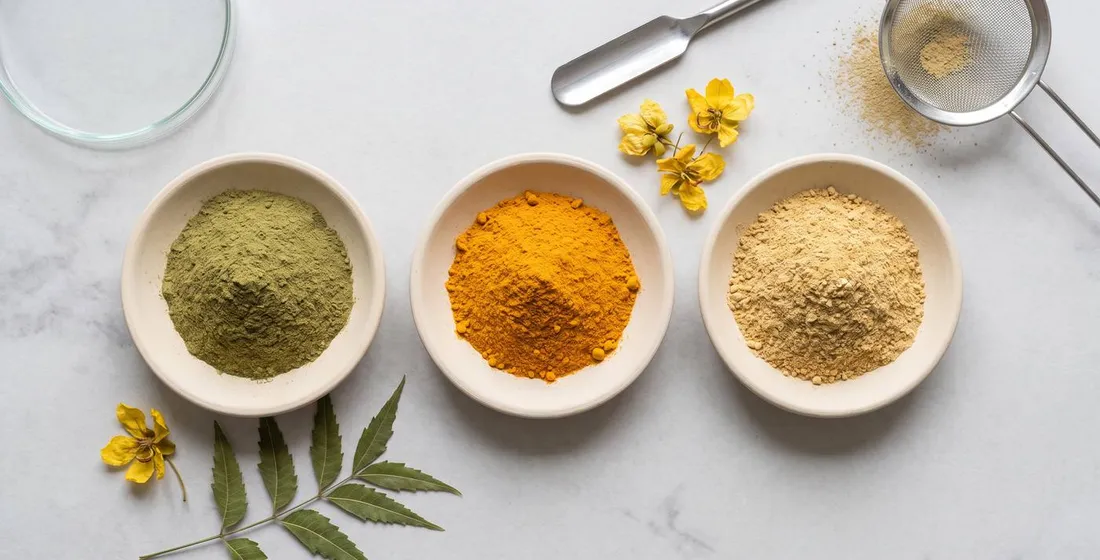
Buyer’s snapshot
- ISO 17516:2014 limits finished cosmetics for the eye area, mucous membranes and children under three to 100 CFU/g total aerobic count, and all other cosmetics to 1,000 CFU/g. A dried herb sold to a food spec is rarely held anywhere near that.
- The EU sets no numeric heavy-metal limit for finished cosmetics. German authorities treat lead above 0.5 mg/kg in toothpaste as technically avoidable, a third of the EU food limit for turmeric.
- Silk Route Ventures (SRV) supplies neem, turmeric and ranawara powders produced under BRCGS and FSSC 22000 V6, which are food-safety certificates. It does not hold a cosmetic GMP certificate.
- The comparison table and the COA checklist below are the parts to forward to quality assurance.
A botanical powder that passes a food-grade specification can still fail a cosmetic one. Food law asks whether the ingredient is safe to eat at the level it is eaten. Cosmetic law asks whether the finished product is safe on skin, gums or eyes for its whole shelf life, with a preservative system that has to cope with whatever the powder brought in. This piece is for formulators and buyers at cosmetic and oral-care brands in the EU, the UK and Japan specifying neem, turmeric or ranawara powder from Sri Lanka: where the specs diverge, what the COA needs to carry, and which checks stay with the buyer. For the wider supply base, see the guide to sourcing functional herbs and Ayurvedic botanicals from Sri Lanka.
What separates a cosmetic-grade botanical powder from a food-grade one?
A cosmetic-grade powder is not a different plant or a different mill. It is the same leaf, rhizome or flower held to a specification written around the finished cosmetic: microbial counts low enough to survive dilution into a product capped at 100 or 1,000 CFU/g under ISO 17516:2014, metals judged against cosmetic orientation values, a particle size the skin or gum will tolerate, and an INCI name.
Microbiology is the largest gap, because food herbs are often cooked, brewed or encapsulated, while a cosmetic is applied raw and stored open. Heavy metals come next, judged against what good manufacturing can achieve rather than a legal ceiling. Then particle size, and the name on the label.
| Parameter | Typical food-grade expectation | Typical cosmetic and oral-care expectation |
|---|---|---|
| Governing logic | Safe to eat at intake level (EU Regulation 2023/915 for contaminants) | Finished product safe in use (EU Regulation 1223/2009, safety assessor sign-off) |
| Total aerobic count | Agreed per spec; dried herbs that are cooked or brewed often carry 10,000 to 100,000+ CFU/g | Low enough that the finished product stays within 100 CFU/g (Category 1) or 1,000 CFU/g (Category 2) |
| Specified organisms | Salmonella, E. coli absent | P. aeruginosa, S. aureus, C. albicans and E. coli not detected |
| Lead | 1.5 mg/kg for root and rhizome spices such as turmeric; 3.0 mg/kg in food supplements (EU) | No EU number; BVL orientation 2.0 mg/kg for cosmetics, 0.5 mg/kg for toothpaste |
| Particle size | 60 to 80 mesh common for blending and capsule fill | 100 mesh or finer for masks, tooth powders and pastes; stated as a distribution |
| Name on pack | Common or botanical name | INCI name, for example AZADIRACHTA INDICA LEAF POWDER |
| Decontamination | Steam or none; ethylene oxide residue capped at 0.1 mg/kg in EU food | Declared method; ethylene oxide is a prohibited substance in EU cosmetics |
Why microbial limits decide most cosmetic botanical specs
ISO 17516:2014 sets 100 CFU/g for Category 1 cosmetics (children under three, eye area, mucous membranes) and 1,000 CFU/g for Category 2. A powder dosed at 2% carries its bioburden straight into the base, so a 100,000 CFU/g food-spec powder adds about 2,000 CFU/g before any preservative acts.
That arithmetic is where most food-spec powders fall out of a cosmetic brief. At 2% inclusion, a powder at 10,000 CFU/g still contributes around 200 CFU/g, twice the Category 1 ceiling. Toothpaste, mouthwash and gum products contact mucous membranes, which is why many safety assessors place oral care in Category 1. The preservative system, verified by an ISO 11930 challenge test, protects the product in use. It is not there to clean up a dirty raw material, and the Annex I safety report asks for the microbial specification of each raw material.
Products that are the powder itself change the maths again. A neem face pack, a turmeric mask powder or a herbal tooth powder sold dry has no dilution and often no preservative. The raw-material spec is the finished-product spec.
Spec snapshot: neem leaf powder for a cosmetic or oral-care base Botanical: Azadirachta indica, leaf only (no kernel, seed or bark fraction) INCI: AZADIRACHTA INDICA LEAF POWDER Particle size: 80 or 100 mesh as standard from the Silk Foods Ceylon (SFC) mill; finer to be agreed on sample COA: moisture, microbial panel, heavy metals and pesticide residues on every batch SRV MOQ: 50 kg per SKU; 2 to 3 weeks PO to dispatch
The plant-part line exists because of a dated event. On 20 July 2023 the European Commission published Regulation (EU) 2023/1490, adding margosa kernel extract to the Annex II list of substances prohibited in cosmetics from 1 December 2023. At the point of listing, the entry was reported in 3,521 notified cosmetic products, each of which needed reformulating or withdrawing inside four months. Leaf material stayed permitted. A neem spec that does not name the leaf will come back from an auditor, and the margosa leaf powder spec for skin-claim and oral-care SKUs covers that boundary in more detail.
How heavy-metal expectations change from food to cosmetics
EU cosmetics law lists lead, arsenic, cadmium, mercury and their compounds as prohibited substances in Annex II but allows technically unavoidable traces if the product stays safe. German authorities put that line at 2.0 mg/kg lead for cosmetics and 0.5 mg/kg for toothpaste, while Health Canada caps finished cosmetics at 10 mg/kg lead.
There is no single cosmetic number, only orientation values the safety assessor matches to market and format. At 1% to 5% inclusion, a food-grade metal result is usually comfortable once diluted. In a powder-only product it is not. A turmeric lot at 1.2 mg/kg lead is legal as an EU spice, but sold as a 100% tooth powder it sits more than twice above the BVL toothpaste orientation value.
Turmeric needs its own line in the contract for a second reason: lead chromate adulteration of the rhizome in parts of South Asia, documented in the Ceylon vs Indian turmeric lead-risk comparison. Ask for lead by ICP-MS on every batch, plus arsenic, cadmium, mercury and antimony, the five metals the BVL values cover. The guide to reading per-lot heavy metal and pesticide results on a COA explains how to judge them against a limit of quantification.
Particle size, colour and the INCI name
Food blending tolerates 60 to 80 mesh, which is roughly 250 to 180 microns. Masks, scrubs, tooth powders and pastes usually want 100 mesh (about 150 microns) or finer, written as a sieve pass percentage or a full distribution, because grit on gums and skin is the first consumer complaint.
Colour flips too. Turmeric is bought for colour in food; in a cream it stains fabric, skin and toothbrush bristles. Neem leaf powder browns as it oxidises, which shows in a white paste long before it shows in a capsule.
Then the name. EU labels use the common ingredient names in Commission Decision (EU) 2019/701, which follow INCI. Neem leaf powder appears as AZADIRACHTA INDICA LEAF POWDER and turmeric as CURCUMA LONGA ROOT POWDER, even though the material is milled rhizome. Ranawara is the case to check before the brief goes out. COSMILE Europe lists CASSIA AURICULATA LEAF POWDER, with skin conditioning as its function, but when this was written it showed no flower-powder entry. Ranawara is traded in Sri Lanka mainly as the dried flower, as the ranawara sourcing spec sets out. A brand that wants flower material may need to confirm or apply for an INCI name; one that is content with leaf has a name ready.
What should a cosmetic formulator ask for on the COA?
A cosmetic COA for a botanical powder should name the INCI, the botanical with plant part, the batch and origin, then report total aerobic count, yeast and mould, the four specified organisms, five heavy metals, particle size, moisture and a decontamination statement. The safety assessor needs each field for the product safety report under EU Regulation 1223/2009.
Buyer’s checklist: COA fields for a cosmetic or oral-care botanical powder
- INCI name, botanical name and plant part, plus CAS and EC numbers where listed
- Batch number, origin district and production date, traceable to the farm or collector
- Total aerobic microbial count and total yeast and mould count, with method
- P. aeruginosa, S. aureus, C. albicans and E. coli: not detected, with sample mass stated
- Lead, arsenic, cadmium, mercury and antimony, with limit of quantification
- Particle size as a sieve pass or distribution, plus moisture and total ash
- Decontamination statement: method named, ethylene oxide and irradiation excluded or declared
- Pesticide residue panel matched to the destination market
Items 1, 2, 5, 6 and 8 overlap with what a food buyer already receives. SFC issues a COA on every batch covering moisture, microbial load, heavy metals and pesticide residues where relevant, with third-party testing against customer-specific parameters on request. Items 3, 4 and 7 must be explicit in a cosmetic brief, because a food COA reports microbiology against food organisms and food limits. The spec guide for single-botanical powders bound for the EU and Japan covers the plant-part and mesh fields.
What the cosmetic buyer has to verify on their own side
SFC produces these powders under BRCGS and FSSC 22000 V6, food-safety standards that cover spices and herbals. Neither is a cosmetic GMP certificate. ISO 22716 covers finished cosmetics and EFfCI GMP covers cosmetic ingredients. SRV holds neither, so supplier qualification sits inside the buyer’s own GMP system.
That is normal. Article 8 of Regulation 1223/2009 puts the GMP obligation on manufacture of the cosmetic product, and a brand working to ISO 22716 qualifies raw-material suppliers through specification, documentation, incoming testing and, where risk justifies it, an audit. An audited food-safety system and batch traceability give that process a lot to work with. They do not replace these steps:
- Incoming testing against the ISO 17516 category of the finished product, at least for the first lots
- The safety assessor’s review of the raw-material specification in the product safety report
- A preservative challenge test on the finished formula, run with the actual powder lot
- Regulatory status in each market: EU Annex II and III, the UK equivalents, and Japan’s Standards for Cosmetics or the quasi-drug route for medicated toothpaste
- Claim wording under Regulation (EU) 655/2013, which keeps a cosmetic away from antibacterial or gum-disease language
Where SRV walks away Briefs that need the raw material supplier to hold ISO 22716 or EFfCI GMP certification in its own name, or a powder guaranteed to Category 1 limits without a sample cycle to confirm it. SRV will not claim a certificate it does not hold. For those programmes, a specialist cosmetic-ingredient processor is the honest answer.
Frequently asked questions
Can a food-grade botanical powder be used in a cosmetic?
Often, if the specification is rewritten for the finished product. ISO 17516:2014 caps Category 2 cosmetics at 1,000 CFU/g and Category 1 products, which many assessors apply to oral care, at 100 CFU/g. The buyer’s safety assessor confirms suitability; the supplier’s food certification does not make that judgement.
What is the INCI name for neem, turmeric and ranawara powder?
Neem leaf powder is AZADIRACHTA INDICA LEAF POWDER and turmeric is CURCUMA LONGA ROOT POWDER. For ranawara, COSMILE Europe lists CASSIA AURICULATA LEAF POWDER with a skin-conditioning function. Flower material had no listed powder entry when checked in October 2026, so confirm the name before labelling.
Does Silk Route Ventures supply botanical powders for cosmetic and oral-care brands?
Yes, as ingredient supply. SRV ships neem, turmeric and ranawara powders from the Silk Foods Ceylon facility in Matale, produced under BRCGS and FSSC 22000 V6 with a COA on every batch and a 50 kg per SKU first-order MOQ. It does not hold a cosmetic GMP certificate, so qualification stays with the buyer.
How Silk Route Ventures can help
Silk Route Ventures (SRV) supplies bulk Ayurvedic and functional botanical powders, including neem leaf, turmeric and ranawara, to wellness, cosmetic and oral-care brands in the EU, the UK, Japan and beyond. The Silk Foods Ceylon (SFC) facility in Matale, 1 km from Nalanda Gedige, mills on a line running 100 to 200 kg per hour under BRCGS and FSSC 22000 V6, with USDA Organic and EU Organic on the relevant SKUs and a COA on every batch. First-order MOQ is 50 kg per SKU, samples ship by international courier in 3 to 5 business days, and production runs 2 to 3 weeks from PO to dispatch. Send the cosmetic specification with the sample request, and the team will confirm which parameters need third-party testing. Buyers comparing the wider range can start with the Sri Lankan herb powders SRV supplies, or go straight to the neem powder product sheet. Contact us to send an inquiry or request a sample.
Sources
- International Organization for Standardization, ISO 17516:2014 Cosmetics, Microbiology, Microbiological limits. https://www.iso.org/standard/59938.html (retrieved 1 October 2026)
- European Parliament and Council, Regulation (EC) No 1223/2009 on cosmetic products, including Article 8 and Annex I. https://eur-lex.europa.eu/eli/reg/2009/1223/oj/eng (retrieved 1 October 2026)
- European Commission, Commission Regulation (EU) 2023/915 on maximum levels for certain contaminants in food. https://eur-lex.europa.eu/eli/reg/2023/915/oj/eng (retrieved 1 October 2026)
- Journal of Consumer Protection and Food Safety, Technically avoidable heavy metal contents in cosmetic products (2016). https://link.springer.com/article/10.1007/s00003-016-1044-2 (retrieved 1 October 2026)
- Health Canada, Guidance on heavy metal impurities in cosmetics. https://www.canada.ca/en/health-canada/services/consumer-product-safety/cosmetics/labelling/safety-ingredients.html (retrieved 1 October 2026)
- European Commission, Commission Regulation (EU) 2023/1490 amending Regulation (EC) No 1223/2009 as regards CMR substances. https://eur-lex.europa.eu/legal-content/EN/TXT/PDF/?uri=CELEX:32023R1490 (retrieved 1 October 2026)
- COSMILE Europe (Cosmetics Europe), ingredient entry for Cassia Auriculata Leaf Powder. https://cosmileeurope.eu/inci/detail/2727/cassia-auriculata-leaf-powder/ (retrieved 1 October 2026)
- SGS, EFfCI GMP certification scheme for cosmetic ingredients. https://www.sgs.com/en-us/services/effci-gmp-certification-scheme (retrieved 1 October 2026)