
MCT Oil C8 and C10 Sourcing: Fractionation and Buyer Specs
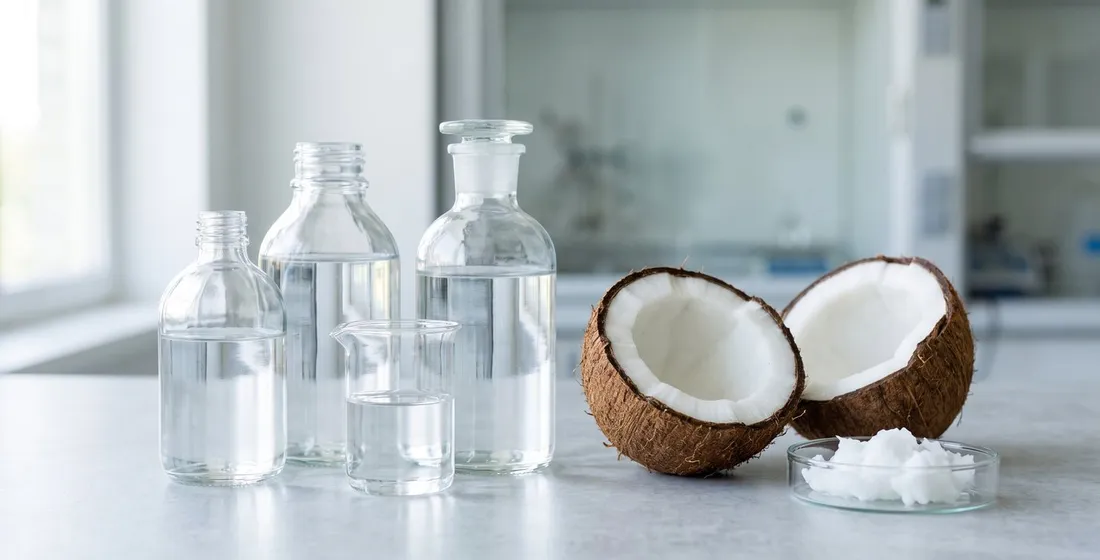
Key takeaways
- MCT oil is a manufactured fraction, not a coconut grade. Coconut oil is split into free fatty acids, the C8 (caprylic) and C10 (capric) acids are distilled off, and they are re-esterified onto glycerol. The result is typically 50 to 80% C8 and 20 to 50% C10, the composition range in the European Pharmacopoeia medium-chain triglycerides monograph.
- Coconut oil itself carries only 4.6 to 10.0% C8 and 5.0 to 8.0% C10 under Codex CXS 210-1999. Roughly half of it is lauric acid (C12), which high-purity MCT specs cap at 3% or less. That gap is why an MCT spec is written against a fractionator’s document, never a coconut oil standard.
- Silk Route Ventures (SRV) does not fractionate MCT. What SRV supplies from the Silk Foods Ceylon (SFC) facility in Matale is the upstream coconut oil (virgin, white, and RBD) under BRCGS and FSSC 22000 V6, plus the coconut formats that sit around an MCT SKU in a wellness range.
A familiar kind of one-line RFQ reaches Sri Lankan coconut suppliers: “Ceylon MCT oil, C8, 2 MT, organic.” Every word in it is reasonable, and the combination still cannot be quoted as written. Sri Lanka’s coconut sector produces virgin, white, and refined coconut oil at scale, but the hydrolysis, distillation, and re-esterification steps that turn coconut oil into a C8 concentrate run in dedicated oleochemical plants, most of them in Malaysia and Indonesia. The honest reply is a question back: is the brief the MCT, or the Ceylon coconut story behind it?
This guide is for wellness and nutraceutical formulators who need both answers. It covers how MCT is made, what C8 and C10 grades mean on a spec sheet, the certificate-of-analysis parameters that separate a clean MCT from a mislabelled one, and where a Ceylon coconut supplier fits in the chain (and where it does not).
What is MCT oil, and how is it made from coconut oil?
Medium-chain triglyceride (MCT) oil is a structured lipid made by concentrating the six-, eight-, and ten-carbon fatty acids from a lauric oil and bonding them back onto glycerol. The standard industrial route has four stages, each of which a buyer can ask a fractionator to document:
- Hydrolysis. Refined coconut oil (or palm kernel oil) is split with high-pressure steam into free fatty acids and glycerol.
- Fractional distillation. The fatty acid mixture is vacuum-distilled. C8 and C10 boil at lower temperatures than C12 and the longer chains, so they come off first and are condensed as a separate cut.
- Re-esterification. The C8 and C10 cut is esterified back onto glycerol, using an acid catalyst or an immobilised lipase, and the excess free acids are stripped under vacuum.
- Refining. The crude MCT is bleached and deodorised with steam under vacuum to a neutral, colourless oil.
A 2020 paper in AIP Conference Proceedings on MCT synthesis from virgin coconut oil reported a distillate of 81.74% medium-chain fatty acids at 130 to 140°C under low pressure, before esterification with glycerol at 170°C. The point for a buyer: MCT is several chemical process steps removed from the coconut, and the quality of those steps, not the palm’s origin, sets most of the specification.
For the side-by-side view of virgin, RBD, and MCT as three distinct coconut oil products, see the B2B buyer’s guide to Ceylon virgin coconut oil.
How much C8 and C10 does coconut oil actually contain?
Codex Alimentarius CXS 210-1999 sets the fatty acid ranges for coconut oil by gas chromatography: caprylic acid (C8:0) at 4.6 to 10.0% and capric acid (C10:0) at 5.0 to 8.0% of total fatty acids. Lauric acid (C12:0) dominates at 45.1 to 53.2%. That profile is why coconut oil is marketed as “rich in medium-chain fatty acids” while still being a very different product from MCT oil.
| Fatty acid | Coconut oil, Codex CXS 210-1999 | MCT oil, European Pharmacopoeia monograph |
|---|---|---|
| Caproic (C6:0) | ND to 0.7% | Max 2.0% |
| Caprylic (C8:0) | 4.6 to 10.0% | 50.0 to 80.0% |
| Capric (C10:0) | 5.0 to 8.0% | 20.0 to 50.0% |
| Lauric (C12:0) | 45.1 to 53.2% | Max 3.0% |
| Myristic (C14:0) | 16.8 to 21.0% | Max 1.0% |
Source: Codex Alimentarius, Standard for Named Vegetable Oils (CXS 210-1999), Table 1; European Pharmacopoeia, Triglycerides, medium-chain (monograph 0868), as summarised in published pharmacopoeial texts.
The arithmetic is worth doing once. Taking the Codex ranges at face value, C8 plus C10 is roughly 10 to 18% of coconut oil’s fatty acids. So a tonne of coconut oil holds, at a theoretical ceiling, somewhere around 100 to 180 kg of C8 and C10 acids before distillation losses (an illustrative calculation, not a plant yield). The other 80% or more of the tonne, mostly lauric and myristic acid, goes to soap, surfactant, and oleochemical markets. MCT economics are set by how well a fractionator sells that remainder, which is one reason MCT is priced as an oleochemical and not as a coconut oil.
C8, C10, and blend grades: which one should a formulator spec?
Commercial MCT is sold in a handful of recurring grades, and the grade name on a quote rarely tells the whole story. The table below lists the common conventions; the numbers on the actual spec sheet are what bind the supplier.
| Grade as usually quoted | Typical C8 : C10 | Where formulators tend to use it |
|---|---|---|
| Pharmacopoeial MCT (Ph. Eur. or USP-NF) | 50 to 80% C8, 20 to 50% C10 | Clinical nutrition, carrier oil for softgels and liquid actives |
| 60/40 blend | About 60 : 40 | General food and supplement use, creamers, powders |
| 70/30 blend | About 70 : 30 | Keto and sports nutrition positioning |
| C8 concentrate | 95% C8 or higher | Premium ketogenic SKUs, where C8’s faster ketone response is the claim |
| C10-rich | Mostly C10 | Niche; some cosmetic and clinical uses |
A 60/40 and a 70/30 can both sit inside the pharmacopoeial range, so “meets Ph. Eur.” is not by itself a grade. If the finished product makes a C8 claim on the label, the spec should state the minimum C8 percentage and the ceiling for C6, because caproic acid carries a sharp, goaty off-note that consumers notice in unflavoured oils and coffee creamers.
Writing an MCT oil spec: the parameters a COA should show
An MCT RFQ that asks for “MCT oil, food grade” invites the same problem as a coconut oil RFQ that never names the grade: the buyer finds out what arrived when the COA does. Ask for these parameters by name, batch by batch:
- Fatty acid profile by GC, reporting C6, C8, C10, C12, and C14 separately, with the C8 and C10 minimums and the C6 and C12 ceilings the grade requires
- Acid value and peroxide value, since residual free acids from esterification and oxidation both show up in taste
- Moisture and saponification value
- Feedstock declaration in writing: coconut only, palm kernel only, or mixed lauric stream. A large share of global MCT starts as palm kernel oil, so a “coconut MCT” label depends entirely on this document
- Catalyst and process residues where relevant, plus heavy metals
- Certification scope for the specific product: organic status, where claimed, follows the SKU and the fractionating site, not the coconut estate alone
The same discipline applies one step upstream. If a brand is also buying the coconut oil that feeds its range, the virgin coconut oil specification RFQ template lists the Codex and APCC parameters for the virgin grade, and the COA cadence and traceability primer covers what per-batch testing should look like.
Can you source MCT oil from Ceylon coconut?
Sri Lanka grows the coconut, but it is not where most MCT is made, and a Ceylon supplier who implies otherwise deserves a follow-up question. Silk Route Ventures does not run hydrolysis or distillation for MCT and does not sell C8 or C10 distillate. The team says so on the first call rather than quote a brokered position on another plant’s product.
Where SRV and SFC do fit in an MCT-led wellness range:
- The coconut oil itself. Virgin, extra virgin, white, and RBD coconut oil from the Matale oil line, in bulk and retail formats, with a 1 metric tonne bulk MOQ per SKU and a batch COA on every shipment.
- The companion SKUs. A brand selling MCT often sells a virgin coconut oil jar, a coconut milk powder creamer base, or a coconut flour beside it. SFC runs those formats under the same BRCGS and FSSC 22000 V6 audit scope, so a second coconut SKU does not start a new supplier qualification.
- Provenance a label can defend. Coconut oil from a named facility in Hapugasyaya, Nalanda, Matale, with traceability up to farm, is a claim a buyer can document. “Ceylon MCT” usually is not, unless the fractionator can show a segregated coconut-only feedstock chain back to a Sri Lankan supplier.
For the regional picture, including why fractionation capacity sits in Malaysia and Indonesia, the Ceylon versus Philippine coconut supply comparison for VCO and MCT buyers goes further. For choosing between the two oils in a formula, the virgin coconut oil versus RBD comparison and the coconut, sunflower, and MCT fat systems matrix cover the application trade-offs.
Regulatory framing for US and EU supplement buyers
In the United States, MCTs are marketed as food ingredients, dietary supplement components, and medical food inputs on a generally recognised as safe (GRAS) basis, according to a 2026 review of MCT regulatory perspectives in Nutrients. In Germany and across the EU, the same review notes MCTs are used mainly in foods for special medical purposes, such as fat malabsorption and ketogenic dietary therapy, while Japan also allows them in functional foods under its FOSHU and Foods with Function Claims schemes.
Two practical consequences for a formulator. First, the pharmacopoeial monographs (European Pharmacopoeia and USP-NF) are the most widely recognised written specs for MCT, so quoting against one of them gives both parties a fixed target. Second, the health claims around MCT, ketones, and energy are regulated by market, and a supplier’s COA supports composition only. Claim substantiation sits with the brand. For MCT inside capsules, the brand should confirm at RFQ stage whether the contract manufacturer handles oil fills at all; SFC’s published capsule line figures (100,000 capsules per shift, 180 bottles per SKU MOQ) are covered in the capsule contract manufacturing MOQ guide.
Frequently asked questions
What is the difference between C8 and C10 MCT oil?
C8 (caprylic acid) has eight carbons and C10 (capric acid) has ten. The European Pharmacopoeia medium-chain triglycerides monograph allows 50 to 80% C8 and 20 to 50% C10, so most commercial MCT is a blend. C8 concentrates of 95% or more are sold separately for ketogenic positioning and cost more per kilogram.
Is MCT oil the same as coconut oil?
No. Codex CXS 210-1999 puts coconut oil at 4.6 to 10.0% C8 and 5.0 to 8.0% C10, with 45.1 to 53.2% lauric acid. MCT oil is produced by hydrolysing coconut or palm kernel oil, distilling off the C8 and C10 acids, and re-esterifying them onto glycerol, which leaves lauric acid at 3% or less.
What should an MCT oil COA include?
A full fatty acid profile by GC (C6, C8, C10, C12, C14 reported separately), acid value, peroxide value, moisture, saponification value, and heavy metals, plus a written feedstock declaration stating coconut, palm kernel, or mixed. Without the feedstock statement, a “coconut MCT” label claim cannot be verified.
Does Silk Route Ventures supply MCT oil?
No. Silk Route Ventures does not fractionate MCT or resell C8 and C10 distillate. SRV supplies virgin, white, and RBD coconut oil from the Silk Foods Ceylon facility in Matale under BRCGS and FSSC 22000 V6, with a 1 metric tonne bulk MOQ, and the coconut formats that sit beside an MCT SKU in a wellness range.
How Silk Route Ventures can help
Silk Route Ventures (SRV) supplies the coconut side of a wellness range from the Silk Foods Ceylon (SFC) facility in Matale: virgin and extra virgin coconut oil, white and RBD coconut oil, coconut milk powder, and coconut flour, under BRCGS and FSSC 22000 V6, with USDA Organic and EU Organic on qualifying SKUs. Every batch ships with a COA against the parameters the buyer names, samples reach the buyer’s lab in 3 to 5 business days by courier, and production runs 2 to 3 weeks from PO to dispatch. For an MCT brief, the team will say plainly where the facility fits and where a dedicated fractionator is the better call. Contact us to send a coconut oil RFQ or review the full coconut products range.
Sources
- Codex Alimentarius (FAO/WHO), “Standard for Named Vegetable Oils,” CXS 210-1999, Table 1 fatty acid composition. Retrieved 2026-09-28. https://www.fao.org/fao-who-codexalimentarius/sh-proxy/tr/?lnk=1&url=https%3A%2F%2Fworkspace.fao.org%2Fsites%2Fcodex%2FStandards%2FCXS+210-1999%2FCXS_210e.pdf
- European Directorate for the Quality of Medicines (EDQM), European Pharmacopoeia, “Triglycerides, medium-chain” (monograph 0868). Retrieved 2026-09-28. https://www.edqm.eu/
- “Medium-Chain Triglycerides: Scientific and Regulatory Perspectives from Germany and Japan with a US Context: A Concise Review,” Nutrients 18(7), 1027, 2026. Retrieved 2026-09-28. https://www.mdpi.com/2072-6643/18/7/1027
- “Synthesis and characterization of medium-chain triglyceride (MCT) from virgin coconut oil (VCO),” AIP Conference Proceedings 2243, 020007, 2020. Retrieved 2026-09-28. https://pubs.aip.org/aip/acp/article/2243/1/020007/697861/Synthesis-and-characterization-of-medium-chain
Further reading
- Sri Lanka Coconut Development Authority → https://www.cda.gov.lk/web/index.php?lang=en
- USP-NF, Medium-Chain Triglycerides monograph → https://www.uspnf.com/
Written by the Silk Route Ventures Trade Team. Silk Route Ventures (E-Silk Route Ventures Ltd) is a Sri Lankan B2B supply-chain operator for Food, Beverage, Wellness, and Nutraceuticals buyers. To request a sample: Contact us or email info@esilkroute.com.lk.