
Mustard Seed and Fenugreek: Two Commodities, Two MRL Regimes
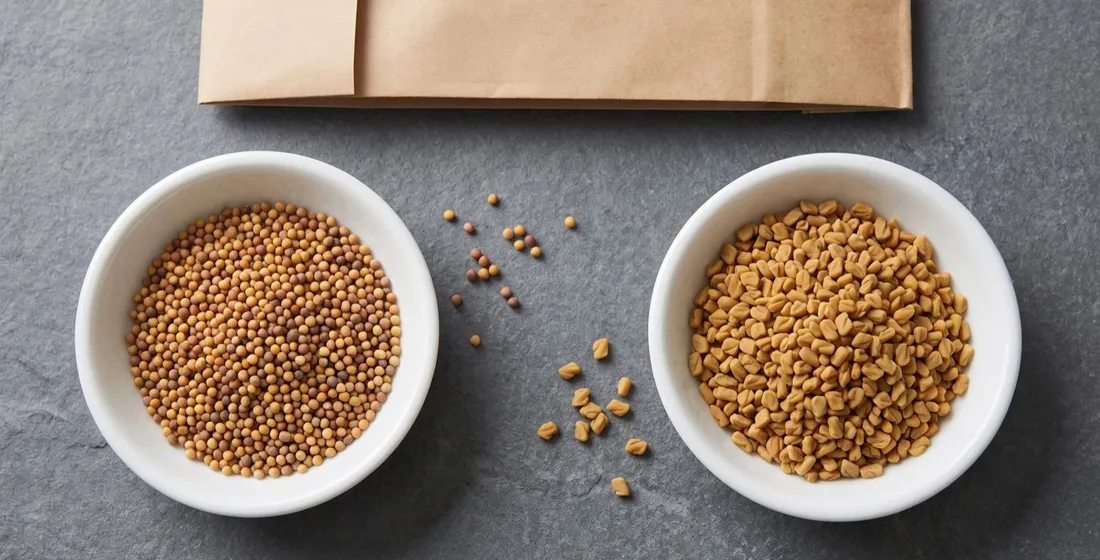
Buyer’s snapshot
- EU pesticide law files mustard seed as an oilseed (code 0401080) and fenugreek as a seed spice (code 0810080). Two different commodity groups, two different limits for the same active substance.
- Commission Regulation (EU) 2025/1212 set acetamiprid at 0,15 mg/kg on mustard seeds while the seed spice group carrying fenugreek stayed at 0,05 mg/kg. The gap runs both ways and it moves.
- Mustard is the tenth entry on the EU allergen list and must be emphasised in the ingredients list. Fenugreek is on no allergen list anywhere and disappears into the word “spice.”
- Silk Foods Ceylon processes both seeds on one spice line at 100 to 200 kg per hour under BRCGS and FSSC 22000 V6, with a 50 kg first-order MOQ per SKU and a COA on every batch.
- Written for procurement teams specifying a blended condiment SKU for US or EU retail. The RFQ block at the close is the procurement-actionable part.
A buyer writing a spec for a mustard-and-fenugreek condiment blend usually writes one specification and applies it to both seeds. One pesticide panel, one aflatoxin figure, one allergen line. It reads like good discipline. Under EU law it is two mistakes in opposite directions, because the two seeds are not in the same regulatory class and never have been. Mustard seed is an oilseed. Fenugreek is a spice. Almost every downstream number follows from that split, and the split is invisible on a purchase order. It is the companion to the Silk Route Ventures (SRV) piece on coriander, cumin and fennel blend formulation and MRL discipline, which handles three spices inside one group. This one handles two commodities that sit in different groups.
Why do mustard seed and fenugreek carry different pesticide limits?
Because Regulation (EC) No 396/2005 sets limits against commodity codes, not against ingredients. Annex I, as replaced by Commission Regulation (EU) No 752/2014, lists “0401080 | Mustard seeds | Brassica juncea; Brassica nigra; Sinapis alba” inside group 0401000 Oilseeds, and “0810080 | Fenugreek | Trigonella foenum-graecum” inside group 0810000 Seed spices. Two seeds, two groups, two separate sets of numbers.
The consequence is easiest to see on one active substance. In 2025 the Commission twice reopened acetamiprid, a neonicotinoid used widely across seed crops. Commission Regulation (EU) 2025/158, adopted on 29 January 2025, listed mustard seeds at 0,01 mg/kg, the limit of analytical determination. Five months later Commission Regulation (EU) 2025/1212, adopted on 24 June 2025 after the European Food Safety Authority found the requested change acceptable, raised mustard seeds to 0,15 mg/kg. Across both instruments the seed spice group sat at 0,05 mg/kg, and fenugreek carries no individual figure of its own, so it takes the group value.
So within one calendar year the legal ceiling on the mustard side of a condiment formula moved fifteenfold while the fenugreek side did not move at all. A procurement team holding a single “spices” panel for the blend was reading the wrong number for mustard in January, and reading a different wrong number for mustard in August. Neither error shows up until a border sample does.
There is a second mechanism underneath this, and it matters more than the headline figures. Article 18(1)(b) of Regulation 396/2005 provides that products carry a default limit of “0,01 mg/kg for those products for which no specific MRL is set out in Annexes II or III.” Mustard seed sits in a heavily traded oilseed group with a real residue-trial dataset behind it, so a large number of actives have a specific figure set. Fenugreek has far fewer. Every active without a fenugreek figure defaults to 0,01 mg/kg. The fenugreek side of the formula therefore fails on a wider surface of substances at a tighter number, even though its headline acetamiprid limit is the more generous of the two.
Spec snapshot: where the two seeds sit in EU law
- Mustard seed: Annex I code 0401080, group 0401000 Oilseeds (Brassica juncea, Brassica nigra, Sinapis alba)
- Fenugreek: Annex I code 0810080, group 0810000 Seed spices (Trigonella foenum-graecum)
- Acetamiprid, per Regulation (EU) 2025/1212: mustard seeds 0,15 mg/kg, seed spices 0,05 mg/kg
- Default where no figure is set: 0,01 mg/kg, per Article 18(1)(b) of Regulation 396/2005
- Aflatoxin B1: mustard seed covered as an oilseed, fenugreek not named in EU law at all
The word “mustard” spans three commodity codes
This is where a testing brief usually goes wrong. “Mustard” is not one entry in Annex I. It is at least three, and they carry different numbers on the same active substance. Reading from the acetamiprid annex to Commission Regulation (EU) 2025/1212:
| Annex I code | Commodity | Annex I group | Acetamiprid MRL |
|---|---|---|---|
| 0251070 | Red mustards | Leaf vegetables, herbs and edible flowers | 0,9 mg/kg |
| 0401080 | Mustard seeds | Oilseeds | 0,15 mg/kg |
| 0810080 | Fenugreek | Seed spices | 0,05 mg/kg (group value) |
An eighteenfold spread, on one substance, across products a formulation sheet might describe in adjacent lines. The mustard greens figure is not a curiosity either: leaf material and seed material from the same botanical family are routinely conflated in supplier documentation, and a lab asked to report “mustard” without a code will pick one.
Give the laboratory the Annex I code, not the ingredient name. That single change to the test request removes most of the ambiguity, and it costs nothing. The same discipline applies to every line of a blend spec, which is the argument SRV makes at more length in how to write a spice RFQ.
For the finished blend, Article 20(1) of Regulation 396/2005 is explicit that there is no separate blend limit to hide behind. Where no MRL is set for a processed or composite food, the limits that apply “shall be those provided in Article 18(1) for the relevant product covered by Annex I, taking into account changes in the levels of pesticide residues caused by processing and/or mixing.” The blend inherits from each component commodity. It does not average them.
Aflatoxin: one seed has a harmonised EU limit, the other does not
Pesticides are the visible half of the divergence. Mycotoxins are the half that catches people out, because the asymmetry here is not a different number. It is the absence of a number.
Regulation (EU) 2023/915, in its text consolidated to 1 January 2025, sets aflatoxin B1 at 2,0 micrograms per kilogram and the sum of B1, B2, G1 and G2 at 4,0 micrograms per kilogram for groundnuts and other oilseeds placed on the market for the final consumer or used as the only ingredient in a food. Mustard seed is an oilseed, so that is the figure it answers to. Seed intended to be sorted or physically treated before it reaches that stage carries 8,0 and 15,0 instead.
Fenugreek has nothing. Entry 1.1.14 of the same regulation sets 5,0 and 10,0 micrograms per kilogram for a closed list of dried spices: Capsicum spp., pepper of the Piper genus, nutmeg, turmeric, and mixtures of dried spices containing one or more of those. Fenugreek is not on that list. It does not appear anywhere in Regulation (EU) 2023/915. Where EU law is silent, national legislation fills the gap, which means a German customer and a Spanish customer can hold the identical fenugreek lot to different aflatoxin figures and both be correct.
Two practical consequences follow. First, a buyer who writes the blend spec at the dried-spice level of 5,0 and 10,0 and cascades it down to raw material has under-specified the mustard by a factor of two and a half. Second, a fenugreek aflatoxin figure has to be negotiated into the contract, because no instrument supplies one by default. Put a number in the specification and name the destination market it was chosen for.
One more mustard-only limit belongs in the file. Entry 2.1.3 of the same regulation sets a maximum of 35,0 grams per kilogram of erucic acid in mustard as a condiment, and 50,0 grams per kilogram in mustard oil. That ceiling attaches to the finished condiment rather than to the seed, and fenugreek has no counterpart to it.
Is mustard a declarable allergen, and is fenugreek?
In the European Union, mustard is the tenth entry in Annex II to Regulation (EU) No 1169/2011: “Mustard and products thereof.” Article 9(1)(c) makes any Annex II ingredient still present in the finished product a mandatory particular, and Article 21 requires that the name “shall be emphasised through a typeset that clearly distinguishes it from the rest of the list of ingredients, for example by means of the font, style or background colour.” Bold type on the label is a legal requirement, not a house style.
In the United States it is not. The nine major food allergens under US law are “milk, eggs, fish, Crustacean shellfish, tree nuts, peanuts, wheat, soybeans, and sesame.” Mustard is not among them. The same condiment SKU therefore carries a bolded mustard declaration for a Rotterdam listing and no mandatory declaration at all for a US one, from the same production run and the same bill of materials.
Fenugreek is on neither list, and that is the part worth pausing on. It is a legume, and it cross-reacts with peanut. Writing in the Journal of Allergy and Clinical Immunology: Global in 2024, Takei and colleagues cite work on sensitisation among children with peanut allergy in which “61 of 92 children (66%) were sensitized to fenugreek,” and note that “fenugreek is hidden in processed food, often included on food labels in the generic term spice.”
So the two seeds in one condiment jar invert each other. The one carrying a mandatory bolded declaration in the EU has no declaration duty in the US. The one with no declaration duty anywhere is the one with documented peanut cross-reactivity, sitting inside a compound ingredient a consumer reads as “spices.” Nothing in the regulation requires you to break it out. Whether the brand does is a decision about its own customers, and it should be taken deliberately rather than by default. The same compound-ingredient question runs through private label spice blend formulation and labelling.
Can a blend dilute its way out of an ethylene oxide finding?
Not reliably, and the reason is worth understanding before the next shipment rather than after it. Ethylene oxide is measured in the EU as a residue defined as the sum of ethylene oxide and 2-chloroethanol expressed as ethylene oxide, which means a fumigation event that happened at origin is still detectable in a metabolite long after the fumigant itself has gone.
At the technical meeting on ethylene oxide convened by the Commission’s Directorate-General for Health and Food Safety on 20 January 2022, the European Food Safety Authority gave its provisional conclusion that “genotoxicity and carcinogenicity of 2CE cannot be excluded and that, therefore, no safe level can be derived.” With no safe level, proportionality arguments lose their footing.
The meeting summary is also candid that enforcement is not uniform. For composite and processed products, it records that “many of the reporting countries confirmed applying the EU approach, thus withdrawing from the market/recalling from consumers such products in case they contain a contaminated ingredient, regardless of their ETO content,” while other countries reported using a risk assessment approach or a calculated composite limit based on the proportion of the ingredients. Read that twice if the SKU is a blend. In a majority of Member States a 3% fenugreek inclusion at fault contaminates the jar regardless of what the jar itself assays at. In others it does not. The same pallet can be recalled in one market and cleared in another.
The scale of that incident is the reason procurement teams still ask about it. In a 2026 review in Comprehensive Reviews in Food Science and Food Safety, Choi, Ahn and Park count 468 RASFF notifications related to ethylene oxide in 2021 and 186 concerning ethylene oxide and 2-chloroethanol in 2022. Seed spices were prominent throughout.
Pesticides remain the dominant failure mode in the category generally. CBI, part of the Netherlands Enterprise Agency, reported in its buyer requirements guidance updated on 12 May 2026 that 279 RASFF issues were recorded for herbs and spices in 2025, that pesticide residues accounted for 35% of violations, and that chlorpyrifos was the single most common active substance involved. Chlorpyrifos has had no lawful use in the EU since Commission Regulation (EU) 2020/1085 cut it to 0,01 mg/kg across all food and feed with effect from 13 November 2020, which tells you the detections are legacy soil and storage residues in producing regions, not current application.
Where the seed in a Ceylon-blended condiment actually comes from
Here is the part most supplier blogs skip. Neither mustard seed nor fenugreek is a Sri Lankan crop of any scale. Mustard’s export volume sits with a handful of large field-crop origins. Agriculture and Agri-Food Canada, in its Outlook for Principal Field Crops dated 18 March 2026, records Canadian mustard seed production falling from 192 thousand tonnes in 2024 to 2025 to a forecast 140 thousand tonnes in 2025 to 2026, recovering to a forecast 152 thousand tonnes in 2026 to 2027, with average prices moving from 860 to 890 to 900 Canadian dollars per tonne across the three years and exports holding near 95 thousand tonnes by drawing on carry-in stocks. Fenugreek’s trade centre of gravity is India, which is also where Sri Lanka buys the fenugreek it uses.
What follows from that is a sourcing rule, not a provenance story. MRL exposure travels with the seed’s growing origin, not with the address of the company that cleaned, ground and blended it. A Matale blending facility does not make an Indian fenugreek lot into a Ceylon one, and no certification changes where a pesticide was applied. What a certified blender does change is whether the lot was screened against the destination market’s limits before it entered the mixer.
The border regime makes the same point from the other direction. Commission Implementing Regulation (EU) 2026/194 of 28 January 2026, amending Implementing Regulation (EU) 2019/1793, places “Sauces and preparations thereof; mixed condiments and mixed seasonings; mustard flours and meals and prepared mustard” under CN code 2103 from India in Annex II, for pesticide residues, at a 20% frequency of identity and physical checks. Annex II is the stricter listing: under Article 11(1) of Regulation 2019/1793 each consignment must be accompanied by an official certificate. The finished blend carries its own border burden, separate from anything its components carry. In the same regulation Sri Lanka appears once, for gotukola at 50%. Neither mustard nor fenugreek from Sri Lanka is listed. That is a fact about the current annexes, not a guarantee about any individual lot.
Where SRV’s position does not fit
- Buyers looking for single-origin Ceylon-grown mustard seed or Ceylon-grown fenugreek. Neither is a Sri Lankan field crop at export scale, and a supplier who tells you otherwise is selling a provenance story the agronomy does not support. Buyers who want a blend price built on unscreened intake. Buyers who want one pesticide panel to cover an oilseed and a seed spice because two panels cost more than one.
What to put in the RFQ for a two-commodity condiment blend
Most of the failure modes above are specification failures rather than supplier failures. They are fixed at the inquiry stage, at no cost, by writing the brief against commodity codes instead of ingredient names.
Buyer’s checklist: specifying a mustard and fenugreek blend
- State the Annex I code for every seed in the formula, not the common name. 0401080 for mustard seed, 0810080 for fenugreek, 0251070 if any mustard leaf material is involved.
- Require two pesticide panels, scoped separately to the oilseed group and the seed spice group, not one panel labelled “spices.”
- Name the destination market on the test request. The limits are jurisdictional, and a lot that clears for the US may not clear for the EU.
- Set a fenugreek aflatoxin figure in the contract, since EU law does not supply one. State which national limit it was chosen against.
- Specify the mustard seed aflatoxin figure against its oilseed status, at 2,0 and 4,0 micrograms per kilogram, not against the dried-spice figure.
- Ask for ethylene oxide results on the fenugreek lot specifically, and ask what the supplier’s position is on composite-product withdrawal.
- Confirm the finished-blend erucic acid position if the SKU is sold as prepared mustard.
- Settle the allergen declaration for both markets at artwork stage, including whether fenugreek will be broken out of “spices” voluntarily.
- Require a COA per batch with the parameters above named individually, not a generic conformity statement.
- Ask where each seed was grown, in writing, and keep that answer with the lot.
Silk Route Ventures supplies both seeds as bulk raw material and processes them through the Silk Foods Ceylon (SFC) facility at Hapugasyaya, Nalanda, in Matale, on a spice line running 100 to 200 kg per hour. Intake screening is scoped to the destination market rather than to a house default, and every batch carries a COA. The wider compliance picture for US and EU shipments is set out in the 2026 Ceylon export compliance checklist, and the way MRL and novel food rules interact for EU-bound botanicals is covered in EU botanical ingredient sourcing. For the fenugreek side specifically, the saponin and format questions are handled separately in fenugreek seed and powder: saponin spec and RFQ checklist. Blend-level ceiling arithmetic for curry formats is in curry powder formulation for private label retail, and the category overview sits in the B2B buyer’s guide to Ceylon spices in 2026.
Frequently asked questions
Is mustard seed legally a spice or an oilseed in the EU?
An oilseed. Annex I to Regulation (EC) No 396/2005, as replaced by Regulation (EU) No 752/2014, lists mustard seeds at code 0401080 within group 0401000 Oilseeds. Fenugreek sits separately at 0810080 within group 0810000 Seed spices. Pesticide and mycotoxin limits follow the code, so the two seeds answer to different numbers.
Does fenugreek have to be declared as an allergen?
No. Fenugreek is not listed in Annex II to Regulation (EU) No 1169/2011, nor among the nine US major food allergens. It is a legume with documented peanut cross-reactivity: Takei and colleagues reported in 2024 that 61 of 92 children with peanut allergy, or 66%, were sensitised to fenugreek. Voluntary declaration is a brand decision.
What aflatoxin limit applies to fenugreek in the EU?
None is harmonised. Regulation (EU) 2023/915 names Capsicum spp., Piper spp., nutmeg and turmeric at 5,0 and 10,0 micrograms per kilogram, and fenugreek appears nowhere in the regulation. National limits apply instead, so the figure has to be agreed in the contract and matched to the destination market.
Does Silk Route Ventures supply mustard seed and fenugreek under organic certification?
Yes, as bulk raw material in whole and powder form. The SFC spice line runs at 100 to 200 kg per hour under BRCGS and FSSC 22000 V6, with USDA Organic and EU Organic available per SKU. First-order MOQ is 50 kg per SKU, with volume breaks at 500 kg, 1,000 kg and 2,500 kg.
How long does a first order take from PO to dispatch?
Two to three weeks for production, with samples shipped door to door by international courier in 3 to 5 business days. Sea freight runs 3 to 4 weeks to the EU and 4 to 5 weeks to the US. Every batch ships with a COA and the standard export documentation pack.
How Silk Route Ventures can help
Silk Route Ventures supplies bulk mustard seed and fenugreek, whole and ground, to specialty spice brands and condiment formulators across the US, EU and Australia, shipped against the buyer’s spec from the BRCGS and FSSC 22000 V6 audited Silk Foods Ceylon facility in Matale. Intake screening is scoped to the destination market’s commodity codes rather than a single house panel, with a COA on every batch and USDA Organic and EU Organic available per SKU. First-order MOQ is 50 kg per SKU and samples ship door to door by international courier in 3 to 5 business days. For brands moving from component supply to a finished private-label condiment, SRV runs blending and private label manufacturing from the same site. Contact us to send an inquiry or request a sample pack.
Sources
European Commission, Regulation (EC) No 396/2005 on maximum residue levels of pesticides in or on food and feed of plant and animal origin, Articles 18(1) and 20(1), retrieved 2026-09-20, https://eur-lex.europa.eu/eli/reg/2005/396/oj/eng
European Commission, Commission Regulation (EU) No 752/2014 replacing Annex I to Regulation (EC) No 396/2005, retrieved 2026-09-20, https://eur-lex.europa.eu/legal-content/EN/TXT/HTML/?uri=CELEX:32014R0752
European Commission, Commission Regulation (EU) 2025/1212 of 24 June 2025 amending Annex II to Regulation (EC) No 396/2005 as regards maximum residue levels for acetamiprid, retrieved 2026-09-20, https://eur-lex.europa.eu/legal-content/EN/TXT/?uri=OJ%3AL_202501212
European Commission, Commission Regulation (EU) 2025/158 of 29 January 2025 amending Annex II to Regulation (EC) No 396/2005 as regards maximum residue levels for acetamiprid, retrieved 2026-09-20, https://eur-lex.europa.eu/eli/reg/2025/158/oj/eng
European Commission, Commission Regulation (EU) 2023/915 on maximum levels for certain contaminants in food, consolidated text of 1 January 2025, retrieved 2026-09-20, https://eur-lex.europa.eu/legal-content/EN/TXT/HTML/?uri=CELEX:02023R0915-20250101
European Commission, Regulation (EU) No 1169/2011 on the provision of food information to consumers, Annex II, Articles 9 and 21, retrieved 2026-09-20, https://eur-lex.europa.eu/legal-content/EN/TXT/HTML/?uri=CELEX:02011R1169-20180101
US Food and Drug Administration, Food Allergies, retrieved 2026-09-20, https://www.fda.gov/food/nutrition-food-labeling-and-critical-foods/food-allergies
European Commission, Commission Implementing Regulation (EU) 2026/194 of 28 January 2026 amending Implementing Regulation (EU) 2019/1793, retrieved 2026-09-20, https://eur-lex.europa.eu/legal-content/EN/TXT/PDF/?uri=OJ:L_202600194
European Commission, Directorate-General for Health and Food Safety, Summary of the Technical Meeting on Ethylene Oxide, 20 January 2022, retrieved 2026-09-20, https://food.ec.europa.eu/system/files/2022-02/rasff_ethylene-oxide-incident_e410_crisis-coord_20220120_sum.pdf
Takei M, Homma Y, Saito A, Yanagida N, Sato S, Ebisawa M, Fenugreek allergy caused by cross-reactivity with peanut: an in vitro analysis, Journal of Allergy and Clinical Immunology: Global, 2024, retrieved 2026-09-20, https://pmc.ncbi.nlm.nih.gov/articles/PMC11260561/
Choi S, Ahn J, Park S, Ethylene oxide and 2-chloroethanol in foods: hazards, detection markers, and regulatory perspectives, Comprehensive Reviews in Food Science and Food Safety, 2026, retrieved 2026-09-20, https://pmc.ncbi.nlm.nih.gov/articles/PMC13529922/
CBI, Netherlands Enterprise Agency, What requirements must herbs and spices meet to be allowed on the European market, updated 12 May 2026, retrieved 2026-09-20, https://www.cbi.eu/market-information/spices-herbs/buyer-requirements
Agriculture and Agri-Food Canada and Statistics Canada, Canada: Outlook for Principal Field Crops, 18 March 2026, retrieved 2026-09-20, https://agriculture.canada.ca/sites/default/files/documents/2026-03/Canada%20Outlook%20for%20Principal%20Field%20Crops_202603.pdf
European Commission, Commission Regulation (EU) 2020/1085 as regards maximum residue levels for chlorpyrifos and chlorpyrifos-methyl, retrieved 2026-09-20, https://eur-lex.europa.eu/eli/reg/2020/1085/oj
Further reading
Coriander, cumin and fennel: blend formulation and MRL discipline for export curry blends
How to write a spice RFQ: specs, certifications and MOQ questions