
Coconut Milk and Cream Co-Packing: Fill Formats and Day Rates
Buyer’s snapshot
- Europe produces no coconuts and imports the entire category. Export data from the four largest Asian suppliers, Sri Lanka among them, puts the flow at over 80,000 tonnes of liquid coconut milk and over 20,000 tonnes of coconut milk powder a year, growing around 5 percent annually (CBI, Netherlands Ministry of Foreign Affairs, 2025).
- Codex sets the minimum pH for coconut milk and coconut cream at 5.9, well above the 4.6 low-acid threshold. A validated thermal process in a hermetically sealed container is therefore a legal precondition, not a quality option.
- On a retorted product the day rate is set by the sterilisation schedule, not by filler speed. Output is complete retort cycles per shift multiplied by containers per load.
- Silk Foods Ceylon in Matale runs a semi-liquid line at 3,000 jars per day and a beverage line at 2,500 bottles per day, per SKU on a single shift, from 1,500 jars or 1,250 bottles. Every batch carries a certificate of analysis, under BRCGS and FSSC 22000 V6.
- The format table and the changeover section below are the two parts worth reading before a launch date is committed. A retail SKU and a food-service SKU are not one production slot.
Most coconut co-packing briefs open with the wrong question. They ask what the filler can do. On a retorted low-acid product the filler is almost never the constraint. The retort is, and a retort works in discrete cycles with a fixed load, so the honest day rate is arithmetic on cycles and containers rather than a bottles-per-minute figure lifted from an equipment sheet.
That distinction decides launch timing, first-run pricing, and whether a food-service SKU can share a week with a retail SKU. Fat-format selection and the dilution arithmetic behind it are covered in the coconut milk fat formats guide, and the 22 against 24 percent cream decision in the glass-jar SKU economics piece. This piece is about the production side: which formats a run supports, how the schedule sets throughput, what a changeover costs, and how the traceability chain is assembled from intake to pallet.
Which coconut pack formats does a co-packing run actually cover?
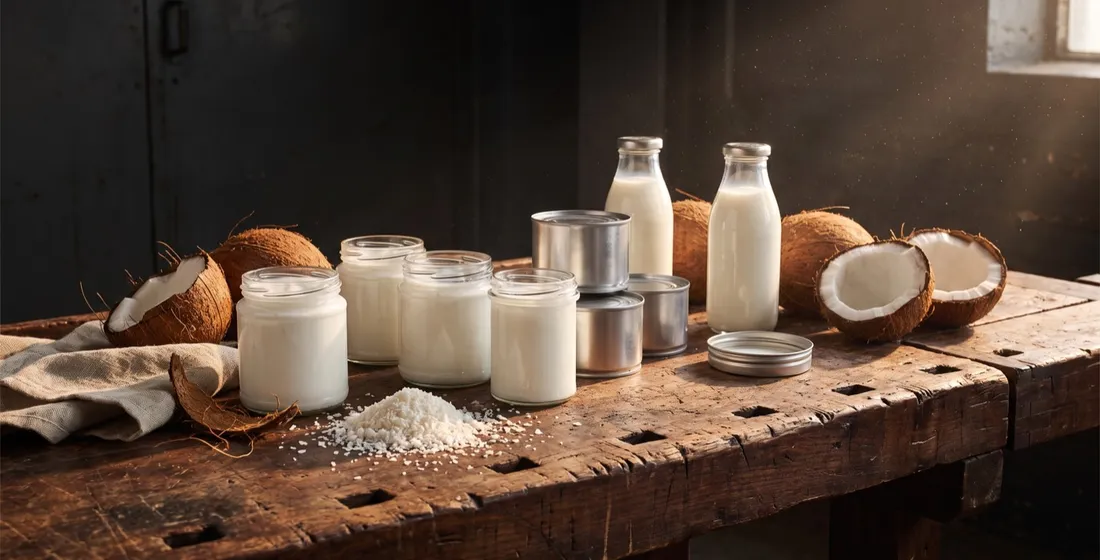
Coconut milk and coconut cream co-packing at Silk Foods Ceylon covers glass jars from 50 ml to 1 litre, a 420 ml square jar, 400 ml round tin cans, and 200 ml glass bottles on the beverage line. Retail and food-service packs both draw on the semi-liquid line at 3,000 jars per day. Bulk coconut ships in metric-tonne lots rather than as unit packs.
The format list matters less than which line a format lands on, because the two lines carry different day rates, different minimums, and different changeover behaviour.
| Pack format | Typical use | Line | Rated day rate | First-run minimum |
|---|---|---|---|---|
| 220 to 330 ml glass jar | Retail cream, single-recipe pack | Semi-liquid | 3,000 jars | 1,500 jars |
| 420 ml square jar | Retail cream, shelf-efficiency pack | Semi-liquid | 3,000 jars | 1,500 jars |
| 500 ml to 1 L glass jar | Food-service cream and milk | Semi-liquid | 3,000 jars | 1,500 jars |
| 400 ml round tin can | Retail milk and cream, export standard | Semi-liquid | 3,000 units | 1,500 units |
| 200 ml glass bottle | Single-serve coconut beverage | Beverage | 2,500 bottles | 1,250 bottles |
| Bulk coconut, per SKU | Ingredient supply, further processing | Bulk | Lot-based | 1 metric tonne |
Two practical notes sit behind that table. The rated day rate is per SKU on a single shift, not a combined figure across concurrent SKUs. And the 1 litre food-service jar carries roughly the same rated jar count as a 220 ml retail jar, so the litres moved multiply while the unit count stays flat. Buyers costing a food-service programme off a retail unit rate read that backwards more often than any other number in the brief.
There is also a fill rule that constrains format choice before any commercial consideration does. The Codex standard for aqueous coconut products asks that a hermetically sealed container be well filled, occupying not less than 90 percent of the water capacity of the container by volume, with flexible containers filled as full as commercially practicable (Codex Alimentarius, CXS 240-2003). A container chosen for shelf presence rather than for fill volume will fail that test, and the fix is a different container rather than a different fill setting.
Spec snapshot: coconut co-packing formats Cream fat formats: 22 percent, 24 percent Milk fat formats: 7, 11, 17, 18 percent Glass: 50, 220, 330, 420 (square), 500 ml, 1 L Tin: 400 ml round Beverage glass: 200 ml single-serve Semi-liquid line: 3,000 jars per day, per SKU, single shift Beverage line: 2,500 bottles per day, per SKU, single shift Bulk coconut minimum: 1 metric tonne per SKU Codex minimum fill: 90 percent of container water capacity by volume
Why the retort schedule, not the filler, sets the day rate
Codex classifies a low-acid food as one with a pH above 4.6 and a water activity above 0.85, and sets the minimum pH for coconut milk and coconut cream at 5.9. The category therefore sits inside the low-acid canned food regime by definition, and in the US that triggers 21 CFR Part 113, which requires a scheduled process established by persons with expert knowledge of thermal processing and delivered to every container in the load. The retort processes a fixed load per cycle, so daily output is cycles per shift multiplied by containers per load.
The arithmetic is worth writing out, because it is the part a capability sheet usually hides. Take a rated 3,000 jars per day. That is not a filler throughput. It is the product of how many complete retort cycles fit inside a shift and how many jars each cycle holds. A cycle covers far more than the hold at temperature. Codex defines coming-up time as the interval, venting time included, between the heating medium entering the closed retort and the retort reaching sterilisation temperature, and sterilisation time as the interval between reaching that temperature and the start of cooling (Codex Alimentarius, CXC 23-1979). Cooling under counter-pressure then follows, and only after that comes unload and reload. On glass the cooling leg is often the longest single element, because glass tolerates thermal shock poorly and the ramp has to be gentle.
Three consequences follow, and each one shows up in a real production plan.
- A larger container does not scale linearly. A 1 litre jar takes longer to reach schedule temperature at its cold spot than a 220 ml jar, which lengthens come-up and hold. Fewer, longer cycles per shift means the unit day rate falls even as the litre output rises.
- Container material changes the cycle. Metal transfers heat faster than glass and tolerates a steeper cooling ramp, so a 400 ml can generally clears a cycle sooner than an equivalent glass jar. Format choice moves the day rate, so it belongs in the production conversation as much as the shelf conversation.
- Partial loads are expensive. A cycle costs the same whether the baskets are full or half full. A first run sized at 800 jars does not cost proportionally less than one sized at 1,500, which is a large part of why the minimum sits where it does.
None of this is exotic. It is the reason a co-packer quoting a coconut cream SKU asks for the container and the fill weight before quoting a date, and why anyone who quotes a date without asking is worth checking twice.
What does a format changeover cost in units?
A format changeover on a coconut line consumes production time in four blocks: cleaning between fat formats, filler and capper change parts, first-article checks against the fill weight and seal specification, and requalification of the retort load pattern when the container changes. A same-container fat change is inexpensive. A container change is not.
The regulation is explicit about why. Under 21 CFR 113.83 the scheduled process must specify the critical factors that affect it, and the examples given are minimum headspace, consistency, maximum fill-in or drained weight, and water activity. Those are container and fill attributes. Change them and the process that was validated no longer describes what is in the retort.
The cheapest change is a fat change inside the same container, for example moving from 17 percent milk to 18 percent milk in the same 330 ml jar. Cleaning is straightforward, the change parts stay on, and the schedule holds because the container and fill weight are unchanged.
The most expensive change is a container change. Moving from a 330 ml jar to a 1 litre jar is not a set-up adjustment. It is a different scheduled process with its own load pattern and its own first-article confirmation before commercial product runs.
The most common correction the SRV team makes in a co-packing briefing sits on exactly this point. A brand arrives with a retail SKU and a food-service SKU in the same launch window, priced as though the second is a variation on the first. It is a second scheduled process on a second container, and putting both into one week either adds a changeover block or splits the week. Brands that hear this at briefing stage move one SKU by a fortnight and keep their launch date. Brands that hear it after the purchase order is placed usually lose more than a fortnight.
For how minimum-order economics behave when a co-packer is genuinely flexible, the low-MOQ contract manufacturing piece sets out where the trade sits.
The traceability chain from intake to pallet
Every coconut batch carries a certificate of analysis, and traceability runs up to farm level. For EU-bound consignments the operative requirement is Article 18 of Regulation (EC) No 178/2002: an operator must be able to identify any person from whom it has been supplied, must hold systems identifying the businesses its product went to, and must make that available to the competent authority on demand. One step back, one step forward, at every stage.
A less obvious requirement runs alongside it. Under 21 CFR 113.83 a scheduled process has to account for seasonal and growing fluctuations, variety differences, and supplier processes. In practical terms, a change in where the kernel comes from is a thermal-process question as much as a commercial one, because it asks whether the validated process still holds. This is why intake identity has to survive all the way to the retort record rather than stopping at goods-in.
The chain assembles in six recorded links, and each one exists because a specific document depends on it downstream.
- Raw intake. Kernel lots are received against a supplier identity and an intake reference. This is the link that makes an organic claim provable, because an organic certificate has to trace back to a certified input, not to a certified factory.
- Preparation and extraction. Intake references carry into the extraction batch. This is where a fat-format decision becomes a batch attribute rather than an order attribute.
- Standardisation. Fat is standardised to the specified format, 22 or 24 percent for cream and 7, 11, 17 or 18 percent for milk, and the target is recorded against the batch.
- Fill and seal. The batch is filled to the specified fill weight and sealed. Fill-in weight and closure records attach here, and they are among the critical factors the scheduled process assumes are being held.
- Thermal process. Retort records attach to the specific load. Codex asks that each record carry the product name and style, the code lot number, the retort and recorder chart identification, container size and type, the approximate container count in the lot interval, the minimum initial temperature, and the scheduled against actual time and temperature.
- Palletisation and dispatch. Batch codes consolidate to pallet, and the document pack is assembled against the consignment.
Two record-keeping points sit behind that list and are worth quoting in an audit conversation. Codex asks that processing records be reviewed by competent plant management before shipment, and no later than one working day after the process, and that they be retained for not less than three years (Codex Alimentarius, CXC 23-1979). US low-acid records under 21 CFR 113.100 run to the same three-year horizon, one year at the plant and two more at a reasonably accessible location. A co-packer that cannot produce a three-year-old retort chart on request is not running the system it says it is.
For organic SKUs the EU adds a second layer. Regulation (EU) 2021/2119, applying from January 2023, requires documentation supporting both a traceability check and a mass balance check, plus documented measures against commingling with non-organic product, with certificates issued electronically through the TRACES system. On a shared coconut line the mass balance check is the one that bites, because it asks whether the organic output could have come from the organic input at all.
Australian-bound consignments follow a parallel logic under a different instrument. Food Standards Australia New Zealand sets its traceability expectations through Standard 1.2.2 on food identification and Standard 3.2.2 on food safety practices, and asks businesses to hold supplier and customer contact details with what each supplies, transaction and delivery dates, and batch or lot identifiers. One labelling consequence catches exporters out: the supplier name and address on pack has to be an Australian or New Zealand business address, which means the importer, not the Sri Lankan manufacturer.
The pack that ships with a coconut consignment is consistent across formats: commercial invoice, packing list, bill of lading or air waybill, certificate of origin, phytosanitary certificate, batch certificate of analysis, and an organic transaction certificate where the SKU is certified organic. Allergen declarations, GMO-free declarations, and shelf-life statements are issued on request rather than by default.
Certification snapshot: Silk Foods Ceylon, Matale BRCGS (coconut, retorted and packaged lines) FSSC 22000 V6 (full processing scope including retort) USDA Organic and EU Organic (per SKU) Sri Lanka EDB-registered, US FDA-registered facility Certificate of analysis on every batch Traceability to farm level
The audit-pack side of this is covered in the FSSC 22000 V6 explainer, and the reading protocol for the analysis certificate itself in the per-lot testing guide.
What EU and Australian demand actually looks like
Europe imports the whole category, and the volume is concentrated. CBI, the market intelligence programme of the Netherlands Ministry of Foreign Affairs, puts annual flows from the four largest Asian suppliers at over 80,000 tonnes of liquid coconut milk and over 20,000 tonnes of powder, with growth of roughly 5 percent a year and the UK taking about 22 percent of the European market in 2024. Between 5 and 10 percent of the canned coconut milk market is organic. Precise customs figures do not exist, because coconut milk shares tariff headings 2008.19 and 2106.90 with other tropical nut preparations.
Two demand signals sit on top of that. Private label across seventeen European markets reached 387 billion euros and a 38.8 percent value share of grocery in full-year 2025, outgrowing branded product in both value and volume (PLMA, citing NielsenIQ). And in the alternative milk category, listening data from Tastewise reported by FoodNavigator in December 2025 puts coconut at 31 percent of online plant-based milk conversation, up 4 percent year on year, and present in 65 percent of alternative milk menu listings. Those are conversation and menu-share measures rather than volume, so treat them as a direction indicator. Australia is smaller and faster: IMARC values the Australian milk alternatives market at 1,058.4 million dollars in 2025 against a forecast of 3,153.2 million by 2034.
One operational note from the CBI briefing is worth more to a co-packer than any of those numbers. European storage temperatures can fall below 22 degrees Celsius, and liquid coconut milk tends to separate into solid fat and water at that point. Separation on arrival is a homogenisation and stabiliser question that belongs in the specification before the first run, not a complaint to be handled after the first pallet lands.
Retail packs and food-service packs price differently
A retail coconut cream jar and a food-service coconut cream jar consume different amounts of the same rated day. The retail pack maximises unit count against a fixed cycle load. The food-service pack maximises litres against fewer and longer cycles. Cost per unit and cost per litre therefore move in opposite directions across the two formats, and one price list rarely serves both.
| Retail pack, 220 to 420 ml | Food-service pack, 500 ml to 1 L | |
|---|---|---|
| Primary metric | Cost per unit | Cost per litre |
| Cycle behaviour | More units per load, shorter come-up | Fewer units per load, longer come-up and cooling |
| Label burden | Full consumer labelling, market specific | Reduced, trade labelling |
| Typical buyer | Retail brand, distributor | Foodservice distributor, manufacturer |
| Switching from the other format | New scheduled process required | New scheduled process required |
A pricing conversation sits underneath this and is worth naming plainly. SRV quotes FOB Colombo. A buyer comparing that against a European or Australian distributor’s delivered price is comparing two different things, because the delivered price already carries freight, duty, and the distributor’s margin. Compared on what basis is the first question to settle. The landed-cost comparison is the honest one, and the SRV trade desk will build it on request.
What belongs in a coconut co-packing RFQ?
A coconut co-packing RFQ needs six things before a co-packer can quote a date rather than a range: product and fat format, container and fill weight, first-run and annual volume, destination market, label and certification requirement, and target launch date. Missing any one of them turns a quote into an estimate.
Buyer’s checklist: coconut co-packing RFQ
- Product and fat format (cream at 22 or 24 percent; milk at 7, 11, 17 or 18 percent)
- Container, fill weight and closure, stated exactly rather than approximately
- First-run volume and expected annual volume, per SKU
- Destination market, because labelling and certification follow the market
- Organic status per SKU, and whether an organic transaction certificate is required
- Target launch date, worked backwards through freight transit
- Whether a second format is planned inside the first twelve months
That last item is the one buyers most often leave out and most often regret leaving out. A co-packer told at briefing stage that a 1 litre food-service SKU follows the retail jar in month six will scope the second scheduled process alongside the first. A co-packer told in month five will scope it in month five.
The general verification protocol for a Sri Lankan manufacturer is set out in the supplier verification guide, and the wider coconut capability picture in the coconut sourcing and contract manufacturing overview.
Frequently asked questions
What is the contract manufacturing minimum for coconut milk and coconut cream? First-run minimums are 1,500 jars per SKU on the semi-liquid line and 1,250 bottles per SKU on the 200 ml beverage line. Bulk coconut ships from 1 metric tonne per SKU. The minimum applies per product rather than across the total order, so a three-SKU launch carries three separate floors.
What is the daily production capacity for coconut co-packing at Silk Foods Ceylon? The semi-liquid line is rated at 3,000 jars per day and the beverage line at 2,500 bottles per day, both on a single shift and per SKU. On retorted product these are schedule-limited figures, set by complete retort cycles per shift and containers per load rather than by filler speed.
Does SRV co-pack coconut milk and cream for EU and Australian brands? Yes. Silk Route Ventures co-packs and private-labels coconut milk and coconut cream for EU and Australian brands under BRCGS and FSSC 22000 V6, with EU Organic available per SKU. Sea freight runs 3 to 4 weeks to both markets, on top of 2 to 3 weeks from purchase order to dispatch.
Can a retail SKU and a food-service SKU run in the same week? Usually not without a changeover block. The two use different containers, and container attributes such as fill weight and headspace are critical factors in the scheduled process under 21 CFR 113.83. Sequencing the two across two weeks is normally cheaper than compressing them into one.
What lead time applies from purchase order to dispatch? Two to three weeks from purchase order to dispatch on an established specification, with a further two to four weeks where new formulation work is needed. Samples dispatch by international courier at 3 to 5 business days. Sea freight adds 3 to 4 weeks to the EU and Australia, or 4 to 5 weeks to the US.
How Silk Route Ventures can help
Silk Route Ventures (SRV) co-packs and contract-manufactures coconut milk and coconut cream at the Silk Foods Ceylon (SFC) facility in Matale, across retail glass, 400 ml tin, and 200 ml single-serve beverage formats. The semi-liquid line runs at 3,000 jars per day against a 1,500-jar first-run minimum, the beverage line at 2,500 bottles per day against a 1,250-bottle floor, both under BRCGS and FSSC 22000 V6, with USDA Organic and EU Organic available per SKU. The cellular manufacturing layout means a second coconut format does not restart the audit clock, and the SRV R&D and NPD team scopes the fat format and the thermal route alongside the production plan rather than after it. Contact us to send an inquiry for a co-manufacturing capability briefing tailored to your format, destination market, and launch volume.
Sources
-
Codex Alimentarius Commission (FAO/WHO), “Standard for aqueous coconut products: coconut milk and coconut cream,” CXS 240-2003 (adopted 2003, amended 2019, 2022, 2024). Retrieved 2026-09-10. https://www.fao.org/input/download/standards/10401/CXS_240e.pdf
-
Codex Alimentarius Commission (FAO/WHO), “Recommended international code of hygienic practice for low-acid and acidified low-acid canned foods,” CXC 23-1979 (revised 1989, 1993). Retrieved 2026-09-10. https://www.fao.org/input/download/standards/24/CXP_023e.pdf
-
US Food and Drug Administration, 21 CFR Part 113, “Thermally processed low-acid foods packaged in hermetically sealed containers,” including 113.3 definitions, 113.83 establishing scheduled processes, and 113.100 records. Retrieved 2026-09-10. https://www.govinfo.gov/content/pkg/CFR-2023-title21-vol2/xml/CFR-2023-title21-vol2-part113.xml
-
European Parliament and Council, Regulation (EC) No 178/2002, Article 18 (traceability). Retrieved 2026-09-10. https://eur-lex.europa.eu/eli/reg/2002/178/oj/eng
-
European Commission, Commission Implementing Regulation (EU) 2021/2119 (records, traceability and mass balance checks for organic operators; TRACES certificates), applying from 1 January 2023. Retrieved 2026-09-10. https://eur-lex.europa.eu/legal-content/EN/TXT/HTML/?uri=CELEX:32021R2119
-
Food Standards Australia New Zealand, “Food traceability” (Standards 1.2.2 and 3.2.2, and required records). Retrieved 2026-09-10. https://www.foodstandards.gov.au/business/food-safety/food-traceability
-
CBI, Netherlands Ministry of Foreign Affairs, “The European market potential for coconut milk,” last updated 12 August 2025. Retrieved 2026-09-10. https://www.cbi.eu/market-information/processed-fruit-vegetables-edible-nuts/exporting-coconut-milk-europe/market
-
PLMA International, citing NielsenIQ, “A mosaic of markets: private label strengthens its position across Europe,” full-year 2025 data. Retrieved 2026-09-10. https://www.plmainternational.com/article/mosaic-markets-private-label-strengthens-its-position-across-europe
-
Ataman, D., “Whole ingredients, protein boosts: plant-based milk trends for 2026,” FoodNavigator (William Reed), 17 December 2025, citing Tastewise data. Retrieved 2026-09-10. https://www.foodnavigator.com/Article/2025/12/17/whole-ingredients-protein-boosts-plant-based-milk-trends-for-2026/
-
IMARC Group, “Australia milk alternatives market report” (2025). Retrieved 2026-09-10. https://www.imarcgroup.com/australia-milk-alternatives-market
Further reading
- Canadian Food Inspection Agency, “Hermetically sealed containers: preventive controls guidance” (venting schedules, temperature distribution testing, record retention) -> https://inspection.canada.ca/en/preventive-controls/controls-food/hermetically-sealed-containers
- Silk Route Ventures, “Qualifying a coconut and plant-based contract manufacturer” -> https://www.esilkroute.com.lk/blog/qualifying-a-coconut-and-plant-based-contract-manufacturer
- Silk Route Ventures, “Jackfruit in brine: retort glass-jar formats for plant-meat SKUs” -> https://www.esilkroute.com.lk/blog/jackfruit-in-brine-retort-glass-jar-formats-for-plant-meat-skus
Written by the Silk Route Ventures Trade Team. Silk Route Ventures (E-Silk Route Ventures Ltd) is a Sri Lankan B2B supply-chain operator for the Food, Beverage, Wellness, and Nutraceuticals sectors. The Silk Foods Ceylon manufacturing arm holds BRCGS and FSSC 22000 V6 certifications. Questions or to request a sample: Contact us or email info@esilkroute.com.lk.