
Tamarind Paste, Seedless, and With-Seeds: Format Selection for Sauce and Chutney Formulators
Buyer’s snapshot
- Tartaric acid is the number to buy on. Tamarind pulp carries roughly 8 to 18% tartaric acid (Muzaffar and Kumar, 2017), which makes it the richest natural plant source of that acid. It sours a Worcestershire reduction or a chutney differently from a citric-acid acidulant, and that difference is the whole reason a formulator specifies tamarind by name.
- With-seeds pods, a deseeded pressed block, and paste or concentrate are one fruit at three processing stages, not three quality tiers. Concentrate is the only one defined by a published spec: India’s IS 5955:1993 sets tamarind concentrate at a minimum 65 Brix, a minimum 9% total tartaric acid, and a maximum 15% moisture.
- Format decides your line labour, not just your landed price. Whole pods need soaking, deseeding, and straining before use; a standardized concentrate drops straight into a reduction at a known acidity.
- The lead-in-tamarind reputation is a candy-and-wrapper problem, not a pulp problem. The US FDA’s own 2006 guidance concludes tamarind pulp handled properly is not a significant lead source, and a supplier that ships per-batch heavy-metal COAs closes that inherited risk.
- Silk Route Ventures supplies tamarind with-seeds, seedless, and paste from a BRCGS and FSSC 22000 V6 audited Matale facility, with a 100 kg first-order MOQ and a certificate of analysis available on request. For formulators writing a tamarind spec, this post is the sheet. For buyers who only want “tamarind, cheapest landed,” the format questions below are exactly where the cheap quote hides.
Most sauce and chutney formulators order “tamarind” and let the supplier decide what arrives. What arrives might be a carton of whole pods that ties up an hour of line labour per batch, a wet deseeded block that drifts in acidity from lot to lot, or a drum of concentrate at an unstated Brix. All three are the same fruit, Tamarindus indica, at three stages of processing, and they behave differently in a hot reduction, a cold-blended chutney, or a shelf-stable bottled sauce. This piece is the spec for buyers who want the format named on the purchase order, not left to the packer. It sits alongside the broader B2B sourcing guide to Ceylon spices, and the format discipline mirrors the one set out for Ceylon cloves and dried ginger.
What is the difference between with-seeds, seedless, and paste tamarind?
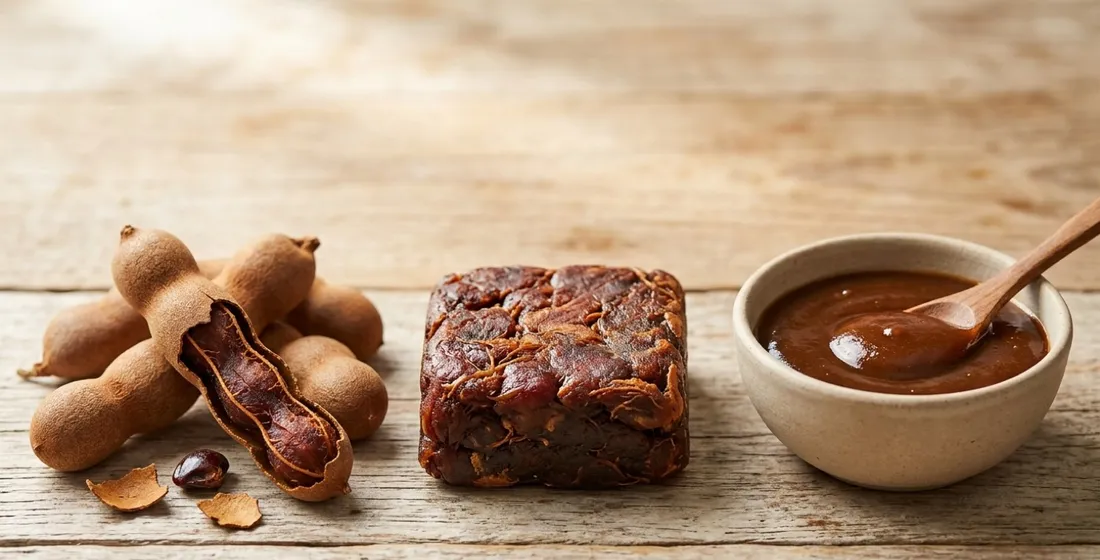
With-seeds tamarind is the whole depodded fruit sold with seeds and fibre still in the pulp. Seedless tamarind is that same pulp pressed into a deseeded block or slab, still containing fibre and around 15 to 18% moisture. Paste, or concentrate, is pulp that has been extracted, filtered, and vacuum-reduced to a standardized acidity: India’s IS 5955:1993 fixes commercial tamarind concentrate at a minimum 65 Brix and a minimum 9% total tartaric acid.
The three are separated by how much processing the supplier has done before the material reaches your line, and that processing is exactly the work you would otherwise do in-house. With-seeds material is the cheapest per kilo and the most labour-intensive at the point of use: it needs soaking in hot water, hand or mechanical deseeding, and straining before it becomes usable pulp. A deseeded block removes the seeds but keeps the fibre, so it still needs soaking and straining. Concentrate removes almost all of that, arriving as a spoonable dark paste that dilutes to a target acidity with a known, repeatable result.
| Attribute | With-seeds (whole pulp) | Seedless block (deseeded) | Paste / concentrate |
|---|---|---|---|
| Processing stage | Depodded; seeds and fibre in | Pressed; seeds removed, fibre in | Extracted, filtered, vacuum-concentrated |
| Soluble solids | Variable, unstandardized | Variable, unstandardized | Minimum 65 Brix (IS 5955) |
| Tartaric acid | 8 to 18% of pulp | 8 to 18% of pulp | Minimum 9% (IS 5955 concentrate) |
| Moisture | Roughly 15 to 20% | Roughly 15 to 18% | Maximum 15% (IS 5955) |
| Line prep before use | Soak, deseed, strain | Soak, strain fibre | Dilute to target acidity |
| Best fit | Slow-cooked, from-scratch chutney | Mid-scale kitchens cutting seed waste | Industrial sauce, standardized dosing |
Source: SRV facility data, Bureau of Indian Standards IS 5955:1993, and Muzaffar and Kumar (2017).
The table answers the first sourcing question on its own. Unlike cardamom, where grade is the price axis, tamarind format is a processing choice: you are not picking a quality grade, you are picking how much of the extraction work is priced into the ingredient versus paid for in your own labour and yield loss. A high-volume bottled-sauce line usually wants concentrate for dosing consistency. A small-batch premium chutney brand may want the deseeded block for the fibre and the from-scratch story. Different formats. Different lines. Different purchase orders.
Why tartaric acid is the number that matters
Tamarind is the richest natural plant source of tartaric acid, and roughly half of that acid occurs as potassium bitartrate rather than the free acid (ScienceDirect Topics, tamarind overview). That single fact is why formulators reach for tamarind instead of a cheaper acidulant. Tartaric acid is a stronger, sharper acid than the citric acid in most souring agents, so tamarind delivers a harder, more persistent sourness at a given dose, and it brings that sourness with body and colour rather than as a clean, flat tang.
The pulp is not only acid. Muzaffar and Kumar (2017) put reducing sugars at roughly 25 to 45% and pectin at 2 to 3.5% of the pulp. Those two numbers matter as much as the acid for a sauce formulator. The reducing sugars drive Maillard browning when tamarind is cooked into a reduction, which is part of the dark colour and rounded flavour of a Worcestershire or an HP-style brown sauce. The pectin and natural gums give tamarind its cling and body in a chutney, so it thickens without a large added-starch load.
SRV finding: In our procurement experience, the cheapest tamarind quotes almost always price on total weight, not on tartaric acid or Brix. A block at 15% acid and a block at 9% acid can look identical and land at the same price per kilo, then dose 60% differently in your recipe. Buying on acidity, not on appearance, is the single change that stabilizes a tamarind line.
This is also why a like-for-like swap between formats fails without a recipe adjustment. Move from a 9% concentrate to a raw block at 14% acid and the finished sauce over-sours unless you re-dose. Specify the tartaric acid figure on the purchase order, ask for it on the batch COA, and the format conversion becomes arithmetic instead of guesswork.
Reading a tamarind concentrate spec sheet
A tamarind concentrate spec is short, and IS 5955:1993 is the most authoritative published version of it. The standard sets a minimum 65 Brix total soluble solids, a minimum 9% total tartaric acid, a minimum 35% total reducing sugar, a maximum 15% moisture, a maximum 2% insoluble pulp, and a maximum 0.50% acid-insoluble ash. Commercial concentrate is typically vacuum-reduced to around 65 to 68 Brix, at which point the pH sits near 2.1 to 3.0.
Spec snapshot: tamarind concentrate (IS 5955:1993 aligned) Total soluble solids: minimum 65 Brix Total tartaric acid: minimum 9% Total reducing sugar: minimum 35% Moisture: maximum 15% Insoluble pulp: maximum 2% Acid-insoluble ash: maximum 0.50% pH: typically 2.1 to 3.0
Two terms cause most of the confusion at the RFQ stage. “Single strength” concentrate is the standard IS 5955 grade above. “Double” and “triple” concentrate are reduced further, so a smaller dose delivers the same acidity and the freight per unit of sourness drops, which matters for a formulator shipping across an ocean. Confirm the strength in writing, because “tamarind paste” on a broker’s offer can mean any of them. The acid-insoluble ash line is the quiet quality tell: a high figure signals grit and soil carried through from poor washing, and it is the parameter a careful buyer checks before the Brix. For the wider discipline of turning these numbers into a purchase order, the same logic that governs writing a Cinnamomum verum sourcing RFQ applies directly to tamarind.
How do you match tamarind format to a sauce or chutney line?
Format follows the process, not the other way around. For a high-throughput bottled sauce, a Worcestershire-style reduction, or a pad-thai or brown-sauce base, concentrate is the honest input: it doses to a known acidity, it needs no seed removal or straining, and it holds a repeatable Brix batch to batch. For a premium, small-batch chutney that leans on a slow-cooked, from-scratch character, a deseeded block earns its place because the fibre and the less-processed pulp carry a fuller texture, and the label reads closer to whole fruit.
With-seeds pods sit at the traditional end. They are the cheapest raw material and the right choice for a producer who already runs a soaking and deseeding step, or who wants maximum control over extraction. They are the wrong choice for a lean line that cannot absorb an hour of prep labour per batch.
The pattern the SRV procurement desk sees most often is a mid-scale sauce brand that started on with-seeds pods in a founder kitchen and never revisited the format after moving to contract volume. The pods that made sense at 200 jars a month quietly cost a shift of deseeding labour at 20,000 jars. The fix is rarely a new supplier. It is moving up the format ladder to a standardized concentrate and re-dosing the recipe to the same tartaric-acid target.
For brands that would rather buy the finished condiment than the raw acid, tamarind chutneys and sauces can be co-manufactured to a private recipe. Silk Route Ventures runs finished spreads, sauces, and semi-liquids on a glass-jar line at 3,000 jars per day from the same Matale site, which suits a distributor or brand owner consolidating a tamarind chutney SKU alongside a broader private-label spice programme. The tamarind format decision above applies whether the buyer is specifying bulk raw material or a finished retail jar.
Is the lead-in-tamarind problem real, and how do you specify around it?
The lead concern attached to tamarind is real in its origin but widely mislocated. The documented cases came from candy, not from culinary pulp. A CDC investigation published in 2002 traced childhood lead poisoning in California to imported tamarind candy, with blood lead levels reaching 88 micrograms per decilitre in one four-year-old, more than half of the tested tamarind suckers exceeding the FDA level of concern, and printed candy wrappers testing as high as 21,000 ppm lead. The lead was in the processing and the packaging, not inherent to the fruit.
The FDA’s 2006 guidance on lead in candy makes the distinction explicit. It recommends a maximum of 0.1 ppm lead in candy, and it states that tamarind pulp itself is not a significant source of lead when handled appropriately; the contamination pathways it identifies are grinding equipment and printed wrappers. Separately, FDA Import Alert 21-07 covers detention of tamarind products for filth, which is a sanitation and foreign-matter issue, not a heavy-metals one. For a buyer, the two together define exactly what to verify.
Buyer’s checklist: de-risking a tamarind purchase
- Per-batch COA with a heavy-metals panel (lead, cadmium, arsenic, mercury) aligned to your destination market
- Tartaric acid percentage and Brix stated on the COA, not just “tamarind concentrate”
- Acid-insoluble ash figure, as a proxy for washing and grit control
- Microbial panel (total plate count, yeast and mould, Salmonella, E. coli), given the pulp’s high sugar content
- Pesticide residue panel matched to the target market MRL list
- Foreign-matter and filth control documentation, given Import Alert 21-07 history
- A sample dispatched against the written spec before any purchase order
Specified this way, the inherited reputation stops being a risk and becomes a filter: it separates suppliers who can produce the documents from those who cannot. A tamarind lot shipped from a BRCGS and FSSC 22000 V6 audited facility, with a COA on request, heavy metals tested through an external laboratory on request, and lots traceable from raw material intake to shipment, addresses the buyer’s concern at the point where it actually lives, in the processing and the paperwork.
Demand for the ingredient is not shrinking, which is why the spec discipline is worth building now. IFT’s Food Technology Outlook 2026 flavour report, published in September 2025, named tamarind among the ingredients riding the “swicy” sweet-heat trend in hot sauces and condiments, alongside yuzu, miso, and black garlic. A souring agent that used to be a regional-cuisine input is moving into mainstream Western condiment development, and the brands specifying it well will be the ones who wrote the acidity and heavy-metals lines into the contract early.
Frequently asked questions
Is tamarind paste the same as tamarind concentrate?
In most trade usage, yes, “tamarind paste” and “tamarind concentrate” refer to the same extracted, reduced product, but the term is loose. A broker’s “paste” can be single, double, or triple strength. India’s IS 5955:1993 defines single-strength concentrate at a minimum 65 Brix and a minimum 9% total tartaric acid. Confirm the strength and the acidity in writing rather than relying on the word “paste.”
What Brix and acidity should tamarind concentrate meet?
For single-strength concentrate, IS 5955:1993 sets a minimum of 65 Brix total soluble solids and a minimum of 9% total tartaric acid, with moisture capped at 15% and acid-insoluble ash capped at 0.50%. Double and triple concentrates run higher on both Brix and acid. Always request these figures on the batch certificate of analysis so recipe dosing stays repeatable.
Does tamarind pulp contain lead?
The FDA’s 2006 guidance on lead in candy states that properly handled tamarind pulp is not a significant lead source. The documented lead cases, including a CDC report from 2002, came from candy processing equipment and printed wrappers, not the fruit itself. A per-batch heavy-metals COA from an audited supplier is the direct way to verify a given lot.
Does Silk Route Ventures supply private-label or contract-manufactured tamarind products?
Yes. Silk Route Ventures supplies bulk tamarind as with-seeds, seedless, and paste for ingredient use, with a 100 kg first-order MOQ per format. It also co-manufactures finished tamarind chutneys and sauces in glass jars on a semi-liquid line running 3,000 jars per day, with unit minimums confirmed on your quote, from the BRCGS and FSSC 22000 V6 audited Matale facility. Contact the trade desk for a spec-matched quote.
How Silk Route Ventures can help
Silk Route Ventures (SRV) supplies single-origin Ceylon tamarind in all three formats, with-seeds, seedless block, and standardized paste, to sauce, chutney, and condiment formulators across the US, EU, and Australia. Bulk raw material ships against the buyer’s spec from the BRCGS and FSSC 22000 V6 audited Silk Foods Ceylon (SFC) facility in Matale, with a certificate of analysis available on request and heavy metals tested through an external laboratory on request. First-order MOQ is 100 kg per format; samples are free for evaluation (you cover the courier) and ship door-to-door by international courier. For brands that would rather buy a finished condiment than the raw acid, SRV co-manufactures private-label tamarind chutneys and sauces in glass jars on the same audit. Contact us to send an inquiry or request a sample against your spec. Certifications, MOQs and lead times are listed on our Ceylon spices supplier.
Sources
- Muzaffar, K. and Kumar, P. (2017). “Tamarind: a mini review.” MOJ Food Processing and Technology, 5(3): 296 to 297. Retrieved 2026-07-04, https://medcraveonline.com/MOJFPT/tamarind-a-mini-review.html
- Bureau of Indian Standards. IS 5955:1993, Spices and Condiments: Tamarind Concentrate, Specification. Retrieved 2026-07-04, https://law.resource.org/pub/in/bis/S06/is.5955.1993.svg.html
- US Food and Drug Administration (2006). Guidance for Industry: Lead in Candy Likely To Be Consumed Frequently by Small Children. Retrieved 2026-07-04, https://www.federalregister.gov/documents/2006/11/24/E6-19809/guidance-for-industry-lead-in-candy-likely-to-be-consumed-frequently-by-small-children-recommended
- Centers for Disease Control and Prevention (2002). “Childhood Lead Poisoning Associated with Tamarind Candy and Folk Remedies, California, 1999 to 2000.” MMWR, 51(31). Retrieved 2026-07-04, https://www.cdc.gov/mmwr/preview/mmwrhtml/mm5131a3.htm
- US Food and Drug Administration. Import Alert 21-07: Detention Without Physical Examination of Tamarind Products Due to Filth. Retrieved 2026-07-04, https://www.accessdata.fda.gov/cms_ia/importalert_63.html
- ScienceDirect Topics. “Tamarind” (agricultural and biological sciences overview). Retrieved 2026-07-04, https://www.sciencedirect.com/topics/agricultural-and-biological-sciences/tamarind
- Institute of Food Technologists (2025). “Outlook 2026: Flavor Trends.” Food Technology Magazine, October 2025. Retrieved 2026-07-04, https://www.ift.org/news-and-publications/food-technology-magazine/issues/2025/october/features/outlook-2026-flavor-trends

Written by the Silk Route Ventures Trade Team. Silk Route Ventures (E-Silk Route Ventures (Pvt) Ltd) is a Sri Lankan B2B supply-chain operator for the Food, Beverage, Wellness, and Nutraceuticals sectors. The Silk Foods Ceylon manufacturing arm holds BRCGS and FSSC 22000 V6 certifications. Questions or to request a sample: Contact us or email info@esilkroute.com.lk.