
Dried Ginger Formats: Whole, Powder, Tea Cut, Pyramid, Kibbled
Buyer’s snapshot
- ISO 1003:2025 sets the trade specification for dried ginger (Zingiber officinale) and fixes the floor for volatile oil at 1.5 ml/100g. That is the number a buyer should hold every format to.
- Drying converts gingerol into shogaol, the compound that makes dried ginger roughly twice as pungent as the fresh root (about 151,000 against 61,000 Scoville units, per peer-reviewed analysis of dried ginger). Format decides how much of that oil survives to the point of use.
- Whole, powder, tea cut, pyramid cut, and kibbled are five specifications of the same rhizome, not five different products. Surface area is the single axis that trades pungency retention against extraction speed and dust.
- Silk Foods Ceylon (SFC) supplies all five formats from a Matale facility under BRCGS and FSSC 22000 V6, with saturated-steam (not ethylene oxide) microbial treatment and a 50 kg first-order MOQ per format.
- For spice, tea, bakery, beverage, and capsule formulators choosing a ginger format, this post is the spec. For buyers who only need “ginger, cheapest landed,” it will read as over-engineered.
Most buyers order “dried ginger” and let the supplier decide the cut. That is where the flavour quietly goes missing. A whole dried rhizome, a fine powder, a tea-bag cut, a pyramid cut, and a kibbled grade are the same Zingiber officinale, but they hold pungency, brew, dust, and store differently enough that the wrong format costs a formulator either flavour or yield. ISO 1003:2025 fixes the species and the minimum volatile oil. The format decides almost everything after that. This piece is for the spice, tea, and nutraceutical buyers who want the cut written on the spec sheet, not left to the packer. It sits alongside the broader B2B sourcing guide to Ceylon spices, and the format discipline mirrors the one set out for Ceylon cloves.
The five dried-ginger formats, and the one decision behind them
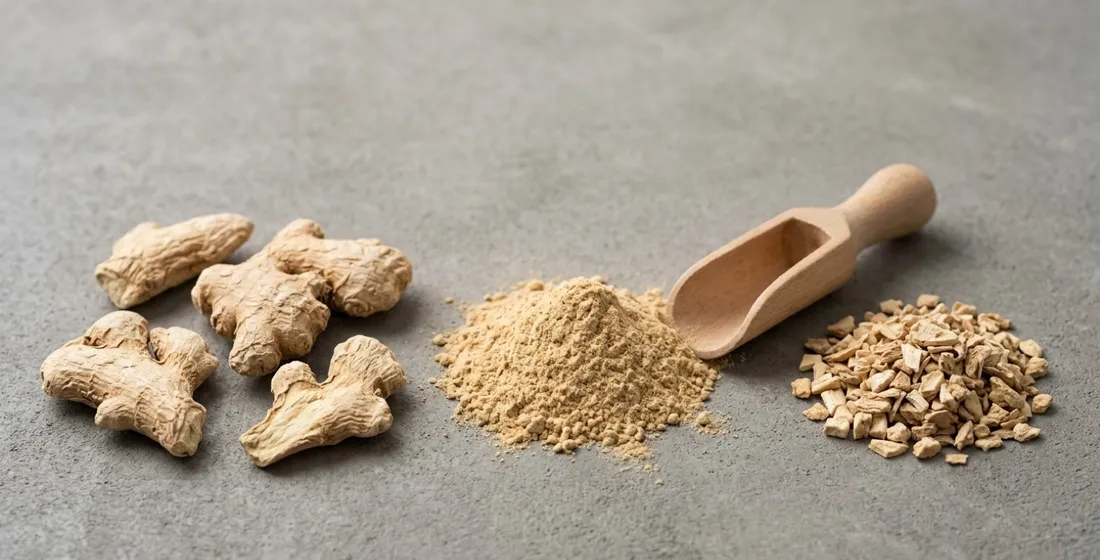
Dried ginger ships in five trade formats: whole or split rhizome, ground powder, tea cut (tea-bag cut), pyramid cut, and kibbled (coarsely cracked pieces). They differ on one axis, which is surface area. More cutting means faster flavour release and faster flavour loss. Whole holds the most volatile oil and the longest shelf life; powder releases fastest and oxidises soonest. The other three sit in between, each tuned to a different end product.
Whole or split ginger is the dried rhizome itself, sometimes peeled, sometimes rough with the skin left on. It is the unprocessed trade unit, and the buyer grinds or extracts it themselves. Powder is milled dried ginger, specified by mesh, and it disperses instantly into a blend or a batter. Tea cut is a small irregular piece, roughly 2 to 5 mm, cut and sifted to drop the dust so it brews clean in a bag. Pyramid cut is coarser, roughly 5 to 8 mm, sized for pyramid and whole-leaf sachets where the consumer sees the botanical through the mesh. Kibbled is a coarse crack, larger than powder, used where a visible inclusion or a slow controlled extraction matters and where airborne dust has to stay low. Each format is a different answer to one question: how fast does the buyer want the ginger to give up its oil, and how long does it need to sit on a shelf first.
What does drying actually do to ginger’s pungency?
Drying ginger does two things at once. It concentrates the rhizome, since fresh ginger is roughly 80% water, and it converts gingerols into shogaols through a dehydration reaction. Shogaols are about twice as pungent as gingerols, near 151,000 Scoville units against 61,000, so dried ginger reads hotter and sharper than fresh even as the bright top notes soften. Volatile oil, the aromatic fraction, is a separate property and a fragile one.
Pungency and aroma are two different things the buyer is paying for. Like turmeric, where the spec that matters is curcuminoid content rather than colour, ginger’s worth sits in measurable compounds, not a label adjective. The heat comes from the gingerol and shogaol pool. The aroma comes from the steam-distillable volatile oil that ISO 1003:2025 holds to a 1.5 ml/100g floor. Drying temperature drives the gingerol-to-shogaol shift, and at very high drying temperatures the conversion can approach half the gingerol pool. The volatile oil behaves the opposite way: gentler drying preserves more of it than aggressive high-heat drying. So good dried ginger is a balance, and the format decides how much of that oil survives milling, storage, and the brew. A whole rhizome keeps the oil locked inside intact cell structure. The moment it is milled to powder, surface area multiplies and the oil starts to leave. Same root. Different cut. Different oil at the point of use.
Matching the format to the end product
For spice blends and bakery, powder wins on dispersion. For functional tea bags, tea cut and pyramid cut win on brew clarity. For extractors, capsule millers, and brands that want to control their own grind, whole or kibbled wins on oil retention and shelf life. The table below maps each format to its application and its main trade-off.
| Format | Typical cut or size | Best-fit applications | Main trade-off |
|---|---|---|---|
| Whole / split rhizome | Intact or halved dried races | Extractors, spice millers, brands grinding in-house, apothecary-style retail packs | Longest shelf life and highest oil retention, but the buyer must grind it |
| Powder (ground) | Milled, specify mesh (e.g. 40 to 80 mesh) | Curry and spice blends, bakery, gingerbread, beverage premixes, capsule fill | Fastest dispersion, but the fastest volatile-oil loss and the most dust |
| Tea cut (tea-bag cut) | Small pieces, roughly 2 to 5 mm | Standard tea bags, RTD infusions, syrups, brines | Fast clean extraction, but more fines than a pyramid cut |
| Pyramid cut | Coarser pieces, roughly 5 to 8 mm | Pyramid and whole-leaf sachets, visible-botanical premium tea | Low fines and a premium look, but slower extraction |
| Kibbled | Coarsely cracked pieces, larger than powder | Visible inclusions, decoctions, controlled slow grind, low-dust handling | Balanced oil retention, but not free-pouring like powder |
Source: SRV format guidance aligned to ISO 1003:2025 dried ginger specification.
Buyers running this table usually split into two camps: spice and tea brands specifying bulk ginger against their own blend or co-packer, and brands that want a finished pack under their own label. Silk Route Ventures (SRV) supplies both, and the format spec is identical whether the order is a bulk raw-material purchase or a private-label retail SKU. The same one-axis discipline, surface area traded against retention, runs across the spice rack, from cardamom grade tiers to black pepper origin selection.
Which format holds its flavour longest in storage?
Whole dried ginger holds flavour longest because the volatile oil stays locked inside intact cell structure with the least surface exposed to air. Powder loses aroma fastest for the same reason in reverse. The practical ranking from most to least shelf-stable runs whole, then kibbled, then pyramid cut, then tea cut, then powder. Buyers carrying long lead times or buffer stock should lean toward the coarser formats.
The implication for a procurement plan is concrete. A brand that mills its own blend close to use can hold whole or kibbled ginger through a long sea freight and a warehousing window without watching the aroma fade. A brand that buys powder for convenience should order it closer to production, or specify foil-lined or nitrogen-flushed packaging, because the same surface area that makes powder disperse fast also lets it oxidise fast. Moisture control matters across every format: dried ginger held above its target moisture cakes and risks mould, so a food-grade liner is not optional on a long route.
Spec snapshot: dried ginger (Zingiber officinale)
Species: Zingiber officinale Roscoe, verified per shipment
Volatile oil: ISO 1003:2025 floor of 1.5 ml/100g; specify higher for tea and extraction grades
Moisture: buyer-specified, commonly 10 to 12% maximum
Format: whole/split, powder (state mesh), tea cut, pyramid cut, or kibbled (state cut size)
Microbial reduction: saturated steam, not ethylene oxide
EU residue: ethylene oxide held to non-detect against the 0.1 mg/kg sum limit
COA: every batch (moisture, volatile oil, microbial, heavy metals, pesticide residue to destination)
SFC MOQ: 50 kg per format, first order
Specifying dried ginger on an RFQ
A defensible dried-ginger RFQ names six things: the botanical species, the volatile-oil floor (ISO 1003:2025 sets 1.5 ml/100g), the moisture ceiling, the format with its cut size or mesh, the microbial-reduction method, and the pesticide and ethylene-oxide position for the destination market. Leaving any of these to the packer is how a buyer ends up with the wrong cut or a border rejection.
Name the species so the lot is not a mystery blend. Put the volatile-oil number on the COA rather than accepting a generic “aromatic” descriptor, because the oil is the flavour being purchased. State the moisture ceiling. State the format and its cut size or mesh. Then settle the microbial method, which carries more weight than buyers expect: ethylene oxide is a non-approved substance in the EU, held to a 0.1 mg/kg sum limit since 2015, and dried ginger from some origins draws extra border testing for exactly this residue (the wider EU MRL picture for dried herbs and spices tracks the shift). Saturated-steam treatment sidesteps the ethylene-oxide question entirely. Finish with a heavy-metals panel and a pesticide screen aligned to the destination, and a COA on every batch.
In Q1 2026, the SRV procurement desk saw the same correction three times in a few weeks. Each was a US functional-tea brand that had ordered “ginger powder” for a pyramid-bag line, then found the fines clouding the cup and bridging in the sachet filler. The fix was not a better powder. It was the right format, a pyramid cut that brewed clear and ran clean through the machine. That lesson costs nothing if it is on the spec sheet before the first order, and a re-blend if it is not.
Buyer’s checklist: specifying a dried-ginger format
- Botanical species (Zingiber officinale) confirmed in writing
- Format named: whole/split, powder, tea cut, pyramid cut, or kibbled
- Cut size in mm for cut formats, or mesh for powder
- Volatile-oil floor on the COA (ISO 1003:2025 baseline 1.5 ml/100g)
- Moisture ceiling and packaging (foil-lined or food-grade liner)
- Microbial-reduction method stated (steam preferred over ethylene oxide)
- Pesticide and ethylene-oxide panel aligned to the destination market
- Sample dispatched against the spec before any PO
Where does Sri Lankan ginger fit for a sourcing buyer?
Sri Lanka grows on the order of 50,000 tonnes of ginger a year and sits among the world’s larger producers, with the rhizome long cultivated in the Matale and Central Province belt. Demand on the buyer side is steady rather than spiky: the global ginger powder market sat near USD 16.0 billion in 2025 and is forecast toward USD 19.8 billion by 2030 at about 4.4% annual growth, with dried and powdered formats taking the bulk of ingredient-trade volume. For a sourcing buyer, the draw of a Ceylon origin is a single source that can supply multiple formats under one certification stack.
Silk Route Ventures supplies bulk dried ginger, and Silk Foods Ceylon mills and cuts it to format at the Matale facility, roughly 1 km from Nalanda Gedige in the geographic centre of Sri Lanka. All five formats come off the same spice and herb line at 100 to 200 kg per hour, under BRCGS and FSSC 22000 V6, with saturated-steam microbial reduction that keeps ethylene oxide out of the EU residue conversation. First-order MOQ is 50 kg per format. Buyers new to the origin can run the facility through a standard Sri Lankan supplier evaluation checklist before the first PO. Samples ship by international courier in 3 to 5 business days; production lead time is 2 to 3 weeks from PO to dispatch, with sea freight at 4 to 5 weeks to the US and 3 to 4 weeks to the EU and Australia. Where a buyer simply wants the lowest landed price with no format discipline, a high-volume lot from a larger producer is the more honest answer. SRV’s case is format precision plus certification, not the cheapest shelf price.
FAQ
Is dried ginger hotter than fresh ginger?
Yes. Drying converts gingerols into shogaols, which are about twice as pungent, near 151,000 against 61,000 Scoville units, so dried ginger reads sharper and hotter than fresh even as the bright aromatic top notes soften. Peer-reviewed analysis of dried ginger (2018 to 2021) documents the conversion and the pungency gap.
What is the difference between ginger tea cut, pyramid cut, and kibbled?
Tea cut is a small piece, roughly 2 to 5 mm, for standard tea bags and fast infusion. Pyramid cut is coarser, roughly 5 to 8 mm, sized for pyramid and whole-leaf sachets where the consumer sees the botanical and fines must stay low. Kibbled is a coarse crack, larger again, used for visible inclusions and slow controlled extraction.
What volatile-oil content should I specify for bulk dried ginger?
ISO 1003:2025 sets the minimum volatile oil for dried ginger at 1.5 ml/100g. Tea and extraction buyers often specify above that floor. Ask for the volatile-oil figure on every batch COA rather than accepting a generic “aromatic” descriptor, since the oil is the flavour the buyer is paying for.
Does Silk Route Ventures supply private-label or bulk dried ginger with BRCGS and FSSC?
Yes. Silk Foods Ceylon mills and cuts dried ginger to whole, powder, tea cut, pyramid cut, or kibbled at its Matale facility under BRCGS and FSSC 22000 V6, with saturated-steam microbial treatment and a 50 kg first-order MOQ per format. Samples ship by international courier in 3 to 5 business days. Contact SRV for a spec sheet or a sample.
How Silk Route Ventures can help
Silk Route Ventures (SRV) supplies certified-organic, single-origin Ceylon spices, including dried ginger in whole, powder, tea cut, pyramid cut, and kibbled formats, to specialty brands across the US, EU, and Australia. Bulk raw material ships against the buyer’s spec from the BRCGS and FSSC 22000 V6 audited Silk Foods Ceylon (SFC) facility in Matale, with saturated-steam microbial treatment and a per-batch COA. First-order MOQ is 50 kg per format; samples ship door-to-door by international courier (DHL, FedEx, UPS) at 3 to 5 business days. For brands ready to launch a private-label ginger SKU under their own label, SRV runs end-to-end private label manufacturing from the same site. Contact us to send an inquiry or request a sample pack.