
White Pepper Sourcing: Ceylon vs Sarawak vs Indonesian Quality and Spec Trade-Offs
Buyer’s snapshot
- ISO 959-2 sets white pepper’s minimum piperine at 4.0% on a dry basis while allowing a volatile oil minimum of only 1.0 ml/100 g in whole berries (ISO 959-2:1998). Removing the pericarp concentrates pungency and strips aroma, and the standards encode that trade in their numbers.
- The European Spice Association caps white pepper moisture at 12%, two points tighter than the 14% ISO allows (ESA Quality Minima Rev. 5). A lot that passes on the ISO number can still be rejected by an EU buyer working to ESA.
- The American Spice Trade Association is stricter on white pepper than on black: extraneous matter 0.50% by weight against 1.00%, and other excreta 1.0 mg/lb against 5.0 mg/lb. Procurement teams who copy a black pepper defect table onto a white pepper RFQ understate their own requirement.
- Neither ASTA nor ESA sets a microbiological limit for pepper. Both say so in writing. Microbiology is purely contractual, and the operative benchmark is a validated 5-log Salmonella reduction.
- Silk Foods Ceylon (SFC) runs white pepper whole, crushed and powder at 100 to 200 kg per hour from Matale under FSSC 22000 V6, at a 50 kg per SKU first-order minimum. A brand that needs a protected origin claim printed on the pack should buy Muntok, not Ceylon. That claim does not exist for Sri Lankan pepper.
White pepper is the same berry as black pepper with the skin taken off, and almost every commercial consequence follows from that one processing step. The chemistry changes, the defect tolerances tighten, the price rises by roughly a third, and the food-safety conversation moves from the field to the soaking tank. Most sourcing pages treat white pepper as a colour variant of black. The specification documents do not, and neither should a contract. This is the origin comparison for a procurement team choosing between Ceylon, Sarawak and Indonesian Muntok white pepper for a US or EU programme.
What does decortication actually do to the specification?
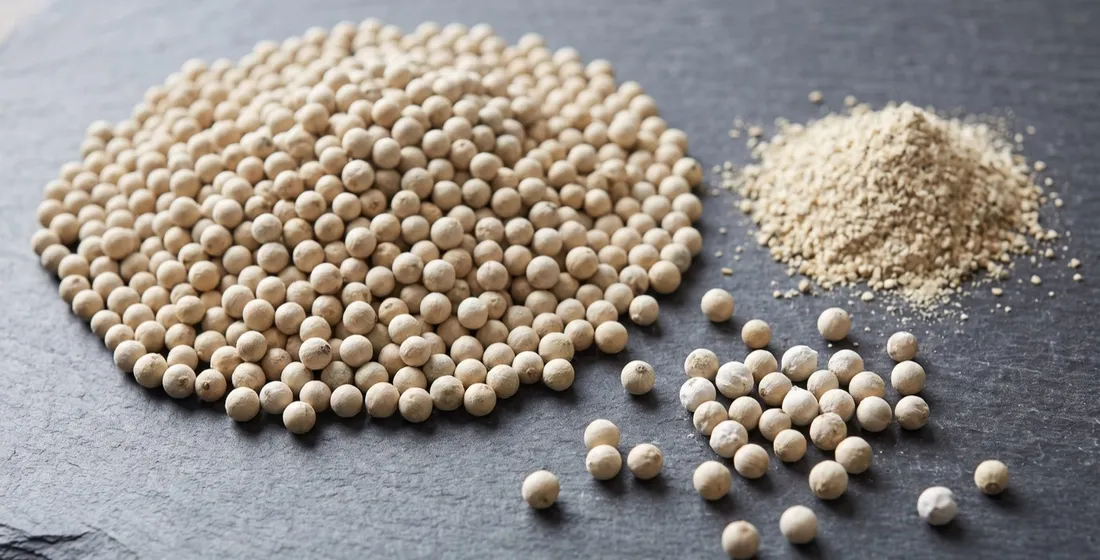
Black pepper is picked before full ripeness and dried whole, so the wrinkled outer pericarp stays on the berry. White pepper is taken from the ripe fruit and the pericarp is removed, with or without a preliminary soak in water (ISO 959-2:1998). The pericarp carries most of the volatile aroma compounds. The kernel carries the piperine. Strip the skin and the pungency concentrates on a mass basis while the aroma falls away.
The standards are explicit about this. ESA’s Quality Minima Rev. 5 sets a minimum volatile oil of 1.5 ml/100 g for white pepper against 2.0 ml/100 g for black, and drops total ash from 7.0% to 3.5% and acid-insoluble ash from 1.5% to 0.3%. The ash figures are the clearest signal: acid-insoluble ash is the silica proxy, and a berry with no skin carries far less field soil into the lot. A white pepper offer that reports 1.2% acid-insoluble ash is not a borderline lot, it is a lot that has been graded against the wrong standard.
| Parameter | White pepper | Black pepper | What the gap tells a buyer |
|---|---|---|---|
| Moisture, % max | 12 | 12 | Same ESA ceiling, but ISO allows 14% for both. Cite the tighter one. |
| Total ash, % max, dry basis | 3.5 | 7.0 | The pericarp is most of the mineral load. |
| Acid-insoluble ash, % max, dry basis | 0.3 | 1.5 | Five times tighter. This is the silica and soil check. |
| Volatile oil, ml/100 g min | 1.5 | 2.0 | Aroma sits in the skin. White pepper cannot match black on nose. |
| Piperine, % min, dry basis (ISO 959-2) | 4.0 | Grade dependent | Pungency concentrates once the skin is off. |
| Extraneous matter, % max (ASTA) | 0.50 | 1.00 | ASTA holds white pepper to double the cleanliness. |
| Other excreta, mg/lb max (ASTA) | 1.0 | 5.0 | Five times tighter on white. Not a typo, and often missed. |
White pepper against black pepper on the published minima. ESA Quality Minima Rev. 5 for moisture, ash, acid-insoluble ash and volatile oil; ISO 959-2:1998 for piperine; ASTA Cleanliness Specifications for extraneous matter and excreta.
One footnote in ISO 959-2 is worth writing into the contract rather than leaving in the standard: volatile oil should be determined immediately after grinding. Ground white pepper sheds volatiles quickly, so a volatile oil result on a retained sample tested four weeks after milling is not measuring the lot the buyer received. If the programme buys ground rather than whole, name the sampling point and the test window, not just the number.
How is white pepper made, and why does that decide the microbiological risk?
Traditional decortication is water retting. Ripe berries sit in water for 7 to 15 days until the pericarp softens enough to be rubbed off, then the kernels are washed and sun dried. A 2024 study in Foods tracked the microbial succession inside that tank and found Prevotella rising from 0.87% to 75.45% of the bacterial community, with Enterobacter, Lactococcus, Selenomonas and Weissella also present, while Candida went from 45% to 82.41% of the fungal community within 12 hours (Fu et al., Foods, 2024). The same paper reports that a mechanical friction pretreatment cut the peeling time to 60 hours.
A multi-day ambient fermentation in open water is an obvious hygiene question, and it is the reason many buyers assume white pepper is the riskier berry. The published evidence is less tidy than that. A survey in the Journal of Food Protection found Salmonella in 1.5% of white peppercorn samples against 8.2% of black, with black peppercorn plate counts reaching 2.0 x 10 to the 8th cfu/g (Pafumi, 1986). That dataset is forty years old and should be read as history rather than as a current baseline, but it points the opposite way to the intuition, and an honest sourcing brief should say so.
What is not ambiguous is that white pepper has its own outbreak record. A multi-state Salmonella Rissen outbreak across California, Nevada, Oregon, Washington and Idaho in 2008 and 2009 was traced to ground white pepper, the first reported S. Rissen outbreak in the United States, with case counts reported between roughly 79 and 100 depending on the source (CIDRAP, 2009). FDA Import Alert 28-04 still runs today under a title that names black and white pepper from Brazil, for Salmonella, and it has been in place since January 1986. The risk is real, it is process driven rather than colour driven, and it is old enough that no buyer should be surprised by it.
Here is the part that catches procurement teams out. ASTA’s Cleanliness Specifications state in the document that they do not address microbiological contamination. ESA’s Quality Minima leaves microbiology to be agreed between buyer and seller. Neither reference standard gives a total plate count, a yeast and mould ceiling or a Salmonella clause. If those numbers are not in the purchase contract, they do not exist anywhere. The benchmark worth citing is the validated 5-log reduction of Salmonella that a microbial reduction treatment must demonstrate under the US preventive controls rule (Food Technology, Institute of Food Technologists, 2022). Non-thermal alternatives generally fall short of it: the same review reports cold plasma at 2.3-log on pepper powder and UV-LED between 0.75 and 3.0 log in powdered seasonings, which is why saturated steam remains the workhorse.
What to write into the microbiological clause
- Total plate count, yeast and mould, Enterobacteriaceae, E. coli and Salmonella in 25 g, each with a numeric limit and a named method. No reference standard supplies these.
- Water activity target of 0.65 maximum, which ESA names as the parameter that governs microbial growth.
- Whether the lot is steam treated, and if so a validation report demonstrating 5-log Salmonella reduction on the specific matrix, not on a surrogate product.
- A written statement that no ethylene oxide has been applied at any point, including before import.
- Certificate of analysis per batch, not per shipment. A consolidated container can carry several production lots.
Origin by origin: Muntok, Sarawak and Ceylon
Indonesia is the only one of the three that is a white pepper origin first. International Pepper Community country statistics put Indonesian white pepper production at 36,324 MT against 28,678 MT of black in 2022, out of 65,000 MT total across 116,680 hectares, with white making up 13,186 MT of 29,579 MT of exports. Malaysia is the reverse: 22,000 MT total, of which 6,600 MT white and 15,400 MT black, from 8,020 hectares, with Sarawak accounting for 98% of national production. Sarawak’s largest export market is Japan at 45%, not Europe or North America, which is part of why it is scarce on Western spec sheets.
Sri Lanka is the honest gap in this comparison. IPC records 24,029 MT of pepper production and 11,461 MT of exports worth USD 75.9 million in 2022, from 42,156 hectares, and 86% of those exports went to India. The IPC country page publishes no black and white split at all. There is no official Ceylon white pepper volume series to quote, and any supplier who quotes one is quoting a market report rather than a trade statistic. The direction of travel is not flattering either: the Sri Lanka Export Development Board reported spices and essential oils earning USD 449.9 million in 2025, down 2.59%, with pepper exports falling 39.68% (Sri Lanka EDB, 2026).
The fourth origin nobody puts in the title belongs in the table anyway. Vietnam exported 35,203 tonnes of white pepper in 2025 out of 247,482 tonnes total, worth USD 1.66 billion (Vietnam Pepper and Spice Association, 2026). By our arithmetic that is roughly 5.3 times Malaysia’s entire 2022 white pepper production and about 2.7 times Indonesia’s 2022 white pepper exports. Vietnam, not Indonesia or Malaysia, is where the volume now sits. A buyer specifying Muntok or Sarawak is buying a defined origin, not the mainstream option.
The label claim available to each origin differs, and this is checkable rather than atmospheric. Lada Putih Muntok was entered in the EU register as a Protected Designation of Origin by Commission Implementing Regulation (EU) 2024/1871 of 28 June 2024, the highest EU geographical indication tier. Sarawak Pepper holds a Malaysian national geographical indication with the Malaysian Pepper Board as registered proprietor, gazetted in 2004, but no EU registration was identified. No geographical indication for Sri Lankan pepper was identified in any register searched. For an EU private label buyer who wants a protected origin on the front of pack, that asymmetry decides the question on its own.
| Muntok (Indonesia) | Sarawak (Malaysia) | Ceylon (Sri Lanka) | |
|---|---|---|---|
| White pepper volume | 36,324 MT produced, 13,186 MT exported (IPC, 2022) | 6,600 MT of 22,000 MT national output; Sarawak is 98% of it (IPC, 2022) | No published black and white split (IPC, 2022) |
| Typical process | Water retting, the classic Muntok method | Water retting, river and tank | Retting and mechanical decortication, lot dependent |
| Protected origin status | EU Protected Designation of Origin, Reg. (EU) 2024/1871 | Malaysian national geographical indication, 2004; no EU registration identified | None identified |
| Principal export market | Broad, EU and Asia | Japan, 45% of Malaysian pepper exports (IPC, 2022) | India, 86% of Sri Lankan pepper exports (IPC, 2022) |
| Indicative price, 22 June 2026 | USD 9,260/t (IPC quotation) | USD 12,250/t ASTA grade (IPC quotation) | Not separately quoted by IPC |
| Practical sourcing note | Deepest white pepper pool and the only EU protected origin claim | Highest price of the three, thinnest availability, Japan takes the best of it | Small, flexible, spec led. Buy it for traceability and blend fit, not for a label claim |
Origin comparison. Volume and price figures are IPC country statistics for 2022 and IPC world price quotations dated 22 June 2026; IPC country pages had not been updated beyond 2022 at the time of writing.
SRV finding: The most common correction the trade desk makes on an inbound white pepper enquiry is not price. It is a defect table and a moisture figure copied straight off the buyer’s black pepper specification. Every parameter that matters moved when the skin came off, usually in the direction of a tighter requirement, and the RFQ that arrives asking for 1.5% acid-insoluble ash on white pepper is asking for five times the tolerance its own reference standard permits.
What does the white pepper price premium actually buy?
The premium is real and it is smaller than folklore suggests. International Pepper Community world price quotations dated 22 June 2026 put Malaysian ASTA white pepper at USD 12,250 per tonne, Indonesian Muntok white at USD 9,260 and Vietnamese white at USD 9,000, against Malaysian ASTA black at USD 9,350, Indonesian Lampung black at USD 7,175 and Vietnamese 500 g/l black at USD 6,100. Calculated from those quotations, the white over black premium runs 29.1% in Indonesia, 31.0% in Malaysia and 47.5% in Vietnam.
Full-year realised numbers land in the same band. Vietnam’s 2025 average export prices were USD 8,629 per tonne for white and USD 6,607 for black, a 30.6% premium by our arithmetic, with both up more than 30% year on year (VPSA, 2026). Note what drove Vietnam’s record USD 1.66 billion pepper export value in 2025: volume fell 1.2% while value rose 26%. That was a price rally, not a supply expansion, and a 2026 budget built on 2024 pepper costs will be wrong in one direction only.
The origin spread inside white pepper is wider than the white-to-black spread. On the same 22 June 2026 quotation, Malaysian ASTA white sits 36% above Vietnamese white. A buyer paying the Sarawak number is paying for a defined and scarce origin whose best material is already committed to Japan. That is a legitimate reason to buy it and a poor reason to assume it is the only clean option. On the published minima, an ISO and ESA compliant lot from any of these origins meets the same numbers.
Which standard should the purchase contract actually cite?
Four documents circulate in white pepper trade and they do not agree. ISO 959-2:1998 is the international product specification and carries the piperine, volatile oil, ash and bulk density numbers, including a 600 g/l minimum bulk density and a black berry tolerance of 10% for processed and 15% for semi-processed white pepper. ESA’s Quality Minima Rev. 5 is what most EU buyers work to and is tighter on moisture. ASTA’s Cleanliness Specifications cover physical defects only. Codex CXS 326-2017 is the intergovernmental reference and structures pepper into three grades keyed to bulk density.
The gap that causes the most argument is moisture. ISO allows 14.0% for whole and ground white pepper. ESA allows 12%. A lot at 13.2% is simultaneously ISO compliant and ESA non-compliant, and a contract that cites ISO alone gives the seller a defensible position on a shipment the buyer cannot use. For anything EU bound, specify 12% and cite ESA. For anything US bound, specify the ASTA cleanliness table explicitly, because ASTA is tighter on white pepper than on black in two places and a generic pepper clause will not capture it.
One more ISO detail is worth carrying into a spec sheet as a description rather than a tolerance. ISO defines white pepper berries at 3 mm to 6 mm diameter and describes the colour as ranging from matt brownish grey to pale ivory white. Buyers who write “bright white” into a specification are describing bleached material, not the standard, and the resulting rejections are avoidable. The standard also carves out Samarinda pepper by name as always containing 20% black berries, which is a reminder that named origin styles carry their own tolerances.
What regulatory limits apply on the way into the EU and the US?
For EU-bound white pepper the controlling text is Commission Regulation (EU) 2023/915. It sets aflatoxin B1 at 5.0 micrograms per kilogram and the sum of aflatoxins B1, B2, G1 and G2 at 10.0 micrograms per kilogram for pepper, described in the regulation as fruits of Piper species including white and black pepper. Ochratoxin A in dried spices other than Capsicum is capped at 15 micrograms per kilogram. The regulation sets no cadmium maximum for the spice categories.
Lead is where a widely used buyer guide and the primary text diverge, and it is worth checking before a contract is signed. Regulation (EU) 2023/915 subdivides dried spices for lead, with fruit spices at 0.60 mg/kg and seed spices at 0.90 mg/kg. Peppercorns are botanically drupes and the regulation’s own aflatoxin entry calls them fruits of Piper species. CBI’s buyer requirements page, last updated May 2026, lists the pepper lead limit as 0.9 mg/kg by treating pepper as a seed spice. Specifying against 0.60 mg/kg costs nothing and removes the argument entirely.
Ethylene oxide remains the fastest route to a rejected container. ESA states plainly that ethylene oxide treatment is banned under European legislation and that the ban covers material treated outside the EU, so importing pre-treated product is illegal in its own right. It still shows up: CBI recorded 279 RASFF issues for herbs and spices in 2025 against 275 in 2024, with Salmonella at 6% of the 2025 total and ethylene oxide the third most reported pesticide issue at 16 notifications. Over 1999 to 2023, herbs and spices accounted for 3,741 RASFF notifications, with Salmonella in pepper among the most reported categories (Eissa et al., Journal of Food Safety, 2024).
For the US, the anchor number is FDA’s draft risk profile on pathogens and filth in spices, which found Salmonella in an average 6.6% of imported spice shipments across FY2007 to FY2009, roughly twice the rate of other imported FDA-regulated foods, with about 12% of shipments carrying pathogens or filth. The balancing fact belongs in the same paragraph: FDA’s later work found retail-level Salmonella prevalence in spices had fallen to nearly zero, because treatment happens between import and shelf. The import figure describes raw material entering a process, not product reaching a consumer, and a supplier who quotes it without the second half is selling fear.
Certification snapshot
- The Matale site is audited to BRCGS and FSSC 22000 V6. The pepper lines run under FSSC 22000 V6, with BRCGS scope extension available per SKU on request.
- BRCGS is the UK retail-driven standard most multiples require for own-label and ingredient suppliers. FSSC 22000 is GFSI recognised and is the filter most multinational buyers use to qualify Asian suppliers.
- USDA Organic and EU Organic are scoped per SKU. Organic shipments carry an organic transaction certificate alongside the batch certificate of analysis.
- Every order ships with a commercial invoice, packing list, bill of lading or air waybill, certificate of origin, phytosanitary certificate and batch certificate of analysis.
Frequently asked questions
Is white pepper more microbiologically risky than black pepper?
Not automatically. Water retting is a 7 to 15 day open fermentation (Fu et al., Foods, 2024), yet a Journal of Food Protection survey found Salmonella in 1.5% of white peppercorn samples against 8.2% of black (Pafumi, 1986). Risk tracks the process and the treatment validation, not the colour. Specify a 5-log validated reduction either way.
What moisture limit should a white pepper contract specify?
Specify 12% and cite ESA Quality Minima Rev. 5. ISO 959-2 permits 14.0%, so a lot at 13.2% is ISO compliant and ESA non-compliant at the same time. Pair the moisture clause with a water activity target of 0.65 maximum, which is the parameter that actually governs microbial growth in storage.
Does Sri Lankan white pepper carry a geographical indication?
No registration for Sri Lankan pepper was identified in any register searched. Muntok white pepper holds an EU Protected Designation of Origin under Regulation (EU) 2024/1871 of 2024, and Sarawak Pepper holds a Malaysian national geographical indication from 2004. Buyers who need a protected origin claim on pack should source Muntok.
Does Silk Route Ventures supply bulk white pepper under private label to the US and EU?
Yes. Silk Route Ventures (SRV) supplies white pepper whole, crushed and powder as bulk raw material against a buyer’s specification, and runs private label packing from the same Matale site. Spice and powder lines run at 100 to 200 kg per hour under FSSC 22000 V6, with a certificate of analysis on every batch.
What is the minimum order quantity and lead time for bulk white pepper?
First-order minimum is 50 kg per SKU, with volume breaks at 500 kg, 1,000 kg and 2,500 kg. Samples ship by international courier at 3 to 5 business days transit. Purchase order to dispatch runs 2 to 3 weeks, then 3 to 4 weeks sea freight to the EU and 4 to 5 weeks to the United States.
How Silk Route Ventures can help
Silk Route Ventures (SRV) supplies single-origin Ceylon spices to specialty brands across the US, EU and Australia, including white pepper in whole, crushed and powder formats. Bulk raw material ships against the buyer’s specification from the BRCGS and FSSC 22000 V6 audited Silk Foods Ceylon (SFC) site in Matale, one kilometre from Nalanda Gedige, with a certificate of analysis on every batch and traceability to farm. First-order MOQ is 50 kg per SKU; samples ship door to door by international courier at 3 to 5 business days transit. For brands ready to consolidate suppliers or launch a private-label SKU under their own label, SRV runs end-to-end private label manufacturing from the same site. Contact us to send an inquiry or request a sample pack.
One caveat worth stating plainly. SRV is the right supplier for a buyer who wants a spec-led, traceable, low-minimum white pepper programme with a certification dossier behind it. It is not the right supplier for a buyer whose brief is a protected origin claim on the front of pack, because Sri Lankan pepper does not carry one. For that brief, Muntok is the honest answer.
Related reading: the black pepper origin comparison across Ceylon, Vietnam, India and Indonesia, the B2B buyer’s guide to Ceylon spices in 2026, how to specify Cinnamomum verum on a sourcing RFQ, Ceylon cinnamon against Vietnamese cassia, cardamom grading for B2B buyers, clove format selection for formulators, private labelling spices, working with low-MOQ contract manufacturers, and the buyer’s guide to organic certifications.
Sources
- ISO, Pepper (Piper nigrum L.), whole or ground, Specification, Part 2: White pepper, ISO 959-2:1998. iso.org/standard/27320.html (retrieved 31 July 2026)
- European Spice Association, Quality Minima Document Rev. 5, 2015, reviewed 2018. srilankabusiness.com (retrieved 31 July 2026)
- American Spice Trade Association, Cleanliness Specifications. astaspice.org (retrieved 31 July 2026)
- Commission Regulation (EU) 2023/915 on maximum levels for certain contaminants in food. eur-lex.europa.eu (retrieved 31 July 2026)
- Commission Implementing Regulation (EU) 2024/1871 of 28 June 2024 entering ‘Lada Putih Muntok’ (PDO) in the register. eur-lex.europa.eu (retrieved 31 July 2026)
- International Pepper Community, country statistics for Indonesia, Malaysia and Sri Lanka, 2022. ipcnet.org (retrieved 31 July 2026)
- International Pepper Community world price quotations, 22 June 2026, as reported in Vietnamese trade press. vietnam.vn (retrieved 31 July 2026)
- Vietnam Pepper and Spice Association, 2025 pepper export results, via VietnamPlus, January 2026. en.vietnamplus.vn (retrieved 31 July 2026)
- Sri Lanka Export Development Board, export performance 2025, published January 2026. srilankabusiness.com (retrieved 31 July 2026)
- Fu et al., Microbial succession during pepper retting, Foods 13(11):1615, 2024. pmc.ncbi.nlm.nih.gov (retrieved 31 July 2026)
- Pafumi, J., Assessment of the microbiological quality of spices and herbs, Journal of Food Protection 49(12):958-963, 1986. pubmed.ncbi.nlm.nih.gov (retrieved 31 July 2026)
- CIDRAP, University of Minnesota, coverage of the FDA report on imported spice contamination and the 2009 Salmonella Rissen outbreak. cidrap.umn.edu (retrieved 31 July 2026)
- US FDA, Risk Profile: Pathogens and Filth in Spices. fda.gov (retrieved 31 July 2026)
- US FDA, Import Alert 28-04, detention without physical examination of black and white pepper from Brazil. accessdata.fda.gov (retrieved 31 July 2026)
- Institute of Food Technologists, Food Technology, microbial loads in spices and dried seasonings, 2022. ift.org (retrieved 31 July 2026)
- CBI, Buyer requirements for herbs and spices, updated May 2026. cbi.eu (retrieved 31 July 2026)
- Eissa et al., Herbs and spices in the RASFF system 1999 to 2023, Journal of Food Safety, 2024. onlinelibrary.wiley.com (retrieved 31 July 2026)
- ARISE+ IPR, Sarawak Pepper geographical indication registration, Malaysian Pepper Board. internationalipcooperation.eu (retrieved 31 July 2026)
Silk Route Ventures (SRV) is the trade and export arm of the E-Silk Route Ventures group, supplying Ceylon spices, herbs, coconut products and plant-based foods to buyers in the US, EU and Australia. The Silk Foods Ceylon (SFC) manufacturing arm in Matale is audited to BRCGS and FSSC 22000 V6. Questions or to request a sample: Contact us or email info@esilkroute.com.lk.