
Vegan Sausage and Chicken-Alternative Contract Manufacturing: Format and Freezer-Pack MOQ
Buyer’s snapshot
- In 2024, US retail dollar sales of plant-based meat fell about 7% to roughly $1.2 billion, yet sausage and chicken formats held up better than burgers as the shelf concentrated into the SKUs shoppers still reach for (The Good Food Institute, 2024).
- The global plant-based sausage market is projected at about $1.97 billion in 2025, rising to roughly $4.83 billion by 2035, a 26.1% compound annual growth rate (Future Market Insights, 2025). Chicken alternatives carry the widest appeal and the lowest production cost of the meat-analogue formats.
- The gating question for a scale-up is not unit price. It is whether the co-manufacturer can extrude, form, case, and blast-freeze a sausage or chicken analogue that survives a freeze-thaw cycle and a second cook.
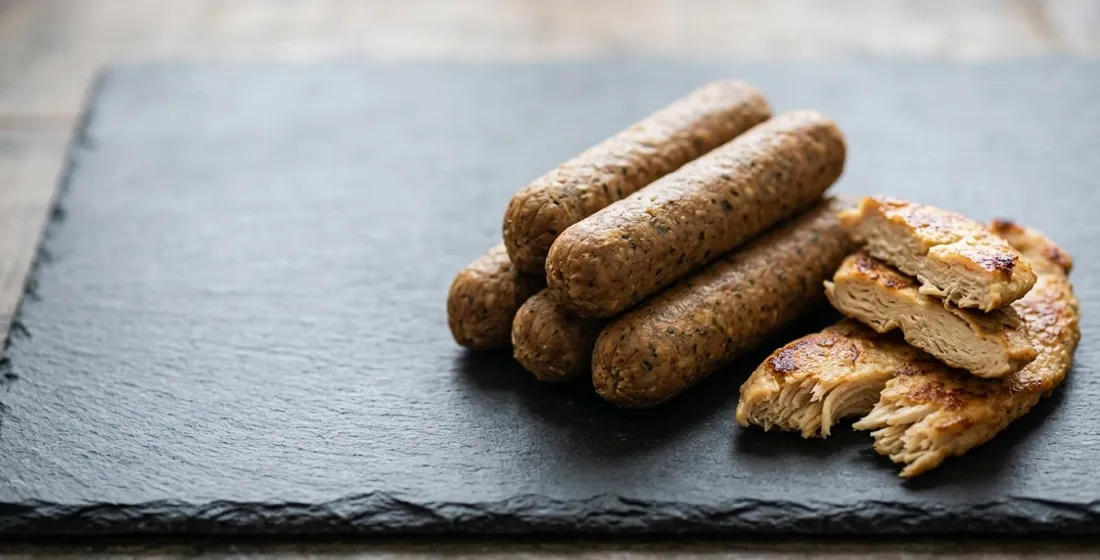
- Silk Foods Ceylon co-manufactures vegan sausage and chicken-alternative formats on its plant-based meat line in Matale (BRCGS and FSSC 22000 V6), in frozen vacuum-pack or shelf-stable retort, with a first-run MOQ of 5,000 to 10,000 units per SKU.
- This guide is for CPG brands and distributors scaling a plant-based sausage or chicken SKU into export retail. For a chilled, domestic-only line with no freight plan, a local co-packer is the more honest answer.
Most contract manufacturers in South Asia quote spice and herb tonnage. A smaller number quote a frozen plant-based patty. Fewer still quote a vegan sausage or a chicken analogue, at scale, on the same food-safety audit that covers their spreads and capsules. The sausage and the chicken piece are two of the harder plant-based formats to make well. The gap between “we can make it” and “we can make it hold texture through a freezer and a fryer” is where the real co-manufacturing conversation sits. This is the capability picture for a scale-up evaluating Sri Lanka for a vegan sausage or chicken-alternative co-pack.
Why sausage and chicken alternatives are the formats still worth co-manufacturing
In 2024, US retail dollar sales of plant-based meat fell roughly 7% to about $1.2 billion (The Good Food Institute, 2024). Read alone, the number argues against the category. Read by format, it argues for discipline. Sausages, hot dogs, and chicken analogues held up better than burgers, and the shelf is concentrating into the SKUs shoppers still buy rather than collapsing evenly across every format.
The forward read points the same way. The global plant-based meat market was valued at about $8.5 billion in 2024 and is projected to reach roughly $40 billion by 2033, an 18.9% compound annual growth rate (Straits Research, 2024). Inside that total, the sausage segment moves faster than the average: about $1.97 billion in 2025, projected to roughly $4.83 billion by 2035 at a 26.1% rate (Future Market Insights, 2025). Chicken alternatives are expected to hold the largest animal-type share of new launches, helped by lower production cost and broad consumer appeal.
Format concentration is the signal a scale-up should act on. In 2025, plant-based patties remained the largest product type, followed by nuggets, tenders, and wings, then grounds, then hot dogs, brats, and sausages, with those categories together making up close to 80% of plant-based meat and seafood dollar sales (The Good Food Institute, 2025). A brand that picks a durable format and a co-manufacturer who can produce it to a retail-ready spec is in a stronger position than one chasing the whole shelf. Sausage and chicken sit on the durable side of that line.
What makes vegan sausage and chicken alternatives hard to co-manufacture?
A vegan sausage and a chicken analogue are texture problems before they are recipe problems. High-moisture extrusion is the core process: a twin-screw extruder hydrates and aligns plant protein into a fibrous, meat-like structure. Moisture typically runs 40% to 80%, with an optimal band near 60%, and the cooling die geometry sets the fiber. Longer dies favor laminar, pork-like structure; shorter dies simulate a chicken-like bite (Journal of Food Process Engineering, 2025). The base proteins are usually legumes: soy, pea, and sometimes lupine.
From there the two formats diverge. A sausage needs an even fat distribution and either a casing or a co-extruded skin that holds shape through forming, freezing, and a second cook, without splitting or weeping. A chicken analogue lives or dies on directional fiber and on staying juicy after the buyer’s fryer or oven, not just off the line. Both have to survive a freeze-thaw cycle without turning rubbery or crumbly. Get the protein-to-fat-to-binder ratio wrong, or the die geometry wrong, and the defect shows up at the end customer, not on the production floor.
This is why format capability matters more than the per-unit quote. A co-manufacturer that runs sausage, chicken alternatives, and other frozen plant-based formats on one line has already solved the extrusion, the forming, the casing, and the freeze logistics. At Silk Foods Ceylon (SFC), the sausage and chicken-alternative formats run on the same plant-based meat footprint as the 15,000 units per day vegan patty line and the 30,000 units per day vegan nugget line. The Silk Route Ventures (SRV) research and development team scopes the formulation in parallel with the production plan, so a brand bringing a target texture and a clean-label constraint gets a development path, not only a price.
Spec snapshot: vegan sausage and chicken-alternative co-pack
- Formats: plant-based sausage (cased or skinless) and chicken-alternative pieces, strips, or fillets
- Process: high-moisture extrusion of legume protein, formed and portioned, then frozen or retorted
- Line: shared plant-based meat footprint (same cellular line as the patty and nugget formats)
- First-run MOQ: 5,000 to 10,000 units per SKU
- Pack options: frozen, vacuum-packed in buckets or retail packs; or shelf-stable retort glass jar
- Certification scope: FSSC 22000 V6 across the plant-based meat scope; BRCGS on the patty and nugget lines on the same footprint; USDA Organic and EU Organic on qualifying SKUs
Frozen or retort: choose the format before you set the MOQ
Format is the decision that drives everything downstream: shelf life, packaging, cold-chain cost, and the channel the SKU can reach. Frozen plant-based meat stays viable for up to 12 months, against roughly three days for a chilled product held in the fridge (Switch Foods, 2024). Frozen shifts cost toward reefer storage and transport but stabilizes shelf life and reduces spoilage risk. Chilled formats lean on modified-atmosphere or vacuum packaging and carry higher quality-assurance intensity and higher shrink exposure across the supply chain (Tridge procurement guide, 2026).
Silk Foods Ceylon offers two export-suited formats, and the sausage and chicken analogue can be built for either. Frozen vacuum-pack is the default for retail and foodservice brands that already run a freezer program. Retort, the same shelf-stable process behind the jackfruit-in-brine retort SKUs and the vegan cheese spread line, removes the cold chain entirely for markets or channels where a freezer program is the harder problem than the price premium. The two formats are not interchangeable at the same MOQ or the same landed cost, so the format decision comes first.
| Attribute | Frozen vacuum-pack | Retort glass jar |
|---|---|---|
| Shelf life | Up to 12 months frozen | 12 to 24 months ambient |
| Cold chain | Reefer required, farm to shelf | None; ships as ambient cargo |
| Packaging | Vacuum bucket or retail pack | Retort-grade glass jar, sealed |
| Texture fit | Best for sausage and breaded or seared chicken pieces | Best for saucy or braised chicken and sausage-in-sauce formats |
| Best-fit channel | Freezer retail, foodservice | Ambient retail, food-aid, remote or hot-climate export |
Source: Silk Foods Ceylon facility data; shelf-life ranges per Switch Foods (2024) and Tridge (2026)
What is the freezer-pack MOQ for vegan sausage and chicken alternatives?
The first-run contract manufacturing MOQ for a vegan sausage or chicken-alternative SKU at Silk Foods Ceylon is typically 5,000 to 10,000 units per SKU, with a sample run available before a volume commitment. The MOQ is set per SKU, not per order: three flavors of sausage are three separate first runs, not one shared floor. That per-SKU rule is the same logic behind the capsule line’s 180-bottle MOQ, and it matters for a launch budget: a lean two-SKU launch is far cheaper to trial than a six-SKU range.
| Format | First-run MOQ | Pack | Cold chain |
|---|---|---|---|
| Vegan sausage (frozen) | 5,000 to 10,000 units / SKU | Vacuum bucket or retail pack | Reefer |
| Chicken alternative (frozen) | 5,000 to 10,000 units / SKU | Vacuum bucket or retail pack | Reefer |
| Sausage or chicken (retort) | 1,500 jars / SKU | Retort glass jar | Ambient |
| Pre-minced or seitan base | 5,000 to 10,000 units / SKU | Frozen block or pack | Reefer |
Source: Silk Foods Ceylon facility data (first-order MOQ ladder, frozen plant-based formats)
Who is actually ordering at these volumes tells the rest of the story. In 2024, cheap supermarket private-label ranges drove the growth that kept European plant-based sales positive: private-label plant-based volumes rose 13.1% in Spain, 11.8% in Italy, and 8.9% in France that year (GFI Europe, 2024). The brands and distributors winning in a flat category are the ones putting a well-made own-label sausage or chicken SKU on the shelf at a defensible price, and that is precisely the buyer a per-SKU MOQ and an in-house formulation team are built to serve.
SRV finding: In the first half of 2026, the SRV trade desk saw the same request arrive in more than one shape: a distributor wanting a single own-label sausage, and a scale-up wanting a chicken strip to sit next to an existing patty. The common thread was not price. It was wanting one co-packer, on one audit, who could run both formats without a separate qualification for each.
Cold chain and export logistics from Colombo
A frozen sausage or chicken SKU is a cold-chain commitment before it is a food product. Silk Foods Ceylon blast-freezes and ships frozen plant-based formats in reefer containers from Colombo. Sea freight runs about 4 to 5 weeks to the US and 3 to 4 weeks to the EU and Australia, with production lead time of 2 to 3 weeks from purchase order to dispatch, and 2 to 4 weeks added upfront when the SRV team is developing a new formulation. Every shipment carries the standard documentation pack: commercial invoice, packing list, bill of lading, certificate of origin, and a batch certificate of analysis, with organic transaction certificates on qualifying SKUs.
The retort format removes the reefer question. A shelf-stable sausage or chicken analogue in a sealed jar ships as ambient cargo, which is why it suits food-aid, hot-climate, and remote-channel buyers for whom a freezer program is the real barrier. Whichever format a brand picks, the co-manufacturing scope is the same: extrusion and forming, freezing or retort, packaging, and the export paperwork handled from one site. Buyers usually reach Silk Route Ventures in one of two modes, a brand specifying ingredient supply against an existing co-packer or a scale-up exploring full contract manufacturing, and the sausage and chicken formats are available under both.
Frequently asked questions
Does Silk Foods Ceylon manufacture vegan sausage and chicken alternatives under contract?
Yes. Silk Foods Ceylon co-manufactures vegan sausage and chicken-alternative formats on its plant-based meat line in Matale, on the same cellular footprint as its vegan patty and nugget lines. The scope is covered under FSSC 22000 V6, with BRCGS on the patty and nugget lines. Formats ship frozen and vacuum-packed, or shelf-stable in retort glass jars, for export retail and foodservice.
What is the contract manufacturing MOQ for vegan sausage and chicken alternatives?
The first-run MOQ is typically 5,000 to 10,000 units per SKU for frozen formats, or about 1,500 jars per SKU for retort, with a sample run available before a volume commitment. The minimum is per SKU, so each flavor is a separate first run. Production lead time is 2 to 3 weeks from purchase order to dispatch, plus 2 to 4 weeks upfront if a new formulation is being developed.
Should a vegan sausage ship frozen or retort?
It depends on the channel. Frozen holds up to 12 months and suits retail and foodservice buyers who already run a freezer program (Switch Foods, 2024). Retort is shelf-stable for 12 to 24 months and ships as ambient cargo, which fits hot-climate, food-aid, and remote channels where a cold chain is the harder problem. Silk Foods Ceylon builds the sausage or chicken analogue for either format.
Can Silk Foods Ceylon develop a custom vegan sausage or chicken-alternative formulation?
Yes. The Silk Route Ventures research and development team scopes custom formulations in parallel with the production plan, so a brand bringing a target texture, a protein preference, or a clean-label constraint gets a development path rather than a fixed catalog SKU. Development typically adds 2 to 4 weeks upfront, with a sample run before any volume commitment.
How Silk Route Ventures can help
Silk Route Ventures (SRV) contract-manufactures finished plant-based SKUs, including vegan sausage and chicken alternatives, vegan patties at 15,000 units per day, and vegan nuggets at 30,000 units per day, under one roof at the Silk Foods Ceylon (SFC) facility in Matale. The site holds BRCGS and FSSC 22000 V6 covering the plant-based meat scope, and the cellular manufacturing layout means a new format does not require a separate audit cycle. Frozen and retort formats are both available, with a 5,000 to 10,000 unit first-run MOQ per SKU and the SRV research and development team scoping the formulation alongside the production plan. Contact us to send an inquiry for a co-manufacturing capability briefing tailored to your SKU and target launch volume.
Sources
- The Good Food Institute, “Plant-based retail market overview” (2024). Retrieved 2026-07-11. https://gfi.org/marketresearch/
- Future Market Insights, “Plant-Based Sausages Market Size, Demand & Growth 2025-2035” (2025). Retrieved 2026-07-11. https://www.futuremarketinsights.com/reports/plant-based-sausages-market
- Straits Research, “Plant-Based Meat Market Size, Trend, Growth & Share” (2024). Retrieved 2026-07-11. https://straitsresearch.com/report/plant-based-meat-market
- Aghagholizadeh et al., “High-Moisture Extrusion in Plant-Based Meat: Challenges and Emerging Trends,” Journal of Food Process Engineering (2025). Retrieved 2026-07-11. https://onlinelibrary.wiley.com/doi/10.1111/jfpe.70107
- Switch Foods, “How Long Does Plant-Based Meat Last And How To Preserve It?” (2024). Retrieved 2026-07-11. https://switchfoods.com/media/how-long-does-plant-based-meat-last/
- Tridge, “Plant-Based Mince Supply Chain, Cost Lock-Points, and Cold-Chain Realities (Procurement Guide, 2026)” (2026). Retrieved 2026-07-11. https://blog.tridge.com/blog-posts/plant-based-mince-supply-chain-cost-lock-points-and-cold-chain-realities-procurement-guide-2026
- GFI Europe / Circana, “European plant-based sales data” (2024). Retrieved 2026-07-11. https://gfieurope.org/european-plant-based-sales-data/
Further reading
- Plant-based and functional food contract manufacturing in Sri Lanka
- Plant-based seitan and pre-minced mix co-manufacturing: format, MOQ, and freezer logistics
- The Good Food Institute, 2025 U.S. retail plant-based market data: https://gfi.org/marketresearch/
Written by the Silk Route Ventures Trade Team. Silk Route Ventures (E-Silk Route Ventures (Pvt) Ltd) is a Sri Lankan B2B supply-chain operator for the Food, Beverage, Wellness, and Nutraceuticals sectors. The Silk Foods Ceylon manufacturing arm holds BRCGS and FSSC 22000 V6 (Bureau Veritas) certifications. Questions or to request a sample: Contact us or email info@esilkroute.com.lk.