
Turmeric Curcuminoid Spec - Matching Origin to Label Claim
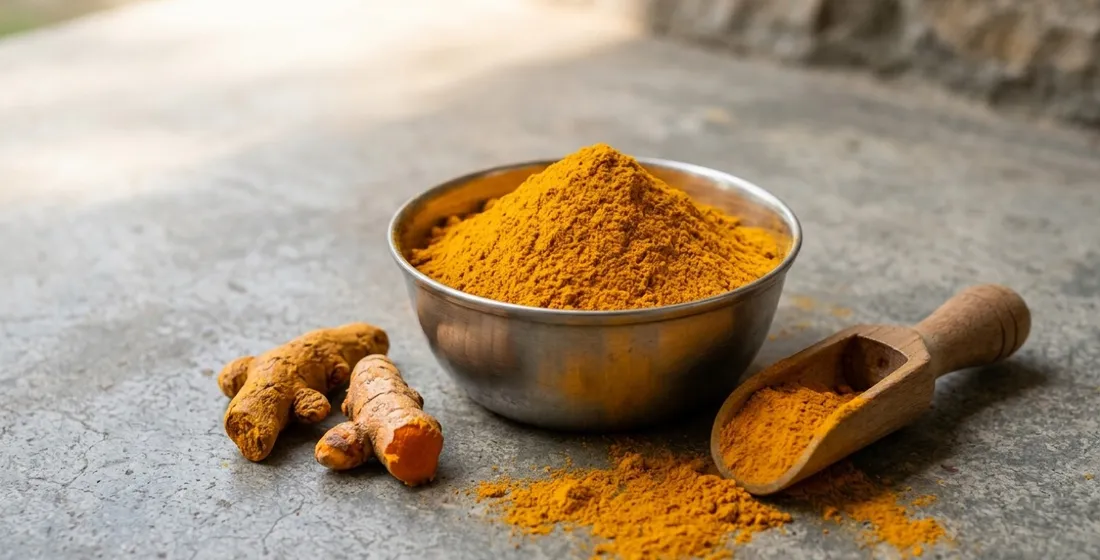
RFQ snapshot
- Dried turmeric rhizome (Curcuma longa) typically carries 2% to 5% curcuminoids by dry weight; a standardized “95% curcuminoids” extract is a different product, roughly 70% to 77% curcumin plus demethoxycurcumin and bisdemethoxycurcumin (UK Committee on Toxicity, 2024).
- India grows close to 75% to 80% of the world’s turmeric, so origin labels travel loosely. Origin alone does not set the curcuminoid number; the assay does (ICRIER, 2022).
- In 2024, a peer-reviewed study confirmed lead chromate adulteration of turmeric at source. Lead chromate is about 64% lead by weight, which is why a per-batch lead assay belongs in every turmeric RFQ.
- Silk Foods Ceylon (SFC) supplies Ceylon turmeric as whole, powder, and tea cut from a Matale facility under BRCGS and FSSC 22000 V6, with curcuminoid assay and a heavy-metals panel available on the batch COA.
- This post is for procurement teams writing a turmeric spec. If the label claim is a curcuminoid percentage, the RFQ has to name the number and the test method, not the origin.
Most turmeric sourcing briefs name an origin and a form, then stop. “Indian turmeric powder, 60 mesh, organic.” That spec buys color and flavor. It does not buy a defensible curcuminoid claim, and it does nothing about the contaminant that has pulled turmeric off shelves for a decade. If the finished label says anything about curcumin or curcuminoids, the spec behind it has to carry an assay number, a test method, and a heavy-metals limit. This piece is the procurement template for getting there.
What does “95% curcumin” actually mean?
A “95% curcuminoids” turmeric extract is not strong turmeric powder. It is a selectively extracted concentrate, standardized so that 95% of its mass is the three curcuminoid molecules: curcumin at roughly 70% to 77%, demethoxycurcumin near 17% to 20%, and bisdemethoxycurcumin at a few percent (UK Committee on Toxicity, 2024). Dried turmeric rhizome itself runs far lower, usually 2% to 5% curcuminoids by dry weight. The gap between the two is the source of most label confusion in the category.
That distinction decides the whole RFQ. A spice buyer ordering culinary turmeric powder needs color, flavor, and clean microbials. A nutraceutical buyer making a curcuminoid claim needs a verified assay and often a concentrated extract. Asking one supplier for “turmeric, 95%” when the buyer means powder, or “turmeric powder” when the buyer means a standardized extract, produces a quote that misses the actual requirement by an order of magnitude on both potency and price.
Why origin alone does not guarantee curcuminoid content
Buyers treat origin as a proxy for potency. It is a weak one. Curcuminoid content varies with cultivar, soil, harvest maturity, curing, and drying far more than with the country name on the bag. India produces close to 75% to 80% of global turmeric volume and holds about 66% of the world export market, so “Indian turmeric” spans an enormous quality range rather than a single grade (ICRIER, 2022; Spices Board of India, 2025).
The honest version of the origin story is this: origin is a traceability and food-safety lever, not a curcuminoid guarantee. A premium single-origin turmeric with no assay on the COA tells the buyer nothing they can put on a label. Specify the curcuminoid percentage and the test method, and let any origin compete against that number. Ceylon turmeric earns its place on traceability, batch documentation, and clean heavy-metals results, not on an assumed potency the spec never measured.
Specifying curcuminoid content in a turmeric RFQ
The fix is a spec that names the number and the method. Curcuminoid assays are not interchangeable. A UV-spectrophotometric reading typically reports a higher curcuminoid figure than HPLC on the same sample, because the spectrophotometric method also picks up co-extracted compounds. If a buyer specifies “5% curcuminoids” without naming HPLC, two honest suppliers can quote against two different numbers. Name the method, then the threshold.
Spec snapshot: turmeric for a curcuminoid claim
- Botanical: Curcuma longa, species confirmed in writing
- Form: powder (60 to 80 mesh typical), whole finger, or tea cut
- Curcuminoid assay: state minimum % AND method (HPLC preferred over spectrophotometric)
- Moisture: typically below 10%
- Heavy metals: per-batch lead assay by ICP-MS, with a stated limit
- Microbial: TPC, yeast and mould, Salmonella, E. coli to destination spec
- COA: every batch, with the curcuminoid figure and the heavy-metals panel
A spec written this way survives an audit. The buyer’s own FSMA-prep or retail auditor can trace the label claim back to a method and a batch result, which is exactly what a “turmeric powder, organic” line item cannot do.
Matching the spec to your label claim
Three label claims, three different specs and price tiers. The most common procurement error is paying extract money for a powder spec, or making a curcuminoid claim on a culinary-grade RFQ. The table below maps the claim to the product to the spec the RFQ has to carry.
| Label claim on finished product | Product to source | Curcuminoid assay to specify | Typical use | Relative price tier |
|---|---|---|---|---|
| ”Turmeric” / “turmeric powder” (color, flavor, golden-latte) | Dried rhizome, powder or cut | Optional; color value if relevant | Culinary spice, blends, beverages | Base |
| ”Turmeric root, standardized to X% curcuminoids” | Dried rhizome, assayed | State % by HPLC, per batch | Capsules, functional powders | Mid |
| ”Curcumin 95%” / “curcuminoids 95%“ | Selectively extracted concentrate | 95% total curcuminoids by HPLC | High-dose capsules, clinical-style SKUs | High |
Source: Silk Route Ventures (SRV) procurement framework, aligned to UK Committee on Toxicity (2024) and EFSA curcumin (E 100) evaluation.
The regulatory frame reinforces the split. In the EU, dried turmeric and turmeric concentrate are treated as colouring foods, while selectively extracted curcumin is the food additive E 100, for which EFSA set an acceptable daily intake of 3 mg per kg of body weight per day (EFSA, 2010). A buyer moving from a culinary powder to a concentrated curcumin SKU is not just buying a stronger ingredient. They are crossing a regulatory category, and the documentation has to follow.
For nutraceutical buyers, bioavailability sits on top of the assay. Curcumin’s low oral bioavailability is well documented, which is why so many SKUs pair it with piperine or use a specialized delivery form (Cureus, 2025). That is a formulation decision, not a raw-material one, but it belongs in the same brief: the assay sets what is in the capsule, the delivery system sets how much reaches circulation, and the label has to be honest about both.
The lead problem: specifying heavy-metals discipline
Turmeric has a contaminant history that procurement cannot treat as optional. Lead chromate, a vivid yellow industrial pigment, has been added to turmeric at source to brighten dull product. Lead chromate is roughly 64% lead by weight, so even small additions drive dangerous lead levels. In 2024, a peer-reviewed study confirmed the practice continuing in parts of South Asia, years after the first US exposure studies flagged it (Environmental Research, 2024; Forsyth et al., 2019).
The trade-desk version of this is concrete. In Q1 2026, the SRV procurement desk fielded three separate US and EU buyers rebuilding their turmeric spec after a heavy-metals failure on incoming product, each one adding a per-batch lead limit they had never written before. The US FDA maintains an import alert covering turmeric for lead, and tests under its toxic-elements-in-spices program, but it has not set a single numeric ceiling, which means the buyer’s own RFQ limit is the real control point.
Buyer’s checklist: turmeric heavy-metals discipline
- Per-batch lead assay by ICP-MS, with a numeric limit stated in the RFQ
- Full heavy-metals panel (lead, arsenic, cadmium, mercury) to destination spec
- Color verified by analysis, never by visual brightness alone
- Country-of-origin and farm-level traceability for organic SKUs
- Certificate of Analysis on every batch, lead figure included
- Sample tested against the spec before any purchase order
Frequently asked questions
What is the difference between turmeric powder and a 95% curcumin extract?
Turmeric powder is the dried, milled rhizome, typically 2% to 5% curcuminoids by dry weight (UK Committee on Toxicity, 2024). A 95% curcumin extract is a selectively extracted concentrate standardized to 95% total curcuminoids. They are different products with different specs, prices, and, in the EU, different regulatory categories.
What curcuminoid assay method should I specify in a turmeric RFQ?
Specify HPLC and a minimum percentage. UV-spectrophotometric assays usually report a higher curcuminoid figure than HPLC on the same sample because they capture co-extracted compounds. Naming the method removes ambiguity, so two suppliers quote against the same number rather than two different ones.
How do I avoid lead in sourced turmeric?
Write a per-batch lead assay by ICP-MS into the RFQ with a numeric limit, and verify color by analysis rather than brightness. Lead chromate adulteration is about 64% lead by weight (Environmental Research, 2024), and the US FDA sets no single ceiling, so the buyer’s own spec limit is the control point.
Does Ceylon turmeric have higher curcuminoid content than Indian turmeric?
Not reliably. Curcuminoid content tracks cultivar, agronomy, and curing more than country (ICRIER, 2022). Origin is a traceability and food-safety lever, not a curcuminoid guarantee. Specify the percentage and HPLC method, and judge any origin against that measured number.
Can Silk Route Ventures supply Ceylon turmeric with a curcuminoid assay, or private-label turmeric capsules?
Yes. Silk Foods Ceylon supplies Ceylon turmeric as whole, powder, and tea cut under BRCGS and FSSC 22000 V6, with curcuminoid assay and a heavy-metals panel on the batch COA. The same site runs turmeric capsule private label. First-order MOQ is 50 kg per SKU for bulk and 180 bottles for capsules.
How Silk Route Ventures can help
Silk Route Ventures supplies Ceylon turmeric to specialty spice and wellness brands across the US, EU, and Australia, shipped against the buyer’s spec from the BRCGS and FSSC 22000 V6 audited Silk Foods Ceylon facility in Matale. Bulk turmeric ships as whole, powder, or tea cut with a curcuminoid assay and a per-batch heavy-metals panel on the COA; first-order MOQ is 50 kg per SKU, and samples ship door-to-door by international courier at 3 to 5 business days. For wellness brands making a curcuminoid claim, the SFC site also runs turmeric capsule private label at a 180-bottle MOQ, and the SRV R&D team scopes standardized-extract sourcing to a stated HPLC spec. Contact us to send an inquiry or request a sample.
Sources
1. UK Committee on Toxicity, “Statement on the potential risk to human health of turmeric and curcumin,” (2024). Retrieved 2026-06-07. https://cot.food.gov.uk/node/13031
2. Indian Council for Research on International Economic Relations (ICRIER), “Making India the Global Hub for Turmeric,” (2022). Retrieved 2026-06-07. https://icrier.org/pdf/Making-India-the-Global-Hub-for-Turmeric.pdf
3. Spices Board of India, export performance data FY2024-25 (as reported 2025). Retrieved 2026-06-07. https://www.prokerala.com/news/articles/a1663228.html
4. European Food Safety Authority (EFSA), “Scientific Opinion on the re-evaluation of curcumin (E 100) as a food additive,” EFSA Journal (2010). Retrieved 2026-06-07. https://www.efsa.europa.eu/en/efsajournal/pub/1679
5. Environmental Research, “Evidence of turmeric adulteration with lead chromate,” (2024). Retrieved 2026-06-07. https://pubmed.ncbi.nlm.nih.gov/39053552/
6. Forsyth JE et al., “Ground Turmeric as a Source of Lead Exposure in the United States,” Public Health Reports (2019). Retrieved 2026-06-07. https://pmc.ncbi.nlm.nih.gov/articles/PMC5415259/
7. Cureus Journal of Medical Science, “Comparative Bioavailability Study of a Standardized Turmeric Extract Versus Curcuma longa With Piperine,” (2025). Retrieved 2026-06-07. https://www.ncbi.nlm.nih.gov/pmc/articles/PMC12712551/
Further reading
- CBI (Centre for the Promotion of Imports), “The European market potential for turmeric for food additives” → https://www.cbi.eu/market-information/natural-food-additives/turmeric-food-additives/market-potential
- Grand View Research, “Turmeric Extract (Curcumin) Market Size & Trends” → https://www.grandviewresearch.com/industry-analysis/turmeric-extract-curcumin-market
*Written by the Silk Route Ventures Trade Team. Silk Route Ventures (E-Silk Route Ventures (Pvt) Ltd) is a Sri Lankan B2B supply-chain operator for the Food, Beverage, Wellness, and Nutraceuticals sectors. The Silk Foods Ceylon manufacturing arm holds BRCGS and FSSC 22000 V6 certifications. Questions or to request a sample: Contact us or email info@esilkroute.com.lk.*