
Moringa Capsule Formulation: Leaf vs Seed and the Protein-Claim Landscape
Procurement snapshot
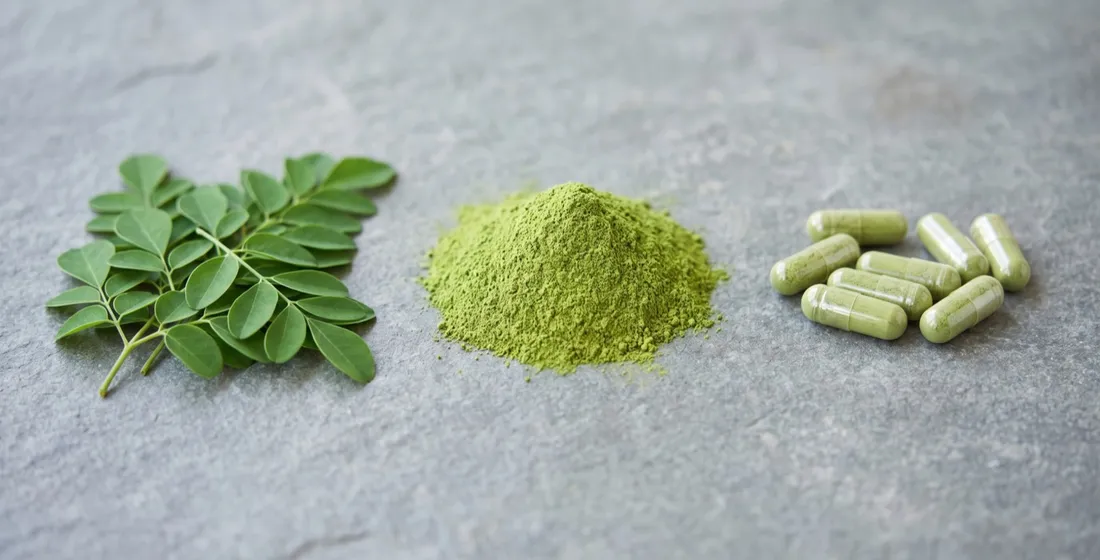
- Moringa oleifera has two commercial parts with two different jobs. The leaf, dried and milled to a fine powder, is the encapsulation ingredient, carrying protein, vitamins, minerals and polyphenols. The seed is an oil and isothiocyanate material, with a distinct actives profile and its own safety file, and it is not the base fill for a nutrition-positioned capsule.
- Leaf powder is nutrient-dense but the serving size defeats a protein claim. Dried moringa leaf runs roughly 26 percent crude protein on a dry basis (PLOS One, 2016), yet a 500 mg capsule holds only about 0.13 grams of protein. Even a six-capsule serving delivers under 1 gram, against a United States “good source of protein” floor of 5 grams per serving (21 CFR 101.54).
- Market access is not uniform. Moringa leaf and leaf powder are accepted as non-novel foods in the European Union, but seed oil is barred from food supplements and extracts are treated as novel (CBI, 2026). Australia and New Zealand went the other way: on 12 November 2025 FSANZ rejected the application to permit moringa oleifera as a food, citing insufficient safety evidence (FSANZ, 2025).
- The quality spec is where a capsule brief is won. Buyers ask for 80 to 100 mesh particle size, moisture under 8 percent, total plate count at or below 1,000 cfu per gram, and steam sterilisation rather than ethylene oxide, an IARC Group 1 carcinogen still flagged on imported botanicals (CBI, 2024).
- Silk Foods Ceylon (SFC) private-labels moringa leaf-powder capsules in HPMC vegetarian shells from a Matale facility under BRCGS and FSSC 22000 V6, with species identity confirmed, moisture and microbial screened, and heavy metals run per batch, at a 180-bottle first-order MOQ. Silk Route Ventures (SRV) supplies bulk moringa leaf powder to COA spec.
- For a brand that wants a defensible greens or botanical SKU, this is the spec and the claim discipline. For a brand chasing a “plant protein in a capsule” angle, the arithmetic does not support the claim, and no supplier can fix that.
Most moringa capsule briefs name a milligram strength, a bottle count, and a headline benefit, then stop. “Moringa 500 mg, 60 count, plant protein.” The fill weight is the easy part. Three harder questions decide whether the product is sellable: which part of the plant is actually in the capsule, what the protein number legally allows a brand to say, and whether the target market permits the ingredient at all. Moringa is one of the most demand-driven botanicals of the decade, with the leaf-powder market valued near 0.65 billion dollars in 2025 and forecast to reach 1.16 billion by 2035 at a 6.2 percent compound annual growth rate (Custom Market Insights, 2026). That demand pulls in briefs that confuse a nutrient-dense leaf with a protein source, and a supplement with a food. This piece works the moringa capsule the way a nutraceutical product team should work it, from the plant part through the claim, before the first batch is filled.
Leaf or seed: which part belongs in the capsule?
For a nutrition-positioned capsule the answer is the leaf, milled to a fine powder. The dried leaf carries the protein, the vitamin and mineral density, and the polyphenols that a greens or botanical SKU is sold on, and it holds all the essential amino acids, with a notably high tryptophan content (MDPI Molecules, 2026). The seed is a different material with a different purpose.
Moringa seed is the source of ben oil and of the rare glucosinolate glucomoringin, which converts to the isothiocyanate moringin, an actives profile studied for anti-inflammatory and other effects but distinct from the leaf’s nutritional value (Nature Scientific Reports, 2018). It also carries its own safety file. A repeated-dose study of isothiocyanate-enriched seed extract set a no-observed-adverse-effect level at 257 mg per kilogram of body weight per day, with mortality at roughly ten times that dose (Journal of Toxicology, 2018). Seed material is therefore an actives or oil ingredient specified on its own terms, not a drop-in substitute for leaf powder in a general-wellness capsule.
The practical rule for a certificate of analysis is to name the part. “Moringa oleifera leaf powder” is a spec. “Moringa extract” or “moringa powder” without the plant part named is a gap, because leaf and seed are not interchangeable in composition, claim, or regulatory status. The same identity discipline a formulator applies to an ashwagandha capsule’s root-versus-leaf question applies to moringa: state the species and the part, per batch.
What the protein number actually allows a brand to claim
Moringa leaf is genuinely protein-rich as a raw material, and that is exactly where briefs go wrong. Dried leaf runs about 26 percent crude protein on a dry basis, with the literature spread from roughly 19 to 35 percent depending on cultivar, soil, season and assay method (PLOS One, 2016). A raw-material percentage is not a serving claim, and the gap between the two is the whole problem.
The arithmetic is unforgiving. At 26 percent protein a 500 mg leaf-powder capsule holds about 0.13 grams of protein. A 1,000 mg fill holds about 0.26 grams. A generous six-capsule daily serving lands between roughly 0.8 and 1.6 grams. In the United States, “good source of protein” requires at least 10 percent of the Daily Value per serving, which is 5 grams, and “high protein” requires 20 percent, or 10 grams, with the protein quality-corrected for digestibility before it counts (21 CFR 101.54). A moringa capsule serving is an order of magnitude short of the lowest bar, before any quality correction is applied.
A raw-material assay of 26 percent protein and a finished serving of under 1 gram are not in conflict. They describe two different things: the concentration in the powder, and the mass a capsule can physically carry. A protein claim lives on the second number, and a capsule format cannot deliver it.
The European Union sets its protein claims against the share of a food’s energy that comes from protein rather than an absolute gram figure (Regulation (EC) No 1924/2006), a threshold a near-calorie-free capsule serving cannot reach either. In both markets the honest position is the same: moringa capsules are a botanical or micronutrient product, sold on vitamin, mineral and phytonutrient content within permitted structure-function limits, not a protein supplement. That is a positioning decision a brand makes on purpose, the way it would frame a gotukola cognitive SKU to the evidence rather than past it.
Spec snapshot: moringa leaf-powder capsule Botanical: Moringa oleifera, leaf only, species and part confirmed per batch Particle size: 80 to 100 mesh for clean encapsulation flow and fill Moisture: under 8 percent for mould control Microbial: total plate count at or below 1,000 cfu per gram; yeast and mould at or below 100 cfu per gram; E. coli and Salmonella absent Sterilisation: steam, not ethylene oxide Heavy metals: lead, cadmium and mercury per batch Capsule shell: HPMC vegetarian (size 0 or 00) or gelatin SFC MOQ: 180 bottles first order; encapsulation under BRCGS and FSSC 22000 V6
Where moringa capsules are sold, and where they are not
Moringa’s regulatory status splits sharply by market, and a brand selling into more than one region has to design to the strictest one. In the United States moringa leaf is marketed as a dietary supplement ingredient under DSHEA, manufactured to cGMP under 21 CFR Part 111, and limited to structure-function claims with the required disclaimer. In the European Union moringa leaf and leaf powder are accepted as non-novel, permitted in supplements under national botanical lists, while moringa seed oil is prohibited in food supplements and extracts are treated as novel foods needing authorisation (CBI, 2026).
Australia and New Zealand are the outlier a 2026 brief must know. On 12 November 2025 Food Standards Australia New Zealand rejected Application A1294, which sought to permit moringa oleifera leaf, immature pods and oil as food, on the grounds that the safety evidence was insufficient (FSANZ, 2025). The effect is that moringa is not permitted as a general food or food ingredient for retail sale in those markets through that pathway, and the therapeutic-goods route is a separate question a brand must confirm before planning an Australian launch.
| Market | Regulatory frame | What it means for a moringa capsule |
|---|---|---|
| United States | Dietary supplement under DSHEA, cGMP 21 CFR 111 | Structure-function claims with the DSHEA disclaimer; no protein or disease claims |
| EU and UK | Leaf and leaf powder non-novel; seed oil banned in supplements; extracts novel | Leaf-powder capsule permitted; verify the exact ingredient form against novel-food status |
| Australia and New Zealand | FSANZ rejected the food application in November 2025 | Not permitted as a food ingredient through that pathway; confirm any therapeutic-goods route first |
Source: SRV regulatory summary; confirm against current regulator guidance before finalising any claim or launch plan.
Specifying moringa leaf powder in an RFQ
A moringa capsule request for quotation should pin six lines: species and plant part with identity testing, particle size in mesh, moisture ceiling, microbial and heavy-metals screening, the sterilisation method, and the capsule shell material. Leaving any line to the filler’s default is how a contaminant or a mislabelled plant part reaches the shelf.
The sterilisation line deserves its own attention, because it is where moringa briefs most often carry hidden risk. Ethylene oxide is an IARC Group 1 carcinogen, banned as a food fumigant in the European Union since 1991, yet EtO residues continue to surface on imported herbs and spices in EU border alerts (CBI, 2024). Steam sterilisation is the compliant, residue-free alternative and is compatible with organic certification, which makes “steam sterilised, EtO-free” a spec line rather than a preference for any EU or United States bound moringa. A brand weighing organic positioning should read that line alongside the wider organic certification picture for its target market.
In early 2026 the SRV procurement desk fielded a familiar version of this gap. A wellness brand arrived with “Moringa Plant Protein, 500 mg” on draft artwork and a supplier certificate that read “moringa powder” with no plant part named and no sterilisation method stated. Two problems sat under one label. The protein claim could not be met at any capsule serving the format allows, and the unnamed powder could have been leaf, seed, or a blend, with different composition and different EU status. The fix was a spec rewrite and a copy change: specify moringa oleifera leaf powder, 80 to 100 mesh, steam sterilised, screened per batch, and reposition the front panel around the leaf’s vitamin and mineral content within structure-function limits. Settled before artwork, that is a purchase-order edit. Caught after print, it is a relabel and a delayed launch.
Where a moringa protein SKU is the wrong fit A brand that wants a “plant protein in a capsule” front panel, a seed-oil actives claim inside a nutrition capsule, or an Australian retail food launch on current rules is buying a compliance problem, not a product. For those briefs moringa in a capsule is the wrong format or the wrong market. SRV builds moringa capsules for brands that will name the plant part, specify the sterilisation method, test per batch, and write the claim to the vitamin and mineral content the format can actually carry.
Frequently asked questions
Is moringa leaf or seed used in a nutrition capsule?
The leaf, milled to a fine powder, is the encapsulation ingredient for a nutrition-positioned product, carrying the protein, vitamins, minerals and polyphenols. The seed is an oil and isothiocyanate material with a separate actives profile and its own safety file (Nature Scientific Reports, 2018), specified on its own terms rather than dropped into a general-wellness capsule.
Can a moringa capsule make a protein claim?
No. Dried moringa leaf runs about 26 percent protein on a dry basis, but a 500 mg capsule holds only about 0.13 grams, and even a six-capsule serving stays under 1 gram against a United States “good source” floor of 5 grams (21 CFR 101.54). A moringa capsule is a botanical or micronutrient product, not a protein supplement.
What spec should a buyer put on moringa leaf powder for capsules?
Specify moringa oleifera leaf, 80 to 100 mesh, moisture under 8 percent, total plate count at or below 1,000 cfu per gram, E. coli and Salmonella absent, steam sterilised rather than EtO-treated, with lead, cadmium and mercury run per batch (CBI, 2024). Name the plant part and the sterilisation method explicitly.
Does Silk Foods Ceylon manufacture moringa capsules under BRCGS and FSSC?
Silk Foods Ceylon encapsulates private-label moringa leaf-powder capsules in HPMC vegetarian shells from a Matale, Sri Lanka facility under BRCGS and FSSC 22000 V6, with species identity confirmed, moisture and microbial screened, and heavy metals run per batch. Silk Route Ventures supplies bulk moringa leaf powder to COA spec, from a 180-bottle first-order MOQ.
How Silk Route Ventures can help
Silk Route Ventures (SRV) and its manufacturing arm Silk Foods Ceylon (SFC) private-label moringa and other botanical supplement capsules for wellness and nutraceutical brands. The team specifies the plant part against the claim, names moringa oleifera leaf powder to a mesh and moisture spec, and confirms steam sterilisation so the ingredient in the capsule matches the ingredient on the label.
Encapsulation runs in HPMC vegetarian shells from a Matale facility under BRCGS and FSSC 22000 V6, with USDA Organic and EU Organic on the relevant SKUs, species identity confirmed and heavy metals screened per batch, and a 180-bottle first-order MOQ that lets an early-stage brand test a SKU without a full production commitment. For brands positioning moringa against a defensible claim, the SRV R&D and NPD team will document the plant part, the spec and the market status before the formulation is locked. Contact us to send an inquiry or request a sample.