
Guduchi Powder for Immunity-Claim Nutraceutical SKUs
Buyer’s snapshot
- The global immune health supplements market was worth roughly USD 75.99 billion in 2025 and is projected near USD 85.63 billion in 2026, a 12.7 percent growth rate (The Business Research Company, 2026). Immunity remains the single largest claim category new botanical SKUs launch against.
- Guduchi is Tinospora cordifolia (family Menispermaceae), known as Rasakinda in Sinhala and sold commercially as Giloy. It is routinely confused with Tinospora crispa and Tinospora sinensis, two related vines traded under the same common names but carrying a different chemical and safety profile.
- Guduchi also carries a documented, if uncommon, liver-injury signal in the published case literature, mostly from India during the 2020 to 2022 period. A defensible SKU names the species on the COA and does not oversell the safety story.
- Silk Foods Ceylon supplies bulk Guduchi powder and private-label capsules from Matale under BRCGS and FSSC 22000 V6, with a 50 kg first-order MOQ and samples in 3 to 5 business days.
- This post is for brands building a compliant structure/function immunity SKU. If the plan is a hard “boosts immunity” or “prevents infection” claim, the regulatory rules do not allow it in the US or the EU, and this is the wrong claim strategy regardless of the supplier.
Most immunity-category RFQs that land on the desk of a Sri Lankan supplier such as Silk Route Ventures (SRV) say “Guduchi extract” or “Giloy powder” with no species named, no marker compound, and no claim language attached. That gap matters twice over. The botanical trade routinely substitutes Tinospora crispa or Tinospora sinensis for true Tinospora cordifolia without the buyer noticing, and the finished label copy has to sit inside a claim framework that is narrower than most immunity-category marketing assumes. This piece is the spec, the honest read on the evidence and safety record, and the claim line a nutraceutical buyer can actually defend. It sits inside the wider guide to sourcing functional herbs and Ayurvedic botanicals from Sri Lanka.
What is Guduchi, and which species belongs on the COA?
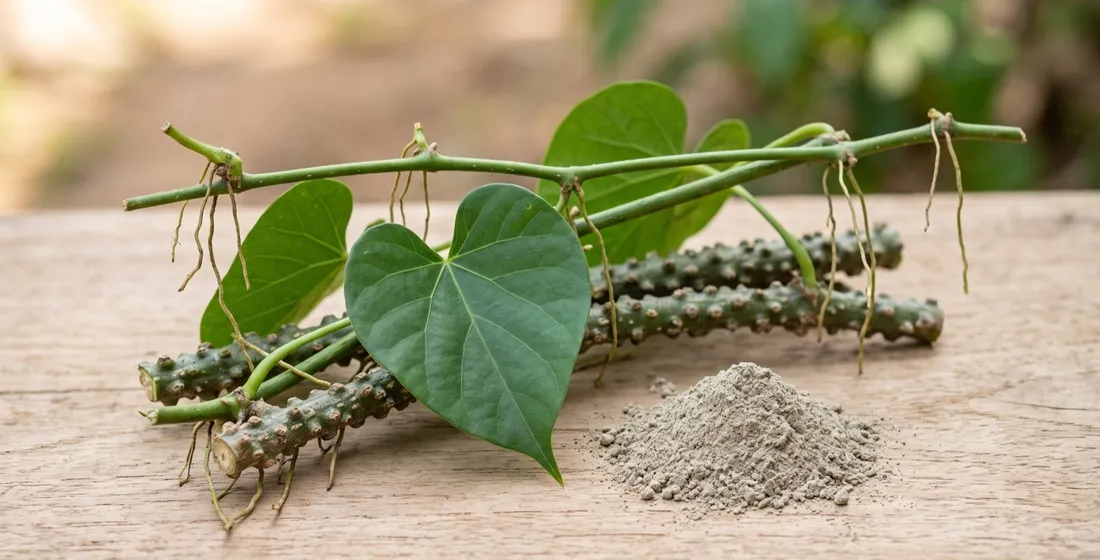
Guduchi (Rasakinda in Sinhala, commercially traded as Giloy) is Tinospora cordifolia (Willd.) Miers, a climbing vine in the moonseed family, Menispermaceae. The stem is succulent and green with a corky, warty bark, and it sends down characteristic thread-like aerial roots at the nodes. The leaves are heart-shaped, simple, with palmate veins radiating from the base. All three features together, the aerial roots, the warty succulent stem, and the cordate leaf, are what separates it from an unrelated plant like neem on sight, and from its own genus-mates on closer inspection.
The closer confusion sits within the genus itself. Tinospora crispa and Tinospora sinensis are both traded across South and Southeast Asia under the same “Guduchi” or “Giloy” names, and they are not interchangeable. A 2023 morphological and phytochemical comparison found T. crispa carries more prominent warty stem protuberances than T. cordifolia, and the two species differ in leaf-surface texture, smooth in T. cordifolia, pubescent in T. crispa (Springer, Genetic Resources and Crop Evolution, 2023). A separate HPTLC and chemometric screening study distinguished the three species with 94.44 percent accuracy using marker-compound band patterns, including tinosporaside and berberine intensity ratios, and confirmed that authentic T. cordifolia is frequently substituted with the two related species in commercial dietary supplements (Planta Medica, 2020).
A spec that names Tinospora cordifolia and asks for a marker-verified COA closes that gap before it reaches the label. It is the same discipline that keeps an Ashwagandha capsule spec tied to a named plant part rather than a generic ingredient name, and the same species-first care a Heenbovitiya inflammation-claim SKU needs against its own look-alike.
Spec snapshot: Guduchi powder (Tinospora cordifolia)
- Species: Tinospora cordifolia, verified per lot (not T. crispa or T. sinensis)
- Part used: stem (the traditional and most-studied plant part)
- Origin: Sri Lanka, Central Province and the Matale growing belt
- Marker: berberine and tinosporaside content on a house HPLC or HPTLC method; no US Pharmacopeial monograph exists yet for this ingredient
- Format: milled powder to an agreed mesh, capsule-ready granulation
- QA per batch: heavy metals, pesticide panel, microbial count, moisture, COA
- Silk Foods Ceylon MOQ: 50 kg bulk powder first order; 180 bottles for private-label capsules
What does the evidence actually show for an immunity claim?
Be precise here, because the claim line depends on it. The best-controlled human data for Guduchi is narrower than the “immunity booster” framing suggests. A randomized, double-blind, placebo-controlled trial in HIV-positive patients gave Tinospora cordifolia extract to 68 participants over six months; 60 percent on the extract reported fewer disease-associated symptoms versus 20 percent on placebo, though not every objective lab parameter tracked improved (Indian Journal of Pharmacology, 2008).
A separate randomized controlled study in diabetic-foot-ulcer patients found that Guduchi normalized neutrophil phagocytic and killing capacity as a surgical adjuvant, with postoperative septicemia in 0 percent of the treated group versus 50 percent of controls (2007 study, PubMed).
Both trials are real signal. Neither is a general “supports immune health in otherwise healthy adults” study, which is the population most immunity-category SKUs are actually formulated for, and that gap is where a buyer’s claim substantiation file has to work harder than a marketing brief usually assumes.
The honest complication is the liver-safety record. Guduchi was promoted heavily in India as an immunity booster during the COVID-19 period, and a documented cluster of drug-induced, autoimmune-like hepatitis cases followed, reported in patients who had recently started Guduchi or Guduchi-containing formulations (Journal of Clinical and Experimental Hepatology, 2022). A 2023 case review catalogued the pattern across multiple published reports: idiosyncratic, likely immune-mediated liver injury, with transaminases typically normalizing within weeks to months of stopping the supplement (Cureus, 2023). This is not a reason to avoid the ingredient. It is a reason a formulator’s dossier should carry a defined dose ceiling, a clean COA with confirmed species identity, and label language that stays inside structure/function claims rather than promising disease prevention.
SRV finding: the most common gap the SRV procurement desk sees on an incoming Guduchi RFQ is the missing species line, the same defect that shows up across most Ayurvedic botanical briefs. A buyer asks for “Guduchi powder” or “Giloy extract” with no binomial name and no marker compound specified. That omission is the single cheapest line item to add to a spec sheet, and it is exactly where a supplier can quietly substitute T. crispa or T. sinensis without the buyer ever finding out.
Writing the claim line: FDA structure/function and EU Article 13.1 on-hold
The claim is where an immunity SKU lives or dies. In the United States, DSHEA permits structure/function language, such as “supports immune health” or “supports a healthy immune response,” provided the manufacturer can substantiate the claim, notifies the FDA within 30 days of first use, and carries the mandatory disclaimer that the statement has not been evaluated by the FDA and the product is not intended to diagnose, treat, cure, or prevent any disease (FDA, Structure/Function Claims guidance). What DSHEA does not permit is a disease claim. “Boosts the immune system against colds and flu,” “supports the body’s ability to resist infection,” and “supports antiviral capabilities” all read as implied disease claims and are not allowed on a supplement label, even though “supports the immune system” alone is permitted because the immune system carries both a structure/function role and a disease-fighting role.
The European Union stays stricter and, for Guduchi specifically, has authorized nothing. Roughly 2,000 botanical Article 13.1 health claims have sat “on hold” at EFSA since 2012, neither authorized nor rejected, and Guduchi’s immunity positioning is not among the small number that have cleared review (Vitafoods Insights reporting on the EFSA on-hold register, 2026). No EU health claim currently exists for Tinospora cordifolia. Because the ingredient does not have an established, documented history of consumption as a food in the EU before May 1997, a food-business operator bringing it into the EU for the first time should also verify its status against the European Commission’s Novel Food status catalogue before assuming the claim conversation is the only open item.
For a brand selling into both markets, the workable route is a US structure/function label with the DSHEA disclaimer, paired with claim-neutral EU copy until the botanical file and the Novel Food question both resolve.
Specifying Guduchi powder in a sourcing RFQ
An RFQ a Sri Lankan supplier can quote cleanly, and that protects the buyer’s label, carries these lines. Species and marker compound come first because they are the cheapest guarantee against the T. crispa and T. sinensis substitution risk described above. The rest is the QA panel a nutraceutical buyer’s own auditor asks for on any botanical intake.
Buyer’s checklist: Guduchi powder RFQ
- Botanical species confirmed in writing as Tinospora cordifolia (not T. crispa or T. sinensis)
- Part used stated (stem)
- Marker compound named (berberine, tinosporaside) with the assay method
- Heavy-metals panel (lead, arsenic, mercury, cadmium) tested per USP General Chapter <561> or an equivalent destination-market method
- Pesticide-residue panel aligned to US or EU limits as relevant
- Microbial panel run to USP General Chapter <2023> (Microbiological Attributes of Nonsterile Nutritional and Dietary Supplements), plus moisture and mesh size to spec
- Per-batch COA and traceability back to the harvest source
- Sample dispatched and approved against the spec before any purchase order
No US Pharmacopeial monograph exists yet for Guduchi specifically. The closest formal reference is the Ayurvedic Pharmacopoeia of India, which sets organoleptic, loss-on-drying, ash-value, and extractive parameters for the raw stem. In the absence of an ingredient-specific USP monograph, the two general USP chapters above (heavy metals and microbiological limits) are what a US-bound buyer’s own quality team will expect to see satisfied, monograph or no monograph. Buyers running this spec usually split into two camps: brands sourcing raw material against an existing capsule co-packer, and earlier-stage brands that want the finished bottle. Silk Foods Ceylon serves both, and the spec above is identical whether the output is a 50 kg bag of powder or a private-label capsule run, including on the USDA Organic and EU Organic SKUs buyers most often ask about.
Powder or capsule? Format and MOQ economics
The format decision sets the MOQ and the lead time. Bulk Guduchi powder at Silk Foods Ceylon carries a 50 kg first-order minimum per SKU, milled on a line that runs 100 to 200 kg per hour, so a single herb SKU clears in well under a day of production. Private-label encapsulation runs 100,000 capsules per single shift and 200,000 per day, with a first-order MOQ of 180 bottles. Fine, uniform particle size matters more for Guduchi than for most bulk spices, because an inconsistent grind slows capsule fill-weight accuracy on an automated line. Samples ship by international courier in 3 to 5 business days; a purchase order moves to dispatch in 2 to 3 weeks, with 2 to 4 weeks added when the brief includes formulation work.
For an immunity-positioned line, the capsule route is usually where the claim actually gets built, because it lets a brand pair a marker-verified Guduchi with better-evidenced immune-support actives inside one compliant formula rather than relying on a single unproven ingredient story. That is R&D and NPD work, not a catalogue pick, and it is where the low MOQ earns its keep: a brand can test a 180-bottle immunity SKU before committing to a container, the same 180-bottle capsule MOQ economics that make early-stage wellness launches workable. The species-and-part precision that makes this work is the same discipline covered in Ashwagandha root versus leaf sourcing, and the economics of testing small before scaling are covered in the guide to working with low-MOQ contract manufacturers.
| Attribute | Guduchi (T. cordifolia) | T. crispa | T. sinensis |
|---|---|---|---|
| Sinhala / trade name | Rasakinda, Giloy | Sometimes sold as Giloy | Sometimes sold as Giloy |
| Stem surface | Warty, moderate protuberances | More prominent warty protuberances | Smoother, less warty |
| Leaf texture | Smooth | Pubescent | Intermediate |
| Marker compounds | Tinosporaside, berberine | Different tinosporaside band (HPTLC) | Different tinosporaside band (HPTLC) |
| Best-documented human data | HIV adjuvant RCT, surgical-adjuvant RCT | Limited; liver-injury reports in the literature | Limited human data |
| Regulatory / safety flag | Idiosyncratic liver-injury case reports | Reported acute fulminant hepatitis cases | Not well characterized in humans |
Source: SRV facility data and species comparisons drawn from Springer (2023) and Planta Medica (2020).
Where Guduchi does not fit
Guduchi is not the ingredient for a brand that wants a front-of-pack “boosts immunity” or “prevents infection” claim. Neither US nor EU rules allow that language for any botanical, and the liver-injury case literature makes an aggressive, high-dose positioning a real formulation-and-legal risk, not a marketing preference to weigh. It is also not a commodity ingredient competing on cost per kilo against unverified wild-harvest material, where the T. crispa and T. sinensis substitution risk is highest. Its value is a species-verified, marker-tested, structure/function-compliant SKU inside a broader immune-support formula, the same conservative-claim discipline that shapes a Beli digestive-claim SKU or a Margosa skin-claim spec. For a brand whose customer chooses on origin and clean sourcing, and who is willing to write conservative label copy, that is the argument. For a brand that wants a disease-prevention claim regardless of the ingredient, no supplier can deliver that legally.
Frequently asked questions
Is Guduchi the same as Giloy, or Tinospora crispa?
Guduchi and Giloy are the same plant, Tinospora cordifolia. Tinospora crispa is a related but different species, more warty-stemmed with pubescent leaves, that is commonly sold under the same trade name across South and Southeast Asia. HPTLC marker-compound testing distinguishes the species with over 94 percent accuracy, which is why a Guduchi COA should confirm the binomial name, not just the trade name.
Can a supplement brand claim Guduchi “boosts immunity”?
No. In the United States, DSHEA permits only structure/function language such as “supports immune health,” with the mandatory disclaimer (FDA, Structure/Function Claims guidance). “Boosts immunity against colds and flu” or “prevents infection” are disease claims and are not allowed. In the EU, no health claim is currently authorized for any Guduchi positioning.
Does Silk Route Ventures supply Guduchi powder and capsules at low MOQ?
Yes. Silk Foods Ceylon supplies bulk Tinospora cordifolia powder at a 50 kg first-order MOQ and private-label capsules at 180 bottles per single shift, from a Matale facility under BRCGS and FSSC 22000 V6, with USDA Organic and EU Organic available on qualifying SKUs. Samples ship in 3 to 5 business days.
What should the Guduchi powder COA show?
At minimum: confirmed species (Tinospora cordifolia), part used, a named marker compound (berberine or tinosporaside) with assay method, a heavy-metals panel, a destination-aligned pesticide-residue panel, microbial counts, moisture, and mesh size. No ingredient-specific US Pharmacopeial monograph exists yet, so the general USP heavy-metal and microbiological chapters are the applicable US reference.
Is Guduchi safe? What about the liver-injury reports?
Published case reports, mostly from India during 2020 to 2022, describe idiosyncratic, likely immune-mediated liver injury linked to Guduchi supplements, with transaminases typically returning to normal within weeks to months of stopping the product (Cureus, 2023). A dose ceiling, a species-verified spec, and conservative structure/function label language are the practical mitigations a formulator’s dossier should carry.
How Silk Route Ventures can help
Silk Route Ventures (SRV) supplies bulk Ayurvedic and functional botanicals and manufactures nutraceutical capsules for wellness brands worldwide. The Silk Foods Ceylon (SFC) facility in Matale holds BRCGS and FSSC 22000 V6 covering encapsulation and powder processing, with USDA Organic and EU Organic on qualifying SKUs. Bulk Guduchi powder starts at a 50 kg first-order MOQ; private-label capsules start at 180 bottles per single shift; samples ship by international courier in 3 to 5 business days. For brands building an immunity-support formula without an existing co-packer, the SRV R&D and NPD team also develops species-verified, claim-compliant blends in-house. Contact us to send an inquiry or request a sample.
Sources
- Springer, Genetic Resources and Crop Evolution, “Evaluation of Tinospora species: T. cordifolia, T. sinensis and T. crispa with microscopic imaging, physicochemical properties and major compounds profiling for authentic uses” (2023). link.springer.com (retrieved 3 August 2026)
- Thieme, Planta Medica (via PubMed), “Comparative Morpho-Anatomical and HPTLC Profiling of Tinospora Species and Dietary Supplements” (2020). pubmed.ncbi.nlm.nih.gov (retrieved 3 August 2026)
- US FDA, Structure/Function Claims guidance. fda.gov (retrieved 3 August 2026)
- Vitafoods Insights, “On-hold botanical claims inch closer to full assessment by the EU,” reporting on the EFSA Article 13(1) on-hold register (2026). vitafoodsinsights.com (retrieved 3 August 2026)
- Cureus, “Tinospora cordifolia (Guduchi/Giloy)-Induced Liver Injury: A Case Review” (2023). cureus.com (retrieved 3 August 2026)
- Journal of Clinical and Experimental Hepatology (ScienceDirect), “Can Guduchi (Tinospora cordifolia), a well-known ayurvedic hepato-protectant cause liver damage?” (2022). sciencedirect.com (retrieved 3 August 2026)
Further reading
- The Business Research Company, “Immune Health Supplements Global Market Report” (2026). thebusinessresearchcompany.com
- Indian Journal of Pharmacology, “Immunomodulatory effect of Tinospora cordifolia extract in human immuno-deficiency virus positive patients” (2008). pmc.ncbi.nlm.nih.gov
- PubMed, “Immunomodulatory role of Tinospora cordifolia as an adjuvant in surgical treatment of diabetic foot ulcers: a prospective randomized controlled study” (2007). pubmed.ncbi.nlm.nih.gov