
Green Coffee Bean Powder for Weight-Management Nutraceutical SKUs
Buyer’s snapshot
- Green coffee bean powder is milled unroasted bean. Green coffee extract is a concentrated fraction. They are different raw materials with different specs, different price points, and different regulatory exposure. Do not write one RFQ for both.
- The single most useful line in a green coffee RFQ is the assay basis. A 2019 peer-reviewed survey of commercial green coffee extracts found products delivered an average of 57 percent of their label chlorogenic acid, and only 28 percent met the marketed 50 percent spec.
- Regulation (EU) 2023/915 sets ochratoxin A maximum levels for roasted and soluble coffee but sets none for green, unroasted beans. A green-bean buyer’s OTA limit is contractual, not statutory.
- No EU health claim for chlorogenic acid or green coffee appears on the Regulation (EU) 432/2012 permitted list, and the US Federal Trade Commission brought two separate enforcement actions against green coffee weight-loss marketers in 2014.
- Silk Foods Ceylon encapsulates botanical powders in Matale under BRCGS and FSSC 22000 V6, at 100,000 capsules per single shift, with a 180-bottle first-order MOQ.
Green coffee bean powder is one of the few botanical ingredients where the sourcing conversation and the legal conversation cannot be held separately. The compound that gives the ingredient its commercial story, chlorogenic acid, is also the compound that regulators in four jurisdictions have looked at and declined to endorse for weight loss. Meanwhile the analytical method used to quantify that compound is inconsistent enough across the supply base that two suppliers can quote the same number and mean materially different things.
That is an awkward ingredient to buy casually. It is a straightforward ingredient to buy well, provided the RFQ is written to close the gaps rather than around them. This is a spec primer for product developers and procurement leads building capsule, tablet, or powder-blend SKUs in the metabolic and weight-management space, written for the US, EU, UK, and Australian markets.
What is green coffee bean powder, and how is it different from green coffee extract?
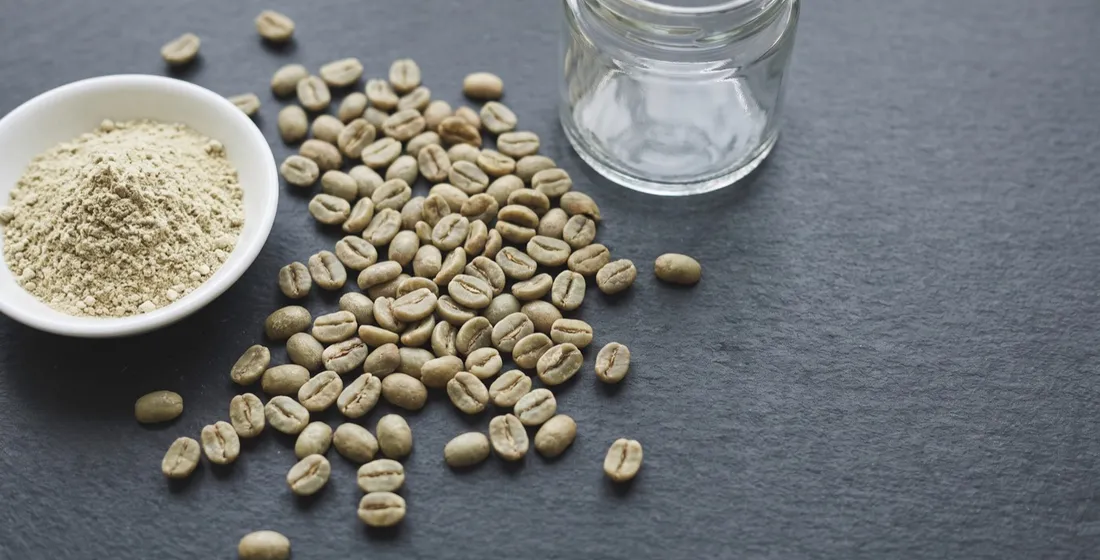
Green coffee bean powder is the whole unroasted coffee bean, cleaned, dried, and milled to a specified mesh. Nothing is removed and nothing is concentrated. Green coffee extract is produced by solvent or water extraction of the bean, concentrating chlorogenic acids into a fraction typically sold at a stated percentage assay, then dried onto a carrier or spray-dried neat. The two materials share an origin and share almost nothing else on a spec sheet.
Peer-reviewed HPLC work published in ACS Omega in 2025 measured 5-caffeoylquinic acid, the dominant chlorogenic acid isomer, at 49.41 to 58.28 mg per gram in green Arabica beans, which is roughly 4.9 to 5.8 percent by weight, with caffeine at 0.79 to 1.27 percent. Commercial extracts are commonly sold at 45 to 50 percent total chlorogenic acids. That is close to a tenfold difference in active loading, and it drives everything downstream: capsule fill weight, tablet compression, dose maths, and unit economics.
The practical consequence is a format decision that has to be made before the RFQ goes out, not after quotes come back. A 500 mg capsule of green coffee bean powder carries roughly 25 to 29 mg of 5-CQA. A 500 mg capsule of a 50 percent extract carries roughly 250 mg. Clinical work on green coffee sits at the extract end of that range, which matters if the label is going to reference any of it.
Why “50 percent chlorogenic acids” is not a specification
This is the section that earns the RFQ. A percentage assay for chlorogenic acid is meaningless without three additional pieces of information: what is being counted, how it is measured, and against what reference standard.
Chlorogenic acids are a family, not a molecule. A supplier may report total chlorogenic acids, summing the caffeoylquinic, feruloylquinic, and dicaffeoylquinic isomers, or may report only 5-CQA and express it as a chlorogenic acid equivalent. Those are different numbers from the same sample. Vinson and colleagues, publishing in the Journal of Medicinal Food in 2019, ran both approaches across a set of commercial green coffee extracts and found the extinction-coefficient method returned 26.8 percent where the 5-CQA single-standard method returned 29.9 percent on the same material, an inflation of about 12 percent in relative terms purely from the choice of basis.
The same study found something more serious. Across the commercial products surveyed, measured chlorogenic acid averaged 157 mg per labelled dose against a label average of 233 mg, so the average product delivered about 57 percent of what its label claimed. Measured content ranged from zero to 61.3 percent by weight. Only 28 percent of the products tested met the 50 percent chlorogenic acid specification they were marketed against. Caffeine averaged 2.8 percent by weight but ranged from zero to 17 percent, which is a wide enough band to change a finished-dose caffeine declaration by an order of magnitude.
Spec snapshot: the four lines that make a green coffee assay auditable
- State whether the reported percentage is total chlorogenic acids or 5-CQA expressed as chlorogenic acid equivalent. Require the same basis on every subsequent lot.
- Name the analytical method and detection wavelength. HPLC with UV detection at 325 nm for chlorogenic acids and 275 nm for caffeine is the conventional pairing in the published literature.
- Name the reference standard and its supplier. Single-standard 5-CQA quantitation and extinction-coefficient quantitation are not interchangeable.
- Require the certificate of analysis to be lot-specific and issued against the received consignment, not a type-test certificate reissued from a historical batch.
Buyers who apply this discipline to curcuminoid assays already know the pattern. The same logic that separates a real curcumin percentage from a marketing percentage in turmeric capsule formulation applies here, and the same discipline that governs an HCA number in garcinia capsule formulation applies to a chlorogenic acid number. Green coffee is the harder case because the isomer family is larger and the reporting convention is less settled.
Powder or extract: matching the material to the SKU
Format selection follows the claim strategy and the dose maths, not the other way round.
| Decision input | Green coffee bean powder | Green coffee extract |
|---|---|---|
| Typical 5-CQA or total CGA loading | Roughly 5 to 6 percent 5-CQA in green Arabica (ACS Omega, 2025) | Commonly sold at 45 to 50 percent total CGA, verify per lot |
| Caffeine | Roughly 0.8 to 1.3 percent in green Arabica | Highly variable, surveyed range 0 to 17 percent by weight |
| Capsule fill required for a 300 mg CGA dose | Not practically achievable in a capsule format | Roughly 600 to 700 mg at a verified 45 to 50 percent assay |
| Best-fit SKU | Whole-food positioned powder blends, functional beverage premixes, clean-label stacks | Standardised capsule and tablet SKUs where dose is on the label |
| Label transparency | Simple, single-ingredient declaration | Requires assay basis, carrier declaration, and solvent disclosure |
| Regulatory profile | Conventional food history, straightforward | Concentrated extracts may raise separate questions, verify per market |
| Cost per unit of active | Higher | Lower |
The powder is the better raw material when the SKU is built on a whole-food or clean-label story and the chlorogenic acid content is a supporting detail rather than the headline. The extract is the better raw material when a specific milligram dose has to appear on the panel. Blending the two, which some formulators attempt to get a “whole bean plus standardised” story, produces a label that is difficult to substantiate and a COA that is difficult to write. It is usually not worth the complexity.
What the claims landscape actually allows
Green coffee has a longer enforcement history than almost any other botanical in the weight-management category, and a formulator who does not know it will write a label that cannot survive contact with a regulator.
In the European Union, the EFSA NDA Panel assessed Article 13(1) claims for coffee and chlorogenic acids in 2011, covering protection against oxidative damage, maintenance of normal blood glucose, and maintenance or achievement of a normal body weight (EFSA Journal 2011;9(4):2057). No chlorogenic acid or green coffee weight-management claim appears on the permitted list established by Regulation (EU) No 432/2012. A separate Article 13(5) application for a standardised coffee preparation was assessed in 2020 and the Panel did not establish a cause-and-effect relationship (EFSA Journal, publication 6055). The practical position for an EU-facing SKU is that there is no authorised claim to use.
In the United States, the Federal Trade Commission brought two actions in 2014. In May it charged the marketers of a product called Pure Green Coffee over claims including substantial weight loss in a matter of weeks. In September it settled with Applied Food Sciences, an ingredient supplier, for 3.5 million dollars, over a study the FTC characterised as too flawed to support any reliable conclusion. The 2012 paper that had driven much of the category’s growth was retracted in October 2014 after the sponsors could not assure the validity of the underlying data. The US Food and Drug Administration has separately issued warning letters covering supplements marketed with unapproved drug claims, including green coffee extract positioned as an inhibitor of diet-related obesity.
The underlying evidence is thinner than the marketing history suggests. A 2023 systematic review and meta-analysis in Systematic Reviews pooled three randomised controlled trials totalling 103 subjects and found a weighted mean difference of 1.30 kg in body weight favouring chlorogenic acid supplementation (95% confidence interval 0.52 to 2.07 kg, p=0.001), at doses of 500 to 800 mg per day over one to eight weeks. The authors flag the small pooled sample and short duration themselves. That is a real signal in a small dataset, and it is not a basis for a weight-loss claim in any of the four markets discussed here.
Certification snapshot
Silk Foods Ceylon (SFC) operates its encapsulation and powder-processing lines under BRCGS and FSSC 22000 V6, with USDA Organic and EU Organic certification on the relevant SKUs. Certificates of analysis are issued per batch. What a certification scheme cannot do is substantiate a claim. Food-safety certification governs how the material is made and traced. Claim substantiation is a separate exercise governed by the target market’s food law, and it belongs in the regulatory file, not the audit file.
The contaminant spec, and the green coffee gap
Here is a specification detail most buyers miss. Regulation (EU) 2023/915 sets maximum levels for ochratoxin A in coffee at 3.0 micrograms per kilogram for roasted coffee beans and ground roasted coffee (Annex I, point 1.2.14) and 5.0 micrograms per kilogram for soluble or instant coffee (point 1.2.15). Those values were introduced by Regulation (EU) 2022/1370 and have applied since 1 January 2023. There is no maximum level for unroasted green coffee beans.
That is not an oversight to exploit. It is a risk to price in. Ochratoxin A in coffee is formed largely during post-harvest handling, drying, and storage, which is exactly the part of the chain a green-bean buyer inherits. Codex adopted a code of practice for the prevention and reduction of ochratoxin A contamination in coffee, CXP 069-2009, in 2009 for precisely this reason. A buyer purchasing green bean or green bean powder should write the OTA limit into the contract, and the sensible place to write it is at or below the downstream roasted limit, with a margin.
| Spec parameter | What to write into the RFQ | Basis |
|---|---|---|
| Ochratoxin A | Contractual limit, typically at or below 3.0 µg/kg with a stated margin | No EU statutory ML exists for green beans, roasted limit is the reference point |
| Pesticide residues | Compliance with Regulation (EC) No 396/2005, default 0.01 mg/kg where no substance-specific MRL is listed for coffee beans (product code 0620000) | EU MRL framework, check the EU Pesticides Database per substance |
| Lead | 3.0 mg/kg for food supplements | Regulation (EU) 2023/915, Annex I, point 3.1.28 |
| Cadmium and mercury | Buyer-specified, there is no general EU maximum level for food supplements as a category | Regulation (EU) 2023/915 |
| Microbiology | Buyer-specified: total plate count, yeast and mould, E. coli, Salmonella absent in 25 g | No EU-harmonised microbiological criteria specific to green coffee or botanical powders |
| Moisture and water activity | Specify both, water activity is the more useful control for OTA risk in storage | Post-harvest practice, Codex CXP 069-2009 |
| Particle size | State mesh and the method used to verify it | Determines capsule fill weight consistency |
The pattern to notice: on this ingredient, more of the specification is contractual than statutory. A buyer who assumes the regulation covers it will end up with a material that is legal and still unsuitable.
Caffeine, which your label and your QA both need
Caffeine in green coffee bean powder runs roughly 0.8 to 1.3 percent by weight in Arabica. In extracts it is far less predictable, with the 2019 commercial survey finding a range from zero to 17 percent depending on whether and how the extract was decaffeinated. That range is why caffeine belongs on every incoming COA, not just the ones where it is expected to matter.
EFSA’s 2015 opinion on caffeine safety concluded that habitual intakes up to 400 mg per day, and single doses up to 200 mg, do not raise safety concerns for healthy non-pregnant adults, with 200 mg per day the reference for pregnant women. Regulation (EU) No 1169/2011 requires a high-caffeine warning on beverages containing more than 150 mg per litre, though beverages based on coffee or tea, or carrying those words in the name, are exempt. That is a beverage rule. It does not automatically govern a capsule SKU, and caffeine labelling for food supplements in the EU remains largely a national-level matter, so a multi-market launch needs the requirement checked per Member State rather than assumed harmonised.
In the United States, the FDA issued guidance in April 2018 stating that dietary supplements consisting of pure or highly concentrated caffeine in bulk quantities are considered adulterated under section 402(f)(1)(A) of the Federal Food, Drug, and Cosmetic Act. Green coffee is not the target of that guidance, but a formulator stacking a high-caffeine extract with other stimulant ingredients should read it before finalising a dose.
Where Sri Lanka fits, and where it does not
An honest answer serves a buyer better than a flattering one. Sri Lanka was a coffee island before it was a tea island. The Export Development Board records roughly 275,000 acres under coffee by 1870, before coffee leaf rust collapsed the sector to about 11,392 acres by the turn of the century, at which point the planters replanted in tea and the country’s agricultural identity changed permanently. Coffee never came back at scale. FAO data, processed by Our World in Data, puts Sri Lankan production at 5,117 tonnes in 2024.
That is a specialty-scale sector, not a bulk origin. Sri Lanka is not where a buyer should source container volumes of nutraceutical-grade green coffee bean powder, and Silk Route Ventures (SRV) does not pretend otherwise. What Sri Lanka does offer this category is manufacturing rather than origin: an encapsulation and powder-blending base with the certification stack that Western buyers audit against, sitting inside the same supply chain that already handles functional herbs and Ayurvedic botanicals at scale. For a green coffee SKU, that usually means the active is sourced to spec from an appropriate origin and the finished dosage form is built in Matale.
The distinction matters commercially. A brand that needs a single partner to source a verified-assay active, blend it with locally grown botanicals such as gymnema or Ceylon cinnamon, and deliver a finished bottle is buying a different service from a brand that needs 20 tonnes of green bean.
The GLP-1 reframe, and what it means for a green coffee SKU
The commercial context for this ingredient changed between 2024 and 2026, and any formulator planning a launch should price that in.
SPINS data reported by NutraIngredients in September 2025 put US weight-management formula sales across mainstream, convenience, and natural channels at 152 million dollars for the year to August 2025, down 2.9 percent, with the Amazon channel down 13.7 percent from 216.5 million to 186.8 million dollars. NielsenIQ data in the same coverage showed total dietary supplements growing 17 percent year on year while weight-management supplements fell 22 percent. Among consumers using GLP-1 receptor agonists, roughly six percent of the US adult population, weight-management supplement use fell 54 percent while blood-sugar and diabetic-support product use rose 265 percent, digestive rose 52 percent, and beauty rose 42 percent.
Read those two numbers together, the minus 54 and the plus 265, and the product strategy writes itself. The category is relocating rather than contracting. Green coffee’s most defensible positioning in 2026 is metabolic and blood-glucose support rather than weight loss, which is also, conveniently, the positioning with the shorter enforcement history. A brand building into that space is choosing the harder formulation conversation and the easier regulatory one.
One item to resolve before an EU launch: the novel food status of concentrated green coffee extracts, as distinct from green coffee bean powder, is not settled in a way that can be stated confidently from the public catalogue. Powder made from the whole unroasted bean has a clear history of consumption. High-CGA concentrated fractions deserve a direct query to the European Commission Novel Food Catalogue or a regulatory consultant before a launch date is committed.
The RFQ: the lines that actually change the quote
- Material: green coffee bean powder or green coffee extract. Never “green coffee.”
- Species and origin: Coffea arabica or Coffea canephora, with country of origin stated.
- Assay basis: total chlorogenic acids or 5-CQA expressed as CGA equivalent. State which.
- Assay value with tolerance, for example 45 to 50 percent total CGA, not “min 45 percent.”
- Analytical method and detection wavelength, with the reference standard named.
- Caffeine content, with a maximum, stated whether native or post-decaffeination.
- Particle size specification and the verification method.
- Moisture and water activity, both.
- Ochratoxin A contractual limit, stated explicitly because no EU statutory limit covers green beans.
- Pesticide residue compliance basis and the market it is written against.
- Heavy metals: lead, cadmium, mercury, arsenic, with limits, noting which are statutory and which are buyer-specified.
- Microbiological limits, buyer-specified, with the sampling plan.
- COA requirement: lot-specific, against the shipped consignment.
- Certification requirements: food safety scheme, organic scheme if applicable, and the scope each certificate actually covers.
The fourteenth line is where most RFQs go wrong. Buyers ask whether a supplier is certified. The useful question is what the certificate’s scope covers, since a facility certified for one process is not certified for another. The same distinction is set out in more detail in the buyer’s guide to organic certifications.
Frequently asked questions
What chlorogenic acid content should I specify for green coffee bean powder?
Unroasted Arabica beans measured by HPLC contain roughly 4.9 to 5.8 percent 5-CQA by weight (ACS Omega, 2025). Specify a range rather than a minimum, name the assay basis, and require lot-specific testing. Concentrated extracts are a separate material, commonly sold at 45 to 50 percent total chlorogenic acids, and need their own specification.
Can I make a weight-loss claim on a green coffee SKU?
No authorised EU health claim exists for chlorogenic acid or green coffee under Regulation (EU) No 432/2012. In the US, the FTC took two enforcement actions in 2014 and the underlying 2012 study was retracted. A 2023 meta-analysis of three trials with 103 subjects found a pooled 1.30 kg difference, which is not a substantiation base. Position on metabolic support and clear the wording with regulatory counsel.
Does SRV offer private label capsule manufacturing for green coffee formulations?
Yes. Silk Foods Ceylon runs encapsulation under BRCGS and FSSC 22000 V6 at 100,000 capsules per single shift and 200,000 per day, with a 180-bottle first-order MOQ for private label. Bulk raw material MOQ is 50 kg per SKU. Samples ship by international courier within 3 to 5 business days.
What is the contract manufacturing lead time for a new metabolic-support SKU?
Standard production runs 2 to 3 weeks from purchase order to dispatch. New formulation work adds 2 to 4 weeks upfront for bench trials, stability planning, and specification sign-off. Sea freight adds 4 to 5 weeks to the US and 3 to 4 weeks to the EU and Australia. Air freight at 3 to 4 days is normal for early formulation iterations.
Is ochratoxin A regulated in green coffee beans?
Not directly. Regulation (EU) 2023/915 sets 3.0 micrograms per kilogram for roasted coffee and 5.0 for soluble coffee, with no maximum level for unroasted green beans. Buyers should set a contractual limit referenced to the roasted value with a margin, and require testing on the received lot rather than accepting a type certificate.
How Silk Route Ventures can help
Silk Route Ventures (SRV) manufactures nutraceutical capsules and supplies bulk Ayurvedic and functional botanicals to wellness brands globally. The Silk Foods Ceylon (SFC) facility holds BRCGS and FSSC 22000 V6 covering encapsulation, with USDA Organic and EU Organic on the relevant SKUs. Capsule MOQ is 180 bottles per single shift, bulk raw material MOQ is 50 kg per SKU, and samples ship by international courier at 3 to 5 business days. For metabolic and blood-glucose positioned SKUs, the SRV research and product development team formulates green coffee alongside locally grown actives including gymnema, Ceylon cinnamon, and turmeric, and writes the specification and COA discipline into the supply agreement rather than leaving it to the first incoming lot. Brands testing a first run will find the economics set out in capsule contract manufacturing MOQ and the full capability in herbal supplement capsules from Sri Lanka. Contact us to send an inquiry or request a sample.
Sources
- Silva et al., chlorogenic acid, caffeine, and trigonelline in green and roasted Arabica coffee by HPLC-DAD, ACS Omega 10(35), 2025. https://pmc.ncbi.nlm.nih.gov/articles/PMC12423835/ (retrieved 8 August 2026)
- Vinson, Chen and Garver, quantitative analysis of chlorogenic acids and caffeine in commercial green coffee extracts, Journal of Medicinal Food 22(3), 2019. https://pmc.ncbi.nlm.nih.gov/articles/PMC6445179/ (retrieved 8 August 2026)
- Kanchanasurakit et al., effects of chlorogenic acid on body weight, systematic review and meta-analysis, Systematic Reviews 12:163, 2023. https://pmc.ncbi.nlm.nih.gov/articles/PMC10503105/ (retrieved 8 August 2026)
- European Commission, Regulation (EU) 2023/915 on maximum levels for certain contaminants in food, 2023. https://eur-lex.europa.eu/eli/reg/2023/915/oj/eng (retrieved 8 August 2026)
- European Commission, Regulation (EU) 2022/1370 amending maximum levels of ochratoxin A in certain foodstuffs, 2022. https://eur-lex.europa.eu/legal-content/EN/TXT/HTML/?uri=CELEX:32022R1370 (retrieved 8 August 2026)
- European Commission, Regulation (EC) No 396/2005 on maximum residue levels of pesticides, in force. https://eur-lex.europa.eu/eli/reg/2005/396/oj (retrieved 8 August 2026)
- EFSA NDA Panel, scientific opinion on the substantiation of health claims related to coffee, including chlorogenic acids, EFSA Journal 2011;9(4):2057. https://www.efsa.europa.eu/en/efsajournal/pub/2057 (retrieved 8 August 2026)
- EFSA NDA Panel, scientific opinion on Coffee C21 and protection of DNA from strand breaks, EFSA Journal publication 6055, 2020. https://www.efsa.europa.eu/en/efsajournal/pub/6055 (retrieved 8 August 2026)
- EFSA, scientific opinion on the safety of caffeine, EFSA Journal 2015;13(5):4102. https://efsa.onlinelibrary.wiley.com/doi/10.2903/j.efsa.2015.4102 (retrieved 8 August 2026)
- US Federal Trade Commission, Applied Food Sciences Inc, file 142-3054, 2014. https://www.ftc.gov/legal-library/browse/cases-proceedings/142-3054-applied-food-sciences-inc (retrieved 8 August 2026)
- US Federal Trade Commission, charges against green coffee bean sellers, May 2014. https://www.ftc.gov/news-events/press-releases/2014/05/ftc-charges-green-coffee-bean-sellers-deceiving-consumers-through (retrieved 8 August 2026)
- US Food and Drug Administration, guidance for industry on highly concentrated caffeine in dietary supplements, April 2018. https://www.fda.gov/regulatory-information/search-fda-guidance-documents/guidance-industry-highly-concentrated-caffeine-dietary-supplements (retrieved 8 August 2026)
- Codex Alimentarius, code of practice for the prevention and reduction of ochratoxin A contamination in coffee, CXP 069-2009. https://www.fao.org/input/download/standards/11250/CXP_069e.pdf (retrieved 8 August 2026)
- NutraIngredients, weight-management supplement category data from SPINS and NielsenIQ, 18 September 2025. https://www.nutraingredients.com/Article/2025/09/18/weight-management-supplement-category-feeling-the-squeeze-as-glp-1-support-grows/ (retrieved 8 August 2026)
- FAO Production: Crops and Livestock Products, processed by Our World in Data, coffee bean production, 2024 data. https://ourworldindata.org/grapher/coffee-bean-production (retrieved 8 August 2026)
- Sri Lanka Export Development Board, coffee from Sri Lanka. https://www.srilankabusiness.com/food-and-beverages/coffee-from-sri-lanka.html (retrieved 8 August 2026)