
Aloe Vera Powder vs Cube vs Gel: Format Selection for Beverage and Capsule Formulators
Buyer’s snapshot
- Decolorized aloe vera (International Aloe Science Council standard: under 10 ppm aloin) and raw whole-leaf juice (10,000 to 20,000 ppm aloin) are not interchangeable inputs. California listed non-decolorized whole-leaf extract as a carcinogen in 2015, and the format you specify decides that label risk.
- A 200:1 spray-dried powder reconstitutes roughly 12.5 lb of liquid aloe from 0.5 g of powder. That ratio is the whole argument for capsules and powder sticks: light, shelf-stable, freight-efficient.
- Liquid extract still held about 63.9% of the aloe vera extract market in 2025 (Mordor Intelligence). Mouthfeel and label simplicity keep gel and diced cube formats dominant in ready-to-drink beverages.
- Silk Route Ventures supplies aloe vera as powder, diced cube, and liquid gel from a Matale facility under BRCGS and FSSC 22000 V6, with a 2,500 bottle/day liquid line and a 25 kg first-order MOQ on powder.
- This post is for beverage and capsule formulators writing an aloe spec. For brands buying “aloe vera” on price alone, the format and aloin questions below are exactly where the cheap quote hides.
Most formulators who source “aloe vera” without naming the format and the decolorization status end up with the wrong input for their application. A capsule brand orders single-strength gel and pays to ship water across an ocean. A beverage brand orders 200:1 powder and loses the fresh mouthfeel its panel scored highest. A third brand specifies whole-leaf for “more actives” and inherits an aloin problem its auditor flags six months later. Aloe vera is three distinct procurement decisions wearing one botanical name. This piece is the spec that separates them.
What’s the real difference between aloe vera powder, cube, and gel?
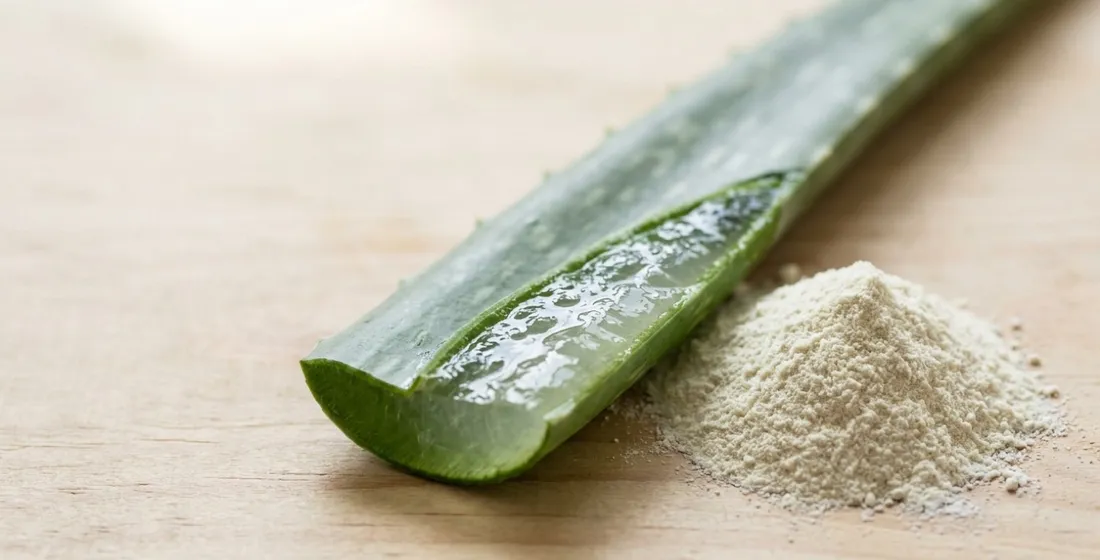
Aloe vera reaches a formulator in three commercial formats, and they differ on water content, processing, and where the actives survive. Liquid gel is the inner-leaf fillet pressed to a single-strength juice, roughly 99% water, the format closest to the fresh plant. Diced cube is inner-fillet flesh cut to size and held in a light syrup, sold for visible texture. Powder is gel concentrated and dried, decolorized along the way, sold at dilution ratios such as 100:1 and 200:1 for reconstitution.
All three start from the same species, Aloe barbadensis Miller, known in Sri Lanka as komarika. The split happens in processing. The inner gel fillet carries the polysaccharides (chiefly acemannan) that formulators want. The outer rind and the latex layer just under the skin carry aloin, an anthraquinone that is the single biggest reason format selection matters.
| Attribute | Liquid gel / juice (1:1) | Diced cube (in syrup) | Spray-dried powder (100:1 / 200:1) |
|---|---|---|---|
| Water content | ~99%, single strength | High; packed in syrup | Low; dried, shelf-stable |
| Primary application | RTD beverage base, tonics, shots | Visible pulp in RTD drinks, bubble tea, fruit teas | Capsules, tablets, powder sticks, reconstituted beverage |
| What the buyer pays for | Fresh mouthfeel, clean label | Texture and visual inclusion | Concentration, freight efficiency, shelf life |
| Decolorization | Required for oral safety | Required for oral safety | Standard in the dry process |
| Typical aloin (oral grade) | Under 10 ppm (IASC) | Under 10 ppm (IASC) | Under 10 ppm (IASC) |
| Freight profile | Heavy, mostly water | Heavy, wet, syrup pack | Light, compact, dry |
| Cold chain | Often needed or preservative system | Syrup-preserved | Ambient |
Source: SRV facility data, International Aloe Science Council quality standard, and supplier dilution-ratio specs, 2026.
The table answers the first sourcing question on its own: you are not choosing a quality tier, you are choosing a water-and-texture profile that has to match the SKU. A capsule cannot hold meaningful liquid gel. A premium aloe shot cannot fake fresh pulp from reconstituted powder. Different formats. Different SKUs. Different RFQs.
Why decolorization and aloin content decide your label risk
Aloin is the procurement landmine in aloe sourcing. The latex layer of the leaf is bitter and laxative, and the anthraquinones in it are why the decolorization step exists. Decolorization, usually activated-carbon filtration, strips aloin from the juice. The International Aloe Science Council (IASC) sets the oral-consumption standard at under 10 ppm aloin A and B; non-decolorized whole-leaf juice runs on the order of 10,000 to 20,000 ppm, two to three orders of magnitude higher.
SRV finding: In our procurement experience, the cheapest aloe quotes are almost always non-decolorized whole-leaf material priced on total solids, not on certified decolorized gel. The price gap is not a discount on the same product. It is a different product with a different label-risk profile.
This is not a theoretical concern. In 2015, California listed “Aloe vera, non-decolorized whole leaf extract” under Proposition 65 as a substance known to cause cancer, following a US National Toxicology Program two-year study that found clear evidence of carcinogenic activity in the large intestine of rats fed non-decolorized whole-leaf extract in drinking water. The decolorized inner-leaf material that the IASC certifies was not implicated. For a US-bound beverage or supplement, that distinction is the difference between a clean filing and a Prop 65 warning on the label.
The practical rule for any oral SKU: specify decolorized, inner-leaf, IASC-certified material with a per-batch aloin assay under 10 ppm. Write it into the RFQ in those words, and ask for the certificate of analysis that proves it on the batch you actually receive.
How to match aloe vera format to the application
Format follows function. The application decides the input, not the other way around, and three patterns cover most briefs that cross a formulator’s desk.
For capsules, tablets, and powder sticks, spray-dried powder is the only workable format. A 200:1 decolorized powder packs the polysaccharide load of roughly 12.5 lb of liquid into half a gram, with water solubility around 90 to 100% for clean reconstitution. Where polysaccharide retention is the headline claim, a freeze-dried powder preserves more heat-sensitive acemannan than spray-dried, at a higher cost per kilo. Confirm the carrier, since many spray-dried aloe powders are standardized on maltodextrin, which a clean-label brand may need to declare or avoid.
For a ready-to-drink aloe beverage where aloe is the base, single-strength liquid gel or juice is the honest input. The category leans liquid for a reason: mouthfeel and a short, recognizable ingredient line. Reconstituted-from-powder aloe drinks exist and ship cheaper, but a sensory panel usually scores fresh single-strength gel higher on body and aftertaste, and the label reads “aloe vera juice” rather than “water, aloe vera powder.”
For visible pulp in an RTD drink, bubble tea, or fruit tea, diced cube is the format. Cubes are cut to size (common dimensions run from 3 mm to 1/2 inch) and held in a light syrup of water, sugar, and an acidulant such as citric acid. Here the texture is the product. No powder reconstitutes into a cube a consumer can chew, so this is a wet-inclusion decision, specified on dice size, syrup Brix, and drained weight, not on dilution ratio.
Spec snapshot: oral-grade aloe vera, all formats
- Species: Aloe barbadensis Miller (inner leaf)
- Aloin: under 10 ppm (IASC oral standard), per-batch COA
- Decolorization: required for all oral formats
- Powder dilution: 100:1 or 200:1, spray-dried or freeze-dried
- Cube: dice size 3 mm to 1/2 inch, syrup Brix to spec, drained weight stated
- Gel: single strength (1:1), preservative or cold-chain system defined
What polysaccharide and acemannan spec should you write into the RFQ?
Polysaccharide content, measured chiefly as acemannan, is the functional spec that separates real aloe actives from diluted or degraded material. Acemannan is the long-chain acetylated mannan that most aloe efficacy claims rest on, and it degrades with heat, time, and aggressive processing. A concentrate that reads 200:1 on the label but tests low on acemannan has either started from poor leaf or lost actives in drying. A supplier-side 200:1 spray-dried powder may specify O-acetyl acemannan in the range of 75,000 mg/kg or higher; ask for the number, the assay method, and a batch certificate, not a marketing ratio.
Beyond the actives, four lines belong in any oral-aloe RFQ. First, the dilution ratio verified against polysaccharide content, so 200:1 means 200:1 in the assay. Second, IASC certification or an equivalent decolorized, under-10-ppm-aloin statement with a per-batch COA. Third, the carrier for powders (maltodextrin, none, or a specified alternative), because it touches the finished label. Fourth, organic status where the brand claims it; USDA Organic and EU Organic aloe is available but must carry the transaction certificate to keep the downstream claim valid. The same RFQ discipline that protects an ashwagandha or gotukola spec applies here: name the active, name the assay, name the number.
What does aloe vera format mean for freight and MOQ?
Format is a freight decision before it is a formulation decision, because aloe is mostly water and water is expensive to move. Liquid gel ships at roughly 99% water, so an ocean container of single-strength aloe is, by mass, an ocean container of water with actives suspended in it. Diced cube adds syrup weight on top. Spray-dried powder inverts the math: the 200:1 concentration that costs more per kilo lands far cheaper per unit of active delivered, and it travels ambient rather than chilled.
SRV finding: For US and EU buyers, the aloe price comparison that actually matters is landed cost per kilo of polysaccharide delivered, not invoice price per kilo of product. A “cheap” liquid gel quote frequently loses to a powder quote once ocean freight on the water weight is added back. Compare FOB to DDP on the same basis, or the number misleads.
That freight reality shapes the MOQ conversation too. Silk Route Ventures (SRV) sets a 25 kg first-order MOQ on aloe powder per SKU, which for a 200:1 material represents a large volume of reconstituted equivalent, while the Silk Foods Ceylon (SFC) liquid line runs at 2,500 bottles per day (200 ml) for finished or semi-finished gel beverages. Buyers running this comparison usually split into two camps: capsule and supplement brands specifying powder for ingredient supply, and beverage brands exploring contract manufacturing of a finished gel or cube SKU. The format choice routes the entire downstream relationship, from MOQ to freight to cold chain. For capsule-side economics specifically, the same capsule MOQ logic that governs other botanicals applies to an aloe capsule line, with the capsule MOQ confirmed on your quote.
Frequently asked questions
Is aloe vera powder as good as fresh aloe gel?
For capsules and tablets, decolorized spray-dried powder at 100:1 or 200:1 is the correct format and reconstitutes to roughly 90 to 100% solubility. For a beverage where mouthfeel is the selling point, single-strength gel scores higher on sensory panels. Neither is universally better; the application decides.
What aloin level is safe for an oral aloe vera product?
The International Aloe Science Council sets the oral standard at under 10 ppm aloin A and B, achieved by decolorizing the juice. Non-decolorized whole-leaf juice runs 10,000 to 20,000 ppm. California listed non-decolorized whole-leaf extract under Proposition 65 in 2015, so decolorized inner-leaf material is the defensible spec for any oral SKU.
Does Silk Route Ventures supply aloe vera for private label and contract manufacturing?
Yes. Silk Foods Ceylon supplies aloe vera as spray-dried powder, diced cube, and liquid gel from its Matale facility under BRCGS and FSSC 22000 V6, with USDA Organic and EU Organic available on relevant SKUs. The liquid line runs 2,500 bottles per day; powder first-order MOQ is 25 kg per SKU. Contact SRV for a sample and spec sheet.
What is the difference between 100:1 and 200:1 aloe vera powder?
Both are concentrated decolorized gel powders; the ratio states how much liquid aloe one part of powder reconstitutes. A 200:1 powder is more concentrated, so it carries more polysaccharide per gram and ships more efficiently, but the spec that matters is verified acemannan content on the batch COA, not the ratio on the label.
How Silk Route Ventures can help
Silk Route Ventures (SRV) supplies aloe vera and a broad range of functional botanicals (ashwagandha, gotukola, gymnema, triphala, turmeric, moringa) to wellness and beverage brands globally, as spray-dried powder, diced cube, or single-strength liquid gel. The Silk Foods Ceylon (SFC) facility in Matale holds BRCGS and FSSC 22000 V6, with USDA Organic and EU Organic on the relevant SKUs, a 2,500 bottle/day liquid line, and a 25 kg first-order MOQ on bulk powder. For early-stage brands without a co-packer, the SRV R&D and NPD team also develops custom aloe formulations and finished beverage SKUs in-house. Contact us to request a sample, a spec sheet, or a decolorized-aloe COA. For bulk orders, see our Sri Lankan herbs supplier.